
Now Is Full of Then
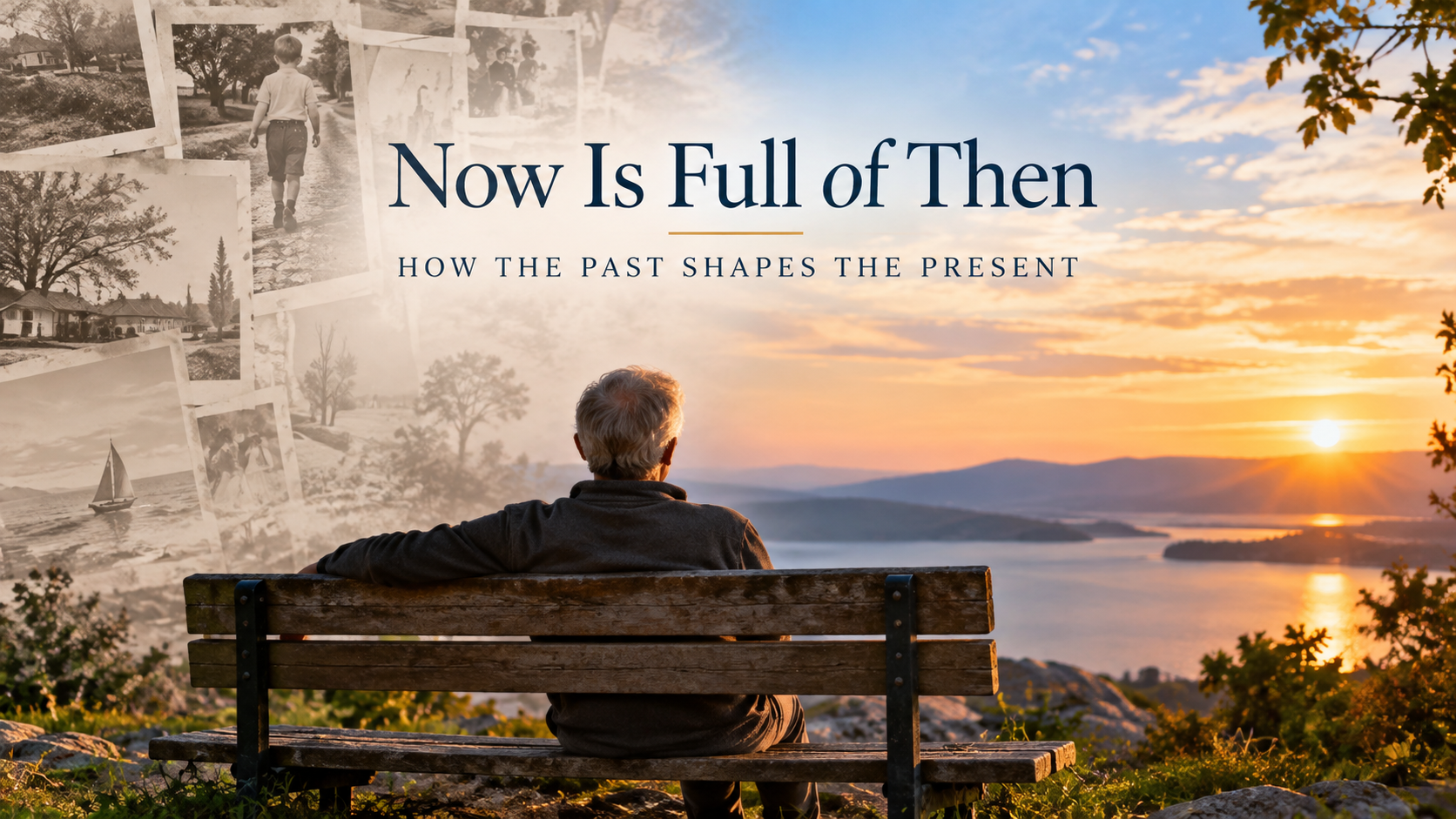
We are often told that all we really have is now.
That seems obviously true. Yesterday is gone. Tomorrow hasn't arrived. Whatever life we are actually living is happening in this moment.
But there is a complication.
Now is full of then.
We don't arrive at the present empty-handed. We bring yesterday with us.
We bring memories of people, conversations, disappointments, accomplishments, mistakes, losses, pleasures, and ordinary moments we may not even realize we remember. We bring assumptions formed years ago and expectations built from what happened the last time.
So when we look at what is happening today, how much are we actually seeing today?
And how much are we seeing what today reminds us of?
The Past Helps Us Understand the Present
There is nothing necessarily wrong with this.
Memory gives our lives continuity. Without some connection to what has already happened, every experience would stand alone.
What we learned yesterday helps us make better decisions today. Relationships deepen because they have histories. Places matter because of what happened there. Even our understanding of ourselves depends partly upon remembering who we have been.
Then gives now context.
But context can also become a filter.
Something happens and, almost immediately, we compare it with something that happened before. We decide what someone's words mean because we have heard similar words before. We anticipate disappointment because we remember being disappointed. We assume something will make us happy because it once did.
Sometimes those conclusions are useful.
Sometimes they prevent us from seeing what is actually there.
What If We Looked at Now by Itself?
Perhaps there are moments when we should try something different.
Instead of immediately asking, What does this remind me of? we might simply ask:
What is here right now?
Look at the room.
Look at the person sitting across from you.
Notice what you hear.
Notice how you feel before deciding why you feel that way.
Notice what has changed.
For a moment, don't compare it with yesterday.
When we do that, something interesting can happen. Familiar things become less familiar.
We may notice that someone we thought we understood has changed. A place we have stopped paying attention to becomes interesting again. Something we considered ordinary suddenly seems valuable.
Perhaps even our understanding of ourselves changes.
The Goal Isn't to Forget Then
I don't think living in the present requires us to abandon the past.
I am not sure we could even if we wanted to.
Our past is part of us. It has taught us, shaped us, warned us, comforted us, and occasionally misled us.
The challenge may simply be recognizing when then is interpreting now for us.
There are times when experience deserves a voice.
There are also times when it deserves to be quiet.
Because occasionally we need to see the person, the place, the problem, or the ordinary moment in front of us without immediately asking the past to explain it.
Maybe that is what being present really means.
Not living without yesterday.
Just giving today a chance to speak for itself.
See related articles
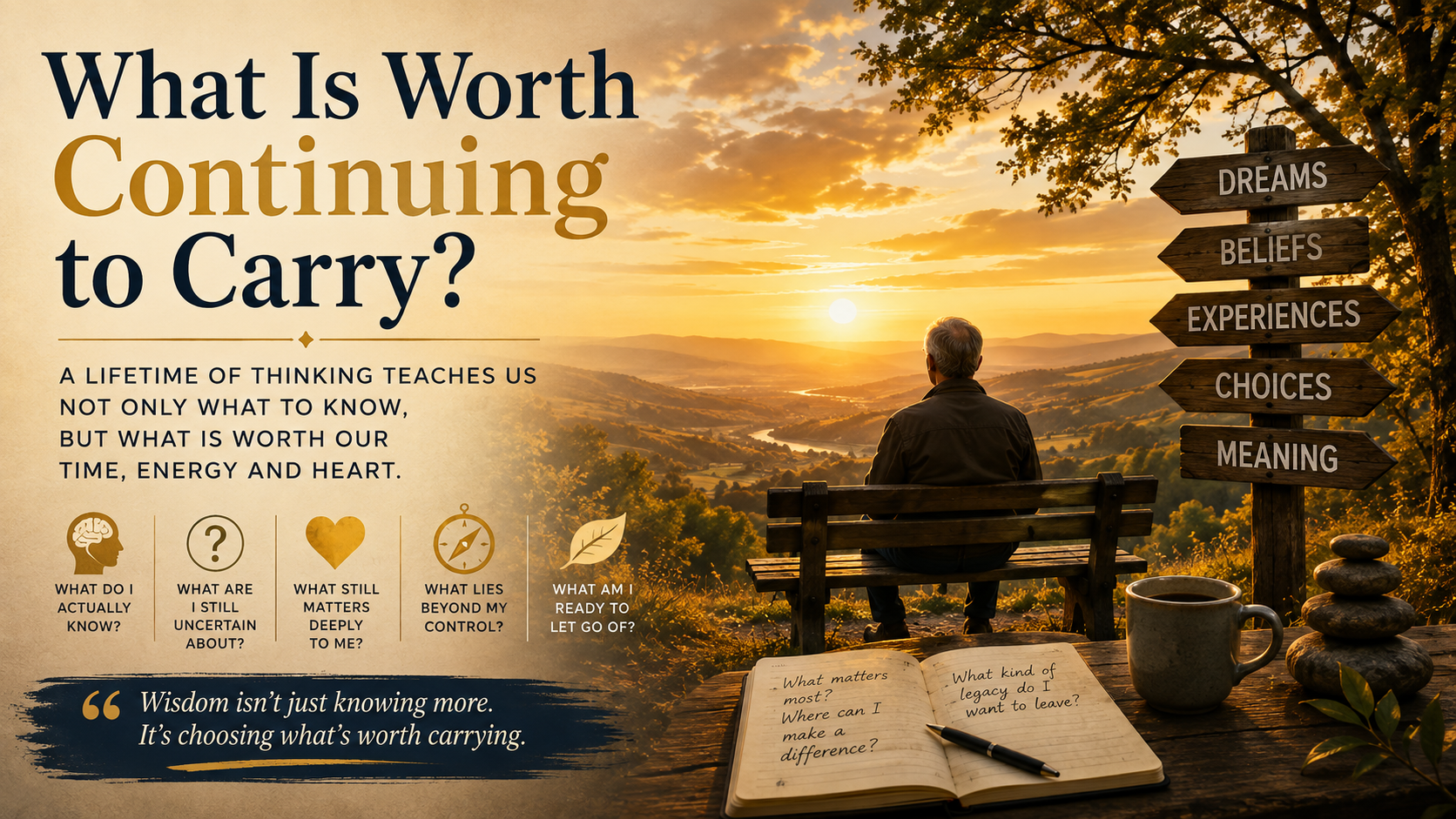
What Is Worth Continuing to Carry?
A lifetime of thinking does not necessarily leave us with more answers.
That seems strange to me because for much of life I thought that was what thinking was supposed to do. We learn. We experience. We make mistakes. We read. We listen. We change our minds. Presumably, all of that should eventually leave us knowing more than we did before.
And in many ways, it does.
But something else happens.
Some things I once thought I understood no longer seem quite so certain. Some questions I once believed had answers now seem larger than the answers I gave them. And some things that once occupied a great deal of my attention simply don't anymore.
I have let go of a lot.
Is that progress?
Not All Uncertainty Is Wisdom
It would be easy to say that growing older has made me more comfortable with uncertainty and leave it there.
There is some truth in that. Experience has taught me to be suspicious of easy answers. I have lived long enough to discover that I could be absolutely certain about something and still be wrong.
But uncertainty is not automatically wisdom.
Sometimes we become uncertain because we have learned enough to recognize complexity. That is intellectual humility.
Other times we haven't changed our minds at all. We have simply decided that something no longer deserves the amount of our life that we once gave it.
Those are very different things.
Politics is one example for me.
I don't spend much time thinking about politics anymore unless the news pushes it in front of me. That doesn't mean I have concluded that politics doesn't matter. Quite the opposite.
I remain concerned about the direction America has taken. Some things that once seemed outside the boundaries of acceptable public behavior have become increasingly normalized, and I don't believe that has been good for the country. I especially think about the kind of America my grandchildren will inherit.
So why don't I spend more time on it?
Because I have also come to recognize how little control I have over most of it.
The familiar answer is that everyone should get involved. Vote. Speak up. Pay attention. Participate.
There is truth in that too.
But there is another truth we don't talk about as much: none of us has unlimited time, energy, attention, or influence.
Eventually we have to decide where to spend them.
Caring Is Not the Same as Carrying
Perhaps that is one distinction I understand better now.
I can care about something without carrying it around with me every day.
I can believe something is wrong without spending hours consuming arguments about it.
I can worry about the world my grandchildren will inherit without believing that watching another hour of political commentary will improve that world.
That raises an uncomfortable question.
When does letting go become wisdom, and when does it become disengagement?
I don't have a clean answer.
"There is nothing I can do about it" can certainly become an excuse. If everyone believed that, nothing would ever change.
But the opposite can also become a trap. We can give enormous amounts of ourselves to things over which we have almost no influence while neglecting the people, relationships, ideas, and small moments where our presence actually does matter.
Maybe part of growing older is becoming more conscious of that tradeoff.
A Different Kind of Sorting
When we are younger, intellectual growth seems mostly about accumulation.
Learn more.
Read more.
Understand more.
Form opinions.
Find answers.
After enough years, growth may involve just as much subtraction.
Some beliefs are discarded because they no longer hold up.
Some answers become questions again.
Some convictions survive and become stronger.
Some things remain important even though we recognize we cannot control them.
And some things we simply decide not to carry any longer.
That doesn't mean they were meaningless.
It means we have made a judgment about what deserves the limited amount of ourselves we have left to give.
Perhaps that is where a lifetime of thinking eventually takes us.
Not toward certainty about everything.
Not toward uncertainty about everything either.
Maybe it takes us toward discernment.
What do I actually know?
What do I only believe?
What have I been wrong about?
What still matters enough for me to stand behind it?
What matters but lies largely beyond my control?
And what have I carried long enough?
Those questions feel different to me now than they would have years ago.
What Deserves the Life We Have Left?
Time changes the question.
When life appears almost unlimited, we can afford to spend enormous amounts of it on things that may or may not matter.
Eventually, time stops looking unlimited.
Then deciding what to think about becomes connected to deciding how to live.
There are still things worth opposing. Things worth defending. People worth helping. Questions worth pursuing.
But there are also arguments I don't need to win, events I don't need to follow, opinions I don't need to have, and uncertainties I don't need to resolve.
Perhaps wisdom is not simply knowing more.
Perhaps part of wisdom is knowing what deserves our certainty, what deserves our attention, and what deserves the limited amount of life we still have available to give it.
A lifetime of thinking may not finally tell us what to think about everything.
It may do something more useful.
It may teach us what is worth continuing to carry.
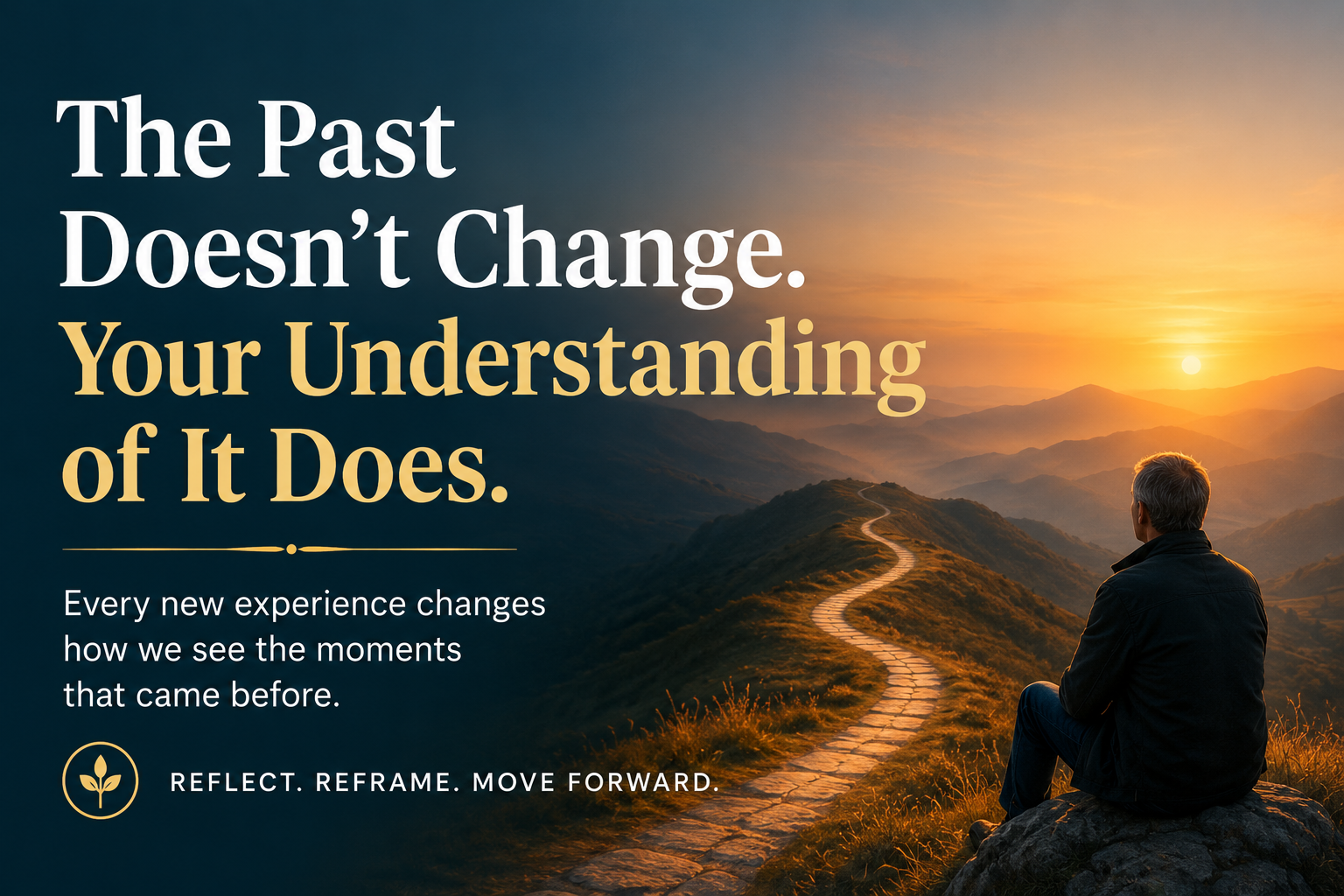
The Past Doesn't Change. Your Understanding of It Does.
We often assume that if we want a clearer future, we should spend more time looking ahead.
We set goals. We make plans. We imagine where we hope to be in a year, five years, or even decades from now.
Yet some of the greatest clarity about where we are going comes from looking in the opposite direction.
Not because the past predicts the future.
But because the meaning of the past is never fixed.
Every new experience changes how we understand the experiences that came before it.
The events themselves remain the same. What changes is the person remembering them.
That is why two people can experience similar circumstances and tell completely different stories about what happened. It is also why our own life story changes over time, even though the facts do not.
We naturally see our lives as a series of connected events. We weave relationships, successes, disappointments, losses, and unexpected opportunities into a narrative that explains who we believe we are.
That narrative quietly shapes our identity.
Stories of successful leaders often illustrate this point. Many describe setbacks, failures, disappointments, or periods of uncertainty as turning points that ultimately shaped their character and direction. Yet very few recognized the value of those experiences while they were living through them.
Only years later, after new experiences provided perspective, did those difficult moments begin to make sense.
Looking backward gave them a clearer understanding of how they had moved forward.
Several years ago, Julie Beck wrote an article for The Atlantic titled Life's Stories. Its subtitle captured an important truth: How you arrange the plot points of your life into a narrative shapes who you are and is a fundamental part of being human.
She quoted developmental psychologist Monisha Pasupathi, who observed that, "To have relationships, we've all had to tell little pieces of our story."
That simple observation carries an important implication.
If we are constantly telling our story to others, we are also constantly telling it to ourselves.
And as we grow, our understanding of that story evolves.
A disappointment that once felt like failure may later appear as preparation.
A career change that seemed frightening may eventually become the moment that redirected your life toward something more meaningful.
A relationship that ended may later reveal lessons you could not have learned any other way.
The events have not changed.
Your understanding has.
That realization can be surprisingly freeing.
Many people carry an outdated version of themselves because they continue to interpret their past through the perspective they had years ago.
But you are no longer that person.
The experiences you've had since then have given you new knowledge, greater empathy, different priorities, and perhaps a deeper understanding of yourself.
Why shouldn't those changes also reshape how you understand your past?
One practice I have found helpful is periodically writing a summary of my own life.
Not a detailed autobiography.
Just the significant moments.
The forks in the road.
The people who influenced me.
The decisions that altered my direction.
The unexpected opportunities.
The painful disappointments.
Then, months or years later, I revisit that summary and write it again.
What surprises me is not how much the facts have changed.
They haven't.
What changes is what I believe those moments meant.
New experiences illuminate old ones.
Connections I never noticed become obvious.
What once appeared random begins to reveal a pattern.
Looking back does something that constantly looking ahead cannot.
It helps us recognize themes.
It reminds us of strengths we forgot we possessed.
It reveals resilience that was quietly forming long before we recognized it.
And it often uncovers purpose hidden beneath experiences that once seemed meaningless.
If you've never reflected on your own story this way, consider asking yourself a few questions.
Which disappointment ultimately changed your life for the better?
Which success mattered less than you expected?
Which relationship taught you something you still carry today?
Which difficult season made you stronger without you realizing it at the time?
Which event would you describe differently today than you would have five years ago?