


How Professionals Can Stay Ready for New Jobs Without Burning Out - By Kurt Brown
By Kurt Brown
When your calendar is full and your life outside work needs attention, staying ready for a new job can feel like another job in itself. There is always a resume to update, a connection to make, or a skill to learn. The pressure to remain marketable can leave you feeling as though you should never switch off.
But being prepared does not require a constant job search. A small, regular investment in your resume, relationships, and skills can help you respond to opportunities without letting career preparation take over your evenings.
Make Career Readiness a Routine
Career readiness starts with three basics: keeping your resume current, maintaining professional relationships, and developing useful skills. These are easier to manage when you give them a little attention regularly. Even checking that your contact information is up to date removes one small obstacle before you need to apply.
Professional relationships matter because people can introduce you to opportunities, share useful context, and help others understand what you bring to a role. This discussion of the importance of networking reinforces the value of staying connected before you need a referral.
Think of it as keeping your passport valid. You do not have to be planning a trip to benefit from being ready. Updating a recent accomplishment or checking in with a former colleague gives you less to catch up on when an interesting opportunity appears.
Use Workforce Insights to Choose a Focus
Staying informed is useful when it helps you decide where to put your effort. It becomes less useful when every headline makes you feel behind.
Choose a few resources relevant to your work. Research such as UoPX workforce insights can offer a broader perspective on careers and workforce issues. Compare what you read with the requirements in job descriptions that genuinely interest you. Look for recurring skills and responsibilities rather than reacting to every new trend.
Then ask one practical question: What is one thing I could strengthen that would help me in my current work and prepare me for the kind of role I might want next? Let that answer guide your attention for the next few weeks.
Try a 15-Minute Weekly Tune-Up
Set aside one recurring 15-minute appointment each week. Divide it into five minutes for your resume, five for your network, and five for a skill. This is a maintenance routine. Larger projects can have their own scheduled time when you need it.
Five Minutes: Update One Resume Line
Open your resume or LinkedIn profile and improve one item. Add a recent accomplishment, clarify a responsibility, or include a measurable result where you have one. Focus on work that demonstrates the abilities your target roles require.
If you cannot find the right wording immediately, record the facts in a running accomplishments note: what you did, why it mattered, and what changed. You can polish the language later. Capturing the details while they are fresh is the useful part.
Five Minutes: Make One Meaningful Connection
Send a brief message to a former colleague, congratulate someone on a new role, or share something relevant to their work. You might write: “I saw your update about the new project. What have you found most interesting about it so far?”
The advice to be yourself, show interest in others is a useful starting point. A message feels more natural when you have a genuine reason to send it and give the other person something specific to respond to.
If a direct message feels like too much that week, leave a thoughtful comment on a post or follow up on an earlier conversation. Choosing a regular day to check in with your connections can make this a manageable habit. One sincere interaction is enough for your weekly check-in.
Five Minutes: Practice One Useful Skill
Choose a skill that appears repeatedly in the roles you are considering. Spend five minutes on one small exercise: try a spreadsheet function, revise a paragraph in a report, or watch a short tutorial segment and apply one idea.
Keep a simple “Proof of Skill” note with examples, screenshots, or a brief account of what you practiced. Over time, those notes can help you describe your progress in an interview and identify where you need more practice.
Five minutes will not be enough for every learning task. If a skill needs deeper work, schedule a separate session with a clear objective and a realistic stopping point. The weekly routine helps you keep it in view.
Stop When the Time Is Up
The time limit is part of the routine. When the 15 minutes are over, write down anything you want to return to and close your files. An unfinished task can wait for a planned session.
During a demanding week, make the routine smaller. Capture one accomplishment or send one message. There is no backlog to repay and no reason to turn a missed week into a lost weekend. Your preparation should fit alongside your work, relationships, and rest.
Common Questions
What if networking still feels awkward?
Start with people you already know and subjects you genuinely care about. Thinking of networking as nurturing an ecosystem can help: relationships grow through attention, shared interests, and mutual support. You do not need to turn every conversation into a request or an opportunity.
What if career preparation is adding to my exhaustion?
If the extra tasks leave you dreading another commitment, reduce them or pause them. Discussions of burnout often describe deep-seated exhaustion, which deserves more attention than a productivity adjustment. Do not turn staying prepared into another test of how much you can endure.
What if I hate updating my resume?
Keep a running note of accomplishments instead. Include a problem you solved, a project you completed, or useful feedback you received. When you return to your resume, you will have specific material to work with rather than trying to reconstruct months of work from memory.
Be Ready Without Being Always On
You can value the job you have and still prepare for what might come next. A current resume, a few maintained relationships, and steady practice give you a place to start when your circumstances or interests change.
Choose a 15-minute slot this week. Improve one resume line, connect with one person, and practice one useful skill. Then stop and give the rest of your day your attention.
Informational interviews offer a practical way to build those relationships. Read “Informational Interviews: Networking With a Purpose” for a closer look at how thoughtful conversations can help you explore career options and learn from others’ experience.
Why Some Experiences Stay With Us for a Lifetime - by Kurt Brown

By Kurt Brown
Some afternoons dissolve before dinner. Others — a first heartbreak, the week you moved to a new city with no one to call, the ordinary Tuesday that turned into a diagnosis — stay lodged in memory for decades, replayed in sensory detail long after the years around them have blurred. Memory researchers have been asking why some experiences endure and most don't since at least the 1970s, and their answers gather around four ideas: a lifelong bias toward memories from youth, an emotional alarm system that locks certain moments in place, a mental shortcut that decides which parts of an experience we keep, and the slow work of weaving hard chapters into the story of who we are.
Why Youth Looms So Large in Memory
Ask most adults over 30 for their most important memories and something odd happens: a disproportionate number come from adolescence and early adulthood. Psychologists call this the reminiscence bump, and it's one of the most consistently replicated findings in autobiographical memory research. A 2018 systematic review in PLOS ONE by Munawar, Kuhn, and Haque analyzed 68 quantitative studies published between 1988 and 2017 and found that the exact window shifts depending on how memories are prompted: roughly ages 10 to 30 for "most important" memories, 5 to 30 for word-cued recall, and as wide as 6 to 39 in life-script studies.
The best-supported explanation isn't simply that youth is more eventful, though it often is. Of the theoretical accounts the review examined, the narrative-identity explanation — that we keep memories from this window because they help build a coherent sense of self — found support in 13 of the studies analyzed. The unflattering memories get kept, too. Writing in Psyche, memory researchers Çağlayan Özdemir, Michelle Leichtman, and David Pillemer note that youthful moments of embarrassment, shame, and regret show the same bump, and stick for the same reason: they had something to teach. If a few memories from that stretch of your life still carry outsized weight, this is probably why. You weren't just living through them; you were building a self out of them.
When Emotion Freezes Time
Some memories skip the years of narrative work and imprint immediately, whole and vivid. Psychologists Roger Brown and James Kulik coined the term "flashbulb memory" in 1977 for these rapidly formed recollections of emotionally significant events, the kind where you can still describe the room, the light, and what someone was wearing years later.
Neuroscientist David Diamond and colleagues, in a 2007 paper in the journal Neural Plasticity, proposed a "temporal dynamics model" to explain the mechanism. Strong emotional arousal activates the amygdala, which sharply enhances the hippocampus's ability to encode detail during a brief window, sometimes only minutes long, before it closes and new memory formation is temporarily suppressed. Lab studies suggest the mechanism is causal: stimulating the amygdala reproduces the memory-enhancing effect, and damaging it abolishes it.
One caveat is worth sitting with. Despite their vividness, flashbulb memories aren't flawless recordings. They mix fragmented sensory detail with a narrative layer added later, and people routinely hold high confidence in details that turn out to be wrong. What the vividness actually certifies is how much the moment mattered to you. The details, researchers keep finding, are more negotiable than they feel.
Why We Remember the Peak and the Ending, Not the Whole Story
Even without extreme emotional intensity, the way an experience concludes shapes how, and whether, we remember it at all. This is the peak-end rule: we judge and remember an experience overwhelmingly by its most intense moment and its final moments, largely ignoring how long it actually lasted.
The original demonstration, a 1993 study by psychologists Daniel Kahneman and Barbara Fredrickson described in an analysis from the Nielsen Norman Group, is almost comically simple. Participants held a hand in 14°C water for 60 seconds, then repeated the trial with 30 extra seconds tacked on as the water was gently warmed. When asked which trial they'd rather repeat, 80% chose the longer, objectively more painful one — because it ended more gently.
Scaled up to a life, this is a little unsettling: the years you spend at a job, in a city, or in a relationship will be remembered less for their duration than for their sharpest moment and their final chapter. It also hands you something practical. When you have any say over how an experience ends — the goodbye said properly, the job left without bitterness — that is the place to spend your care, because the ending will color everything that came before it.
How Hard Chapters Become Defining Ones
Beyond single moments, some of the most durable memories are entire chapters, the years we describe as "when everything changed." Researchers who study autobiographical memory call these turning points: experiences that alter a person's trajectory and get woven into an ongoing life story, an idea formalized in narrative identity theory.
A 2025 study in the journal Behavioral Sciences by Mansfield, Carrington, and Shaw asked 132 emerging adults in the US and UK to narrate their defining turning points. In their sample, 86% of all turning-point narratives centered on being shaped through hardship — 84% among the American participants, 96% among the British. About two-thirds told what researchers call "redemptive" narratives, stories that travel from a difficult beginning to a positive resolution, and telling that kind of story was linked to measurable gains in positive emotion and well-being afterward.
The researchers identified five recurring ways people made meaning of their turning points:
How People Frame a Turning Point
What It Looks Like
Mastery / competence
"I proved to myself I could do something hard."
Personal growth or autonomy
"I became more independent and self-directed."
Relatedness
"It changed who I let myself depend on, or be depended on by."
Unelaborated growth
A sense of having changed, without a fully worked-out story of how.
Unresolved trauma
The chapter is still being processed, without a settled meaning.
If you're in the middle of a hard chapter yourself, there's a strange comfort in this: adversity isn't incidental to a memory becoming permanent — it's often the reason. The seasons of deliberate, effortful reinvention are the ones people are still recounting at dinner tables thirty years on: the cross-country move made on a hunch, the restaurant opened at the worst possible moment, the forty-something who spends nights and weekends working through a bachelor's in software engineering online after twenty years in a different line of work. Chapters like these ask you to reorganize who you are around something slowly and deliberately earned. That demand is why they stick, and why, given enough time, they tend to become the stories people are proudest to tell.
What Makes a Memory Feel Like "Me"?
Not every vivid memory becomes part of someone's identity, though, and the difference seems to lie less in the event than in the telling. Researchers call the relevant quality narrative coherence: whether a person can give a memory a setting, a sequence, a theme, and a sense of cause and effect.
A 2021 study in Frontiers in Psychology by Vanderveren and colleagues asked 333 Belgian emerging adults to narrate their own turning-point memories. Coherence — the structural clarity of the story rather than its emotional content — went hand in hand with healthier identity functioning, and participants who could give a well-organized account of their turning point showed markedly less identity disturbance.
This echoes something the Stoics understood long before psychology had the vocabulary for it. Marcus Aurelius's Meditations — a work Maria Popova of The Marginalian affectionately calls an "indispensable proto-blog" — was never written for an audience. It was a private journal kept not to record what happened to him but to work out what it meant, which is exactly the kind of narration this research describes. A demanding chapter becomes part of a coherent self when you give it that structure (out loud, on paper, to a patient friend) instead of carrying it as a fragment you never quite understood.
Carrying the Chapters Forward
None of this makes memory controllable. You can't decide in advance which afternoon will turn into a flashbulb memory. But the research does suggest where your agency lives: in how you close a chapter, in whether you let a hard season change you instead of numbing your way through it, and in whether you eventually tell yourself a coherent story about what a turning point meant. The moments that last are rarely the loudest ones. They're the ones you let change you, and took the trouble to understand.
Frequently Asked Questions
What's the difference between a flashbulb memory and an ordinary vivid memory?
A flashbulb memory forms almost instantly around a single emotionally intense event: the amygdala's activation sharply boosts hippocampal encoding in a narrow window, producing a memory that feels unusually detailed and durable. An ordinary vivid memory usually strengthens gradually, through repetition, rehearsal, or its role in a larger story you tell about yourself. Flashbulb memories feel more "photographic," but research shows they aren't necessarily more accurate — just more confidently held.
Does the reminiscence bump mean memories from midlife and later don't matter?
No. The reminiscence bump describes which years tend to dominate recall when people are asked for their "most important" memories — not a limit on what can become permanent. Turning-point research shows that identity-reshaping chapters such as a career change, a loss, or a major relocation can imprint just as forcefully in your forties, fifties, or sixties as anything from adolescence.
Can you deliberately make an experience more memorable while it's happening?
To some extent. Since the peak-end rule shows endings carry outsized weight in memory, closing a chapter with intention — a real goodbye, a marked transition, a moment of reflection — measurably shapes how it's remembered. And actively narrating an experience afterward, rather than leaving it as a vague impression, appears to help it settle into your larger story instead of fading into the background.
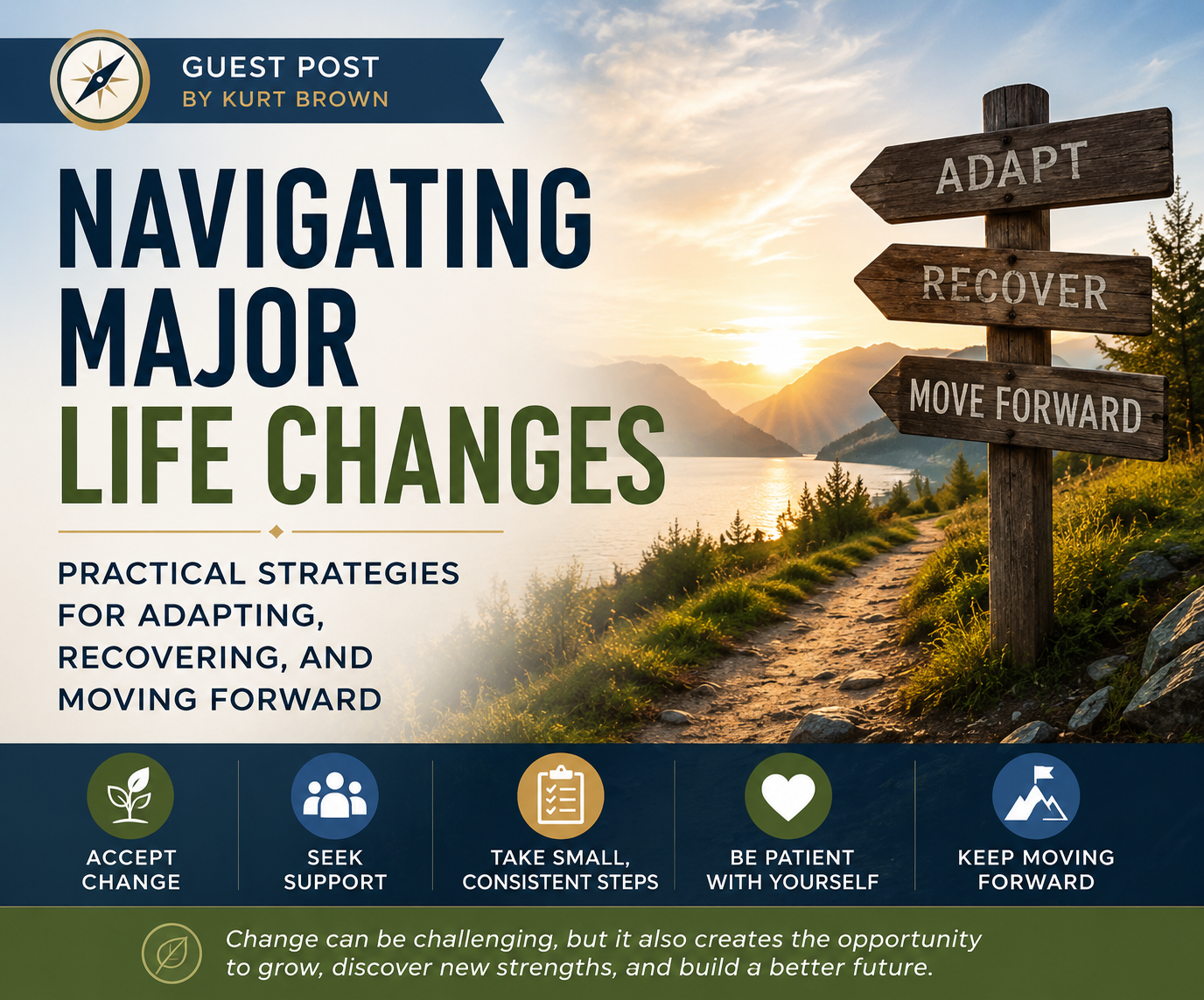
Navigating Major Life Changes
Practical Strategies for Adapting and Moving Forward
Guest Post by Kurt Brown
Major life changes have a way of reshaping nearly every part of our lives. Whether you're changing careers, moving to a new city, ending a relationship, becoming a parent, retiring, or grieving the loss of someone close, transitions often bring uncertainty alongside opportunity.
While every situation is different, one truth remains the same: significant change doesn't simply alter our circumstances. It often changes the story we tell ourselves about who we are. Learning to adapt isn't only about solving practical problems. It's also about discovering new strengths, new perspectives, and sometimes an entirely new direction.
Although change can feel overwhelming, building healthy coping strategies can make these turning points more manageable.
A Quick Overview
Life transitions often create stress because they disrupt familiar routines.
Accepting change is usually more productive than resisting it.
Small, consistent actions help restore confidence and momentum.
Seeking support from trusted people or professionals is a sign of strength, not weakness.
Every major transition offers an opportunity to learn, grow, and redefine personal goals.
Why Big Changes Feel So Difficult
Most of us naturally prefer familiarity. Even positive events, such as getting married, receiving a promotion, or buying a home, can create anxiety because they introduce new responsibilities and unknowns.
Common life transitions include:
Starting or leaving a job
Divorce or the end of a long-term relationship
Becoming a caregiver
Having children
Moving to a different community
Retirement
Serious illness or recovery
Losing someone close
Every transition asks us to let go of something familiar while adapting to something new. Giving yourself permission to experience mixed emotions can reduce the pressure to have everything figured out immediately.
A Simple Roadmap for Moving Through Change
Instead of trying to solve every problem at once, focus on manageable steps that build confidence over time.
Checklist for Navigating a Major Life Transition
☐ Acknowledge what has changed without minimizing your feelings.
☐ Identify what remains within your control.
☐ Maintain healthy routines for sleep, meals, and exercise.
☐ Break large decisions into smaller, achievable actions.
☐ Stay connected with supportive friends and family.
☐ Review your progress regularly instead of expecting perfection.
Small wins create momentum, and momentum often makes difficult situations feel less overwhelming.
Different Transitions, Different Challenges
Every major life transition brings its own unique set of challenges. While no two experiences are exactly alike, understanding some of the common obstacles can make it easier to choose a helpful response.
Career Change
Common challenge: Financial uncertainty and adapting to a new role.
Helpful response: Create a realistic plan, continue developing your skills, and focus on one step at a time.
Moving
Common challenge: Losing familiar surroundings and a sense of community.
Helpful response: Explore your new area, join local groups, and establish routines that help you feel at home.
Divorce
Common challenge: Emotional adjustment and rebuilding daily life.
Helpful response: Lean on trusted friends or family, allow yourself time to heal, and avoid rushing the process.
Retirement
Common challenge: Losing familiar routines, identity, or a sense of purpose.
Helpful response: Pursue hobbies, volunteer, mentor others, or discover new ways to stay engaged and connected.
Becoming a Parent
Common challenge: Lifestyle changes and new responsibilities.
Helpful response: Accept help when it's offered, be patient with yourself, and adapt one day at a time.
Every transition unfolds at its own pace. Comparing your progress to someone else's is rarely helpful because every person's circumstances, support system, and journey are different.
Turning a Career Setback into a Fresh Start
Losing a job or facing a career setback can be discouraging, but it can also become the beginning of something new. Many people use these moments to explore different careers, develop new skills, return to school, or even pursue long-held interests that had previously been set aside.
The important step isn't having every answer immediately. It's remaining open to new possibilities while taking steady, intentional action toward the future you want to create. Career transitions often become opportunities for growth that might never have appeared otherwise.
When Progress Feels Slow
It's natural to expect dramatic improvement after making a major life decision. In reality, adjustment usually happens gradually.
Some signs you're moving in the right direction include:
Feeling less anxious about everyday decisions.
Developing routines that begin to feel natural.
Becoming more optimistic about future possibilities.
Feeling comfortable asking for help when needed.
Looking ahead instead of dwelling only on the past.
Progress is rarely a straight line. Temporary setbacks don't erase the gains you've already made.
Questions People Often Ask
How long does it take to adjust to a major life change?
There isn't a universal timeline. Some people begin feeling more settled within weeks, while others need several months or longer depending on the situation, available support, and the nature of the transition itself.
Is it normal to feel excited and scared at the same time?
Yes. Mixed emotions are common because meaningful change often brings both opportunity and uncertainty. Feeling both hopeful and anxious is part of being human.
When should I seek professional help?
If stress begins interfering with your work, relationships, sleep, or daily functioning for an extended period, speaking with a licensed mental health professional can be an important step toward recovery and resilience.
Building Confidence One Step at a Time
Confidence rarely returns all at once. It grows through repeated action. Each completed task, meaningful conversation, and small success reinforces your ability to adapt and move forward.
Rather than focusing only on the destination, recognize the value of each step that brings you closer to the life you're creating. Those small steps often become the foundation for much larger changes over time.
Change Often Reveals More Than It Removes
Major life transitions rarely leave us exactly as they found us. While they may involve uncertainty, disappointment, or loss, they also invite us to reconsider what matters most, what strengths we possess, and what kind of future we hope to build.
Looking back, many people discover that the changes they once feared became the experiences that helped shape their greatest growth.
Helpful Resources
If you're looking for practical, evidence-based guidance on managing stress and improving emotional well-being during major life transitions, the American Psychological Association offers valuable articles and resources on resilience, stress management, and healthy coping strategies.
Conclusion
Major life changes are rarely comfortable at first, but they often become defining chapters in our lives. Every transition is unique, and there is no perfect roadmap for navigating uncertainty. Yet patience, steady progress, and self-compassion can help us move forward with greater confidence.
Although we rarely choose every change that comes our way, we can choose how we respond to it. Over time, those responses become part of the person we are becoming.
Travel Memories and Meaning: Keeping the Experience Without the Clutter - Guest Post by Kurt Brown

Experiences often leave traces behind. Sometimes they are photographs, sometimes objects, and sometimes simply memories that stay with us. Yet the value of a keepsake rarely comes from the object itself. It comes from the meaning we attach to it. Guest writer Kurt Brown explores how we can preserve meaningful travel memories without accumulating unnecessary clutter.
Frequent travelers and weekend getaway fans know how quickly travel mementos pile up: ticket stubs, little trinkets, and “just because” gifts that felt right on the road.
The tension is real, those travel keepsakes are supposed to hold joy, but at home, they turn into souvenir clutter that makes shelves, drawers, and even good intentions around home organization feel messy. The goal isn’t to stop collecting; it’s to keep reminders that still feel personal without adding more stuff to manage. A clutter-free mindset for travel souvenirs makes room for memories that stay meaningful.
Understanding What Makes a Keepsake Meaningful
A souvenir earns lasting sentimental value when it’s tied to a specific story and a real feeling you had on the trip. The object itself is just a cue; the memory is what makes it matter. When there’s no clear story, it’s often an impulse-purchase tourist item meant to stand in for the experience. Think of a random keychain versus a small pebble from the beach where you had a long, honest talk at sunset. The keychain can blur into the pile, but the pebble instantly brings the moment back. The best reminders work like a shortcut to a feeling.
Build One Photo Collage That Tells Your Trip’s Story
When a keepsake is meaningful, it doesn’t need to multiply, it just needs to bring the feeling of the trip back in a single glance. A photo collage does exactly that: it gathers your favorite travel moments into one space-saving piece of décor that feels personal, stylish, and worth displaying. The key is curating with an emotional through-line, maybe the warmth of late sunsets, the buzz of street markets, or quiet morning walks, so the collage reads like a story instead of a random camera roll.
Keep the selection tight, then elevate it with simple design choices: a balanced composition that gives each image breathing room, an elegant color palette that ties everything together, and subtle text accents (a date, a place name) that add context without looking busy. If you want a little extra polish, photo collage techniques can help everyday snapshots feel more like a high-end keepsake.
Space-Smart Keepsakes You’ll Use in Everyday Life
If travel is one of the happiest memories we replay, it’s worth saving it in ways that don’t turn into a drawer of “someday” stuff.
Make one “hero photo” print per trip: Pick the single image that anchors your collage’s emotional story, then print it at a size that fits an existing frame you already own. Write a one-sentence caption on the back: where, when, and what you felt (“Lisbon, first solo morning, finally exhaled”). One photo that earns wall space beats 40 that live unseen on your phone.
Use one “everyday-use” souvenir rule: Only buy personalized souvenirs you’ll touch weekly: a mug, tea towel, keychain, bookmark, or reusable bag. Add a tiny label at home (date + place) with a permanent marker or small tag so it doesn’t become a mystery object later. An AARP travel writer notes that travel should shape how you live, practical items make that easy.
Start a “one trip, one page” travel journal binder: Instead of a bulky notebook per destination, keep a slim binder with one page per trip: 5 bullet highlights, 1 lesson learned, 1 place you’d return to, and 1 photo strip. Slip in one flat memento (receipt, map snippet) in a clear sleeve. When you feel clutter creeping back in, you’ll have a simple standard for what deserves to stay, and what can be released.