
Creative Expression, Inspiration, & the Practice of Noticing
Inspiration doesn’t always arrive as motivation.
Sometimes it appears more quietly,
as permission.
Permission to notice.
To express.
To stay with what cannot yet be said.
Creative expression begins there.
Not as performance.
Not as output.
But as a way of bringing something internal
into form.
An idea.
A feeling.
A question that hasn’t fully taken shape.
We often think of creativity as something we do.
A process.
A skill.
But more often, it’s something we allow.
A willingness to sit with what we don’t yet understand.
There are moments when motivation pushes us forward.
A plan. A goal. A direction we’ve decided to follow.
And there are other moments when something interrupts that movement.
A thought. An image. A feeling that pulls our attention somewhere unexpected.
We tend to see that as distraction. But sometimes, it’s something else.
Inspiration doesn’t always follow direction. Sometimes it changes it.
It doesn’t ask for control.
It asks for attention.
This is where reflection begins.
Not as a search for answers.
But as a way of staying with a question long enough
to understand it differently.
Pondering, reflecting, noticing, these aren’t separate from creativity.
They are part of it.
We take in what we’ve learned.
What we’ve experienced.
What we’ve observed in others.
And slowly, something forms.
Not all at once. Not completely.
But enough to recognize.
Sometimes that recognition comes through other people.
When we look for what is good in others,
we begin to see more clearly.
Not just who they are,
but how we interpret what we see.
Perfection fades as a standard.
Attention takes its place.
And in that shift, something changes.
We begin to notice more.
In others. In ourselves.
Creative expression lives in that awareness.
It is shaped by observation,
by imagination,
by the willingness to stay with what feels unfinished.
It doesn’t require certainty.
It requires presence.
Over time, this becomes less about creating something specific
and more about how we engage with what is already there.
What we notice.
What we follow.
What we allow to develop.
Inspiration, then, is not separate from the process.
It moves through it.
Sometimes pushing.
Sometimes interrupting.
Sometimes asking us to pause.
And in that pause, something important happens.
We begin to see differently.
Not because we forced a new perspective. But because we gave ourselves enough space for one to emerge.
Creativity Doesn’t Appear. It’s Developed Over Time
We often talk about creativity as if it’s something people either have or don’t.
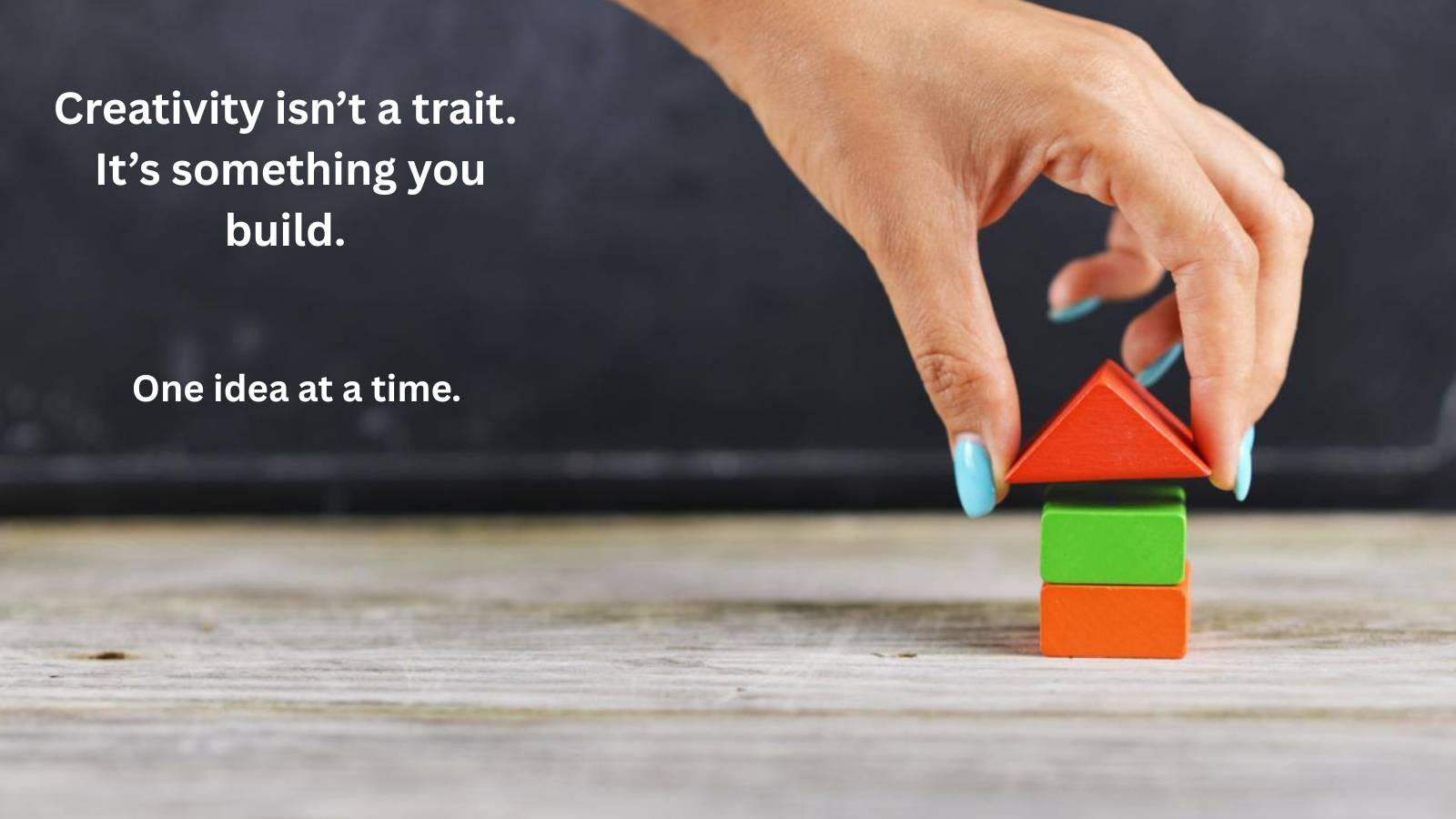
A natural trait. A spark that shows up on its own. But creativity rarely works that way.
It forms gradually. Through exposure. Through attention. Through practice. You can see this early.
Give a child a simple toy. What matters isn’t just the object. It’s what they begin to imagine around it. A train set becomes more than a train.
It becomes:
a landscape
a system
a story
That shift doesn’t happen automatically. It happens when someone encourages them to look a little closer.
To ask:
What else could this become?
Creativity grows in those moments. Not from the object itself. But from how it’s used.
The same pattern continues over time.
Creativity builds on what we already know. On what we’ve seen. On what we’ve paid attention to.
It’s less about inventing something from nothing. And more about combining what already exists in a different way.
That process isn’t always clean. It can feel scattered. Incomplete. Unstructured.
We often associate creativity with messiness for that reason.
Not because mess guarantees results.
But because exploration rarely follows a straight line.
Trying ideas.
Letting some go.
Revisiting others.
That’s part of the process.
But mess alone doesn’t create anything.
Without direction or intention, it stays noise.
Creativity develops when exploration meets awareness.
When you begin to notice patterns. Connections. Possibilities.
Over time, that awareness becomes a way of thinking.
A way of approaching problems.
A way of seeing more than what’s immediately in front of you.
And that’s what people often recognize as creativity.
Not a single moment.
But a pattern that’s been built.
It starts early.
But it doesn’t stop.
Creativity isn’t something you wait for.
It’s something you continue to develop. By paying attention. By exploring. By allowing yourself to think differently.
These thoughts are explored in these books
Creativity is a Practice, Not a Personality Trait

Creativity is often labeled a soft skill, but that description understates its depth and discipline. Creativity can be practiced, strengthened, and refined. It involves learnable approaches—like brainstorming, mind mapping, or lateral thinking, but its real challenge lies not in technique alone, but in consistency, curiosity, and courage.
When we think creatively, we don’t just generate new ideas; we change how we approach problems. Creativity expands perspective. It helps us see alternatives where we once saw limitations, and possibilities where we assumed there were none. Over time, practicing creative thinking strengthens the mental pathways that support imagination, flexibility, and insight.
One of the most reliable ways to deepen creativity is to step outside familiar patterns. That often means taking small, calculated risks. It also means accepting failure as part of the process, not as evidence of inadequacy, but as information. Many meaningful ideas emerge only after multiple false starts. Creativity rarely arrives fully formed; it reveals itself through iteration.
Curiosity plays a central role here. Remaining open to new ideas, questioning assumptions, and allowing ourselves to explore without immediate certainty creates the conditions for genuine creativity to emerge.
Collaboration can also serve as a powerful catalyst. Working alongside others introduces perspectives we might never reach on our own. Shared ideas invite refinement, challenge, and expansion. Creative collaboration isn’t just about productivity; it’s about connection. It reminds us that creativity thrives in dialogue, not isolation.
In today’s world, creativity is no longer optional. As technology evolves and complex social challenges emerge, the ability to think imaginatively and adapt thoughtfully has become essential. Creativity supports innovation, resilience, and problem-solving, qualities increasingly valued across every field.
Creativity is not a talent reserved for a few. It is a practice available to anyone willing to pay attention, take risks, and remain open. With regular effort, creative capacity grows. And with it grows our ability to shape meaningful work, relationships, and contributions to the world around us.
To Stop Thinking and Start Feeling: Creativity Beyond the Mind
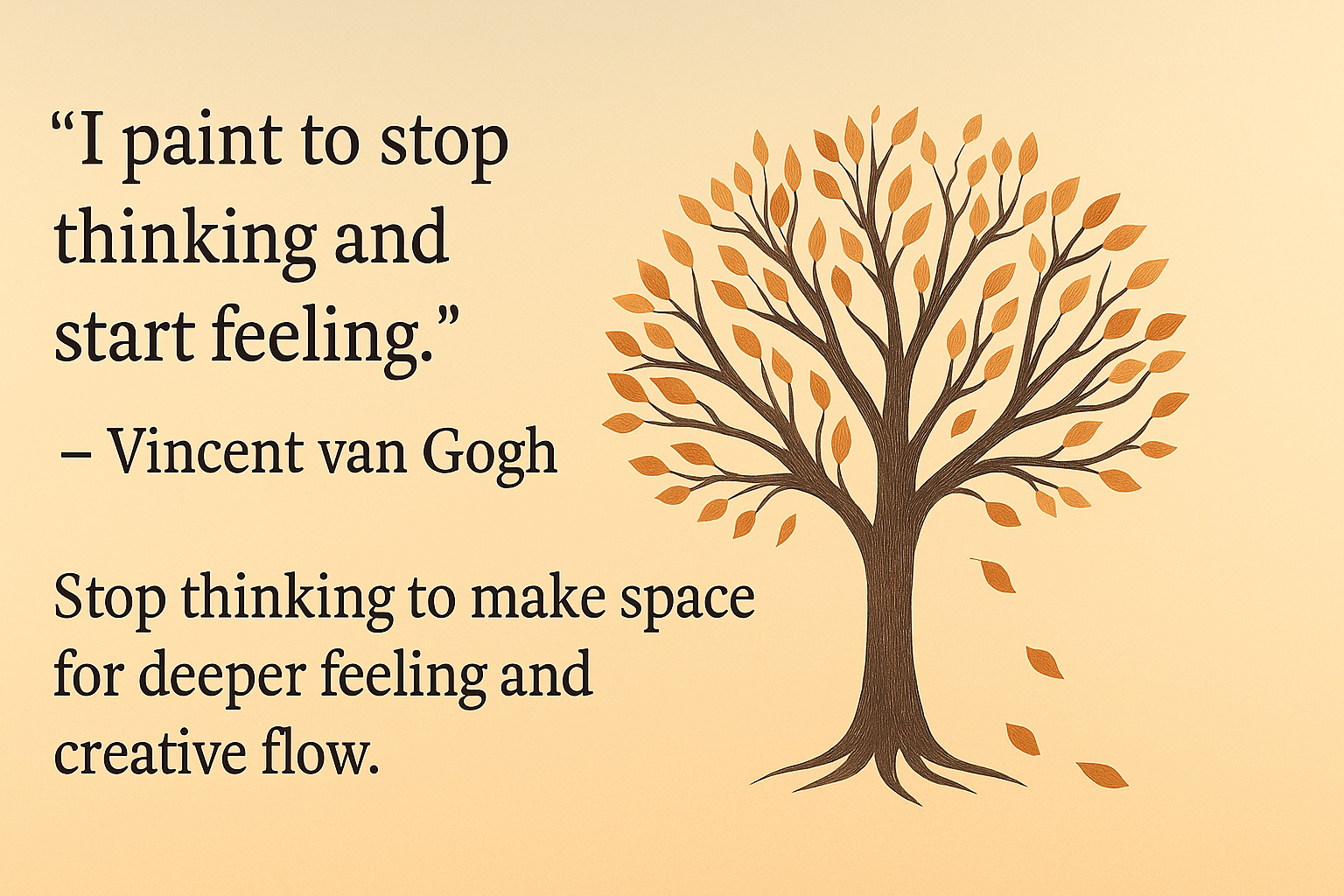
What if the secret to deeper creativity isn’t thinking harder, but stepping back from thinking altogether? Vincent van Gogh once said, “I paint to stop thinking and to start feeling.” He wasn’t rejecting thought; he was making space for something deeper. This reflection explores how quieting the mind can open the door to more inspired, authentic expression, and why that still matters in today’s world.
Imagine the heartbreak of no longer being able to write, paint, or express yourself creatively. For many, it wouldn’t just be a loss of a hobby, it would feel like a loss of identity. Vincent van Gogh once said, “I paint to stop thinking and to start feeling.” That single line captures something profoundly human: the power of art to move us out of our heads and into our hearts.
Van Gogh’s words are more than poetic. They reveal a deep truth—that creativity often begins not with thinking, but with letting go of thought. To stop thinking is not to go blank; it is to make space—for emotion, instinct, and unspoken meaning. When we stop trying to control every idea, we begin to access something more intuitive, something that connects us not only to ourselves but also to the world around us.
🌳 The Stop Thinking Tree
The phrase “to stop thinking” is not about shutting down the mind but about quieting it, gently stepping back from the constant hum of analysis, comparison, and inner chatter. In this quieter space, something unexpected happens: we become more present, more aware, and more emotionally in tune.
It’s a shift from cognition to sensation. From rumination to resonance. From control to connection.
Even when our minds seem still, they’re still at work—just in a different way. They’re listening instead of shouting. They’re observing instead of judging. This is where true creative flow begins: not by forcing ideas, but by allowing them to emerge.
🎨 Opening Sensory Doors
When we let go of overthinking, we open what might be called sensory doors. We become more attuned to light, color, rhythm, and nuance. The words we write feel more alive. The brushstrokes we make carry deeper emotion. Our creative choices become less calculated and more meaningful because they come from a place beyond logic.
To stop thinking is not to be thoughtless. It’s to make room for feeling. And from feeling comes art.
This is not just a creative method—it’s a way of reconnecting with ourselves. In a world driven by speed and certainty, choosing to pause and feel is a radical act. It’s also, perhaps, the most authentic path to inspiration.
Where Creativity Comes From
We talk about creativity as if it comes from some hidden spark inside us. Something original. Something untouched and purely our own.
But when we look closer, the story changes.
Everything we create begins long before we put pen to paper or make a decision.
It begins in the experiences we carry. The people we’ve listened to. The ideas we’ve borrowed, reshaped, and slowly made our own.
Even the most original thinkers aren’t creating from nothing. They are creating from memory. From influence.From the stories that left a mark big enough to follow them through life.
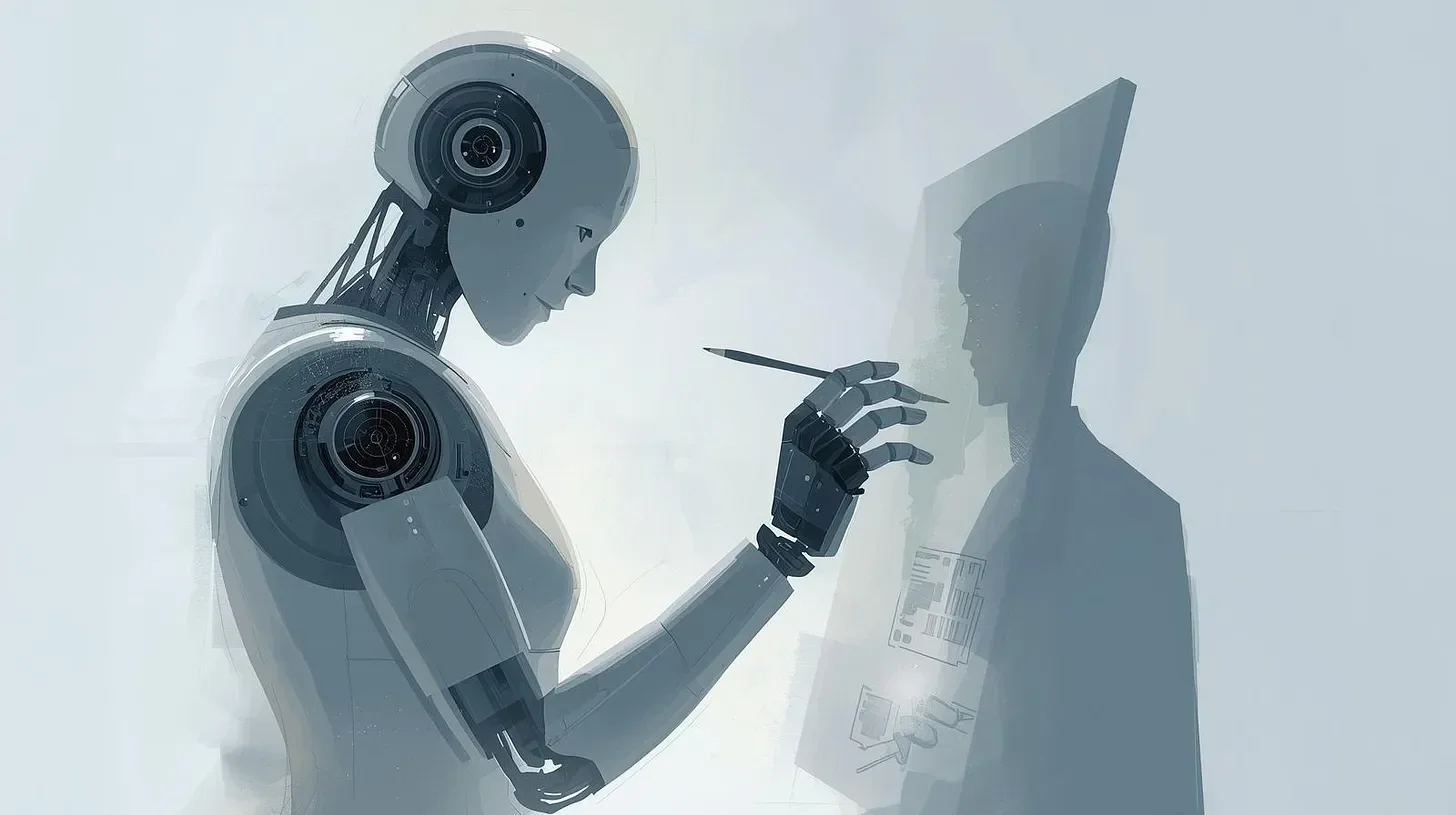
AI works the same way. It draws from patterns, examples, data, and what has already been said. It doesn’t replace creativity. It reveals something we often overlook:
Creativity is not isolation. Creativity is connection.
When we create, whether it’s a drawing, a paragraph, a decision, or a new direction in our lives, we are pulling from the world around us. From the books we’ve read.
The conversations that changed us. The moments that stayed long after they happened.
And maybe that’s the point.
Our creativity isn’t proof that we stand apart from the world. It’s proof that we’re shaped by it.
What matters is not whether an idea is completely original. What matters is what we choose to do with it, how we shape it, how we let it shape us in return.
In the end, the things we create, our work, our choices, our stories, become a reflection of everything that has touched us along the way.
That doesn’t make our creativity less valuable. It makes it more human.
Authenticity and Creativity

We often think creativity begins with talent or inspiration, but it usually begins with honesty.
When we become more authentic, we stop creating from a place of performance and start creating from a place of truth. We’re no longer trying to impress or protect an image. We’re simply following what interests us.
That shift matters. Authenticity makes risk feel less threatening because failure no longer defines who we are. We become more willing to step outside our comfort zone, try something new, and learn from the result. Curiosity opens up. Ideas come more freely. The creative process becomes less about getting it right and more about discovering what’s possible.
Creativity grows when we’re willing to stretch ourselves, challenge assumptions, and persist through uncertainty. And authenticity is what gives us the confidence to take that first step.
How Open-Mindedness Sparks Daily Creativity" →

New ideas aren’t accidents — they’re the result of staying open, curious, and ready to be inspired every day.
Where do new ideas come from? Sometimes we find them intentionally through research or exploration. Other times, they seem to appear out of nowhere.
At the heart of any creative journey is motivation — the force that initiates and guides our search for something new and meaningful. Reading is one of the best ways to spark this search, introducing fresh perspectives and ideas that might not arise otherwise.
Inspiration plays an equally important role. It's that feeling of excitement or enthusiasm when something resonates deeply, signaling that you've found the idea or direction you were seeking. Inspiration doesn't just drive creative projects; it also fuels our daily motivation and focus, keeping us energized and productive.
To tap into inspiration consistently, it's essential to cultivate open-mindedness. An open mind allows you to stay receptive to new ideas, recognize hidden opportunities, and maintain the creative momentum that drives innovation.
When you approach the world with openness, you're not just passively waiting for ideas to come — you’re actively creating the conditions where creativity can thrive. Every conversation, book, experience, or moment of reflection becomes a potential source of inspiration.
By practicing open-mindedness daily, you train yourself to see possibilities where others see obstacles, and to innovate where others remain stuck. Creativity isn’t a rare lightning strike — it’s a habit built on how you choose to engage with the world.
Stay curious. Stay open. Let inspiration find its way in.
Authentic Creativity is About Expressing Your Genuine Self Through Creative Endeavors →

Authentic creativity is about expressing your genuine self through creative endeavors, driven by your purpose and values. It involves aligning your creative work with your core beliefs and personal truths, creating a profound sense of fulfillment and a deeper connection to your creative practic, leaving you with a deep sense of satisfaction and contentment.
When you create authentically, your work can connect with others on a deeper level, reflecting your genuine self and personal truths and fostering a strong sense of connection and engagement.
Authentic creativity is rooted in a deeper understanding of your values and what truly matters to you. It involves expressing your genuine voice and perspective, rather than trying to conform to external expectations or trends. It is about expressing your own unique perspective and experiences, which not only resonates with others on a deeper level but also empowers you, makings you feel valued and significant.

Toys Can Help Teach Creativity →

You can develop creativity by experimenting, exploring, questioning assumptions, using imagination, and processing information. Creativity is similar to learning a sport; it requires practice and a supportive environment to thrive.
For infants and young children, the brain's elasticity and rapid neural formation make learning languages and developing creative ideas easier. Elasticity is the brain's capability to re-route or re-wire to enhance thinking. Some individuals possess a "Creative Eye," which means that when they see something, they are motivated to create a version of it or think of how to use it.
Toys are often used to replicate real-life events.
Creativity can be taught, and toys can greatly aid young children. For instance, consider an 8-year-old boy who receives a small Lionel train set. Do they associate their thoughts about the train set with the actual trains in the countryside or on road trips with their parents? Do they envision a train station, bridges, tunnels, and terrain that could be built around the train tracks? Do they have relatives or neighbors who may have worked on trains and could give input on the new Lionel train set layout? The right gifts and toys can open doors to creativity, but is more required to mentor a young child to think of options and come up with ideas?
Understanding the broader purposes of toys can make a difference in working with children. Is it such a big step from creating a train station as a youngster to understanding graphic design and layout? Sometimes, lifelong passions such as trains come from commitments made by mentors.
Assumed Innovation gets Attention! →

Creativity is the ability to think about a problem in a new or different way or the ability to use imagination to generate new ideas. Creativity begins with a foundation of knowledge, learning a discipline, and mastering a way of thinking. You can learn to be creative by experimenting, exploring, questioning assumptions, using imagination, and then processing that information. Learning to be creative is akin to learning a sport. It requires practice to develop the right muscles and a supportive environment to flourish.
“Creativity is a combinatorial force: it’s our ability to tap into our ‘inner’ pool of resources – knowledge, insight, information, inspiration, and all the fragments populating our minds – that we’ve accumulated over the years just by being present and alive and awake to the world and to combine them in extraordinary new ways.” — Maria Popova, Brainpickings.