
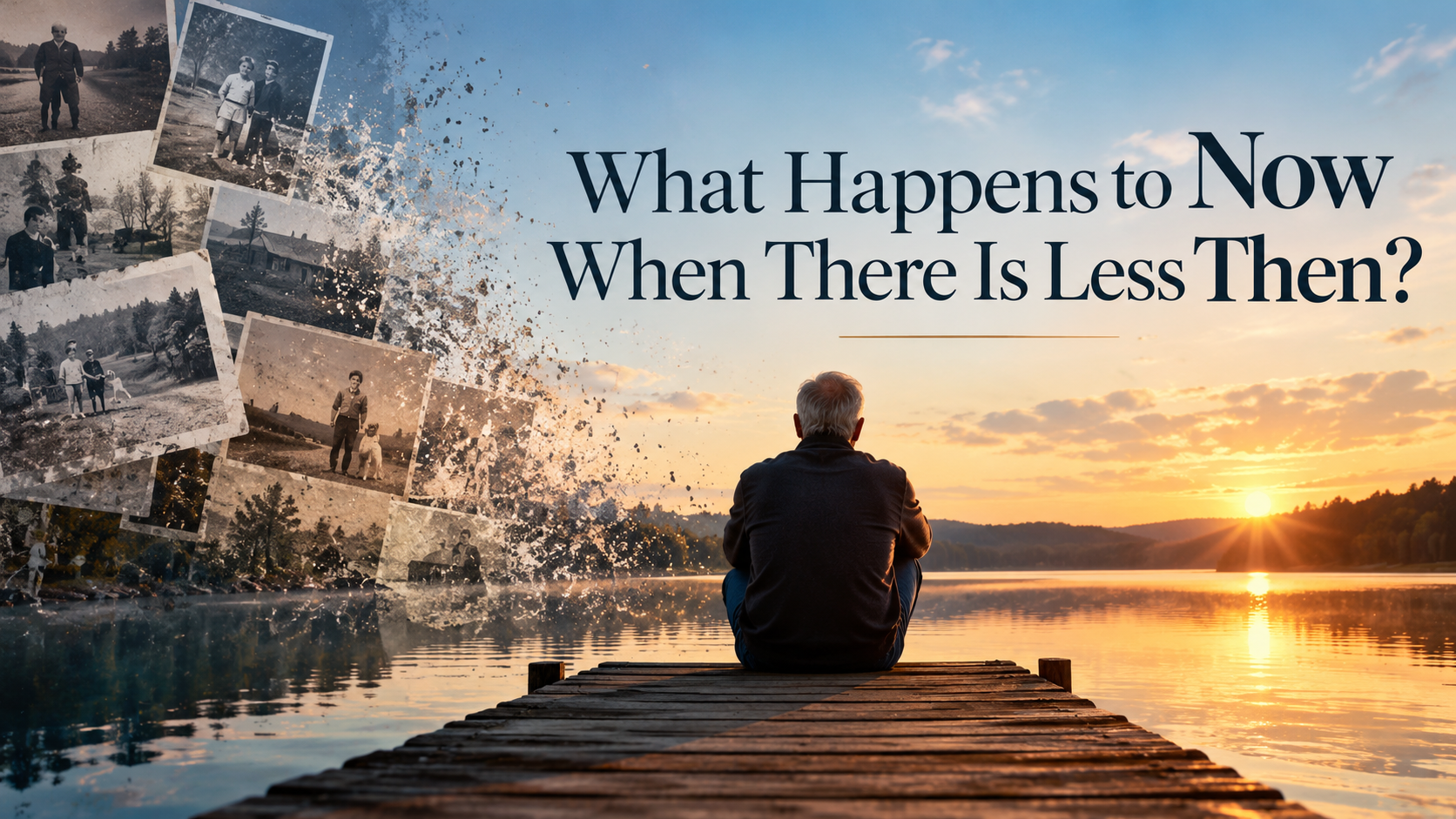
When memory changes, does our experience of the present change with it?
I put the title of this essay on my website before I had written the essay.
I did it so I wouldn't forget it.
There is some irony in that. The essay I wanted to remember is about what happens to the present when some of the past becomes harder to reach.
But perhaps that irony is also part of the answer.
The Past Is Always Part of the Present
Not long ago, I wrote an essay titled Now Is Full of Then, exploring how the past continues to live within the present.
We carry our experiences forward, whether we consciously remember them or not. Our decisions, relationships, beliefs, and attitudes have all been shaped by what came before.
The person we are today is not separate from the person we have been.
But that led me to another question.
What happens when some of those memories become less accessible?
Does the present become something different when we can no longer reach as much of the past?
And perhaps more importantly, does our understanding of who we are begin to change?
Memory Is More Than Remembering
We often think of memory as a collection of experiences we can retrieve.
A conversation. A childhood experience. A particular place. Someone we once knew.
But memory does more than preserve events.
It gives those events meaning.
When we look back, we don't simply recover what happened. We interpret it through the perspective we have today.
An experience that once seemed insignificant may eventually become one of the defining moments of our lives.
Something we believed was a mistake may later appear to have been an unexpected turning point.
In that sense, the past is never entirely finished. Its meaning continues to change as we do.
But what happens when the ability to revisit those experiences begins to change?
The events still happened. Their consequences remain part of our lives.
Yet our ability to recognize those connections may become less certain.
Perhaps that means we can continue to be shaped by experiences we can no longer clearly remember.
Are We Still the Sum of Our Experiences?
I have spent considerable time thinking and writing about the small moments that shape our lives.
One of the ideas behind my book What Matters: We Are the Sum of Small Moments is that we rarely recognize the significance of an experience while it is happening.
We discover its importance later, sometimes many years later.
But that raises an interesting possibility.
If we are the sum of those moments, do we have to remember them to remain the person they helped create?
I don't think so.
A relationship may have changed the way we understand kindness, even when we can no longer recall every conversation.
A difficult experience may have taught us patience, even when its details have faded.
A decision made decades ago may still determine where we live, whom we love, and how we see the world.
The memory may weaken, but the influence doesn't necessarily disappear.
Perhaps our identity is not simply the story we can remember telling ourselves.
Perhaps it also exists in the person that story has already helped us become.
When the Past Becomes Harder to Reach
There is a difference between knowing that the past exists and being able to reach it whenever we want.
Most of us experience this to some degree as we grow older.
Names escape us. Dates become uncertain. Events we once remembered clearly begin to lose their detail.
Sometimes a photograph, a familiar voice, or a particular place brings something back unexpectedly.
Other times, the memory remains just beyond our reach.
I have become increasingly interested in what that experience means, not simply for memory itself, but for our relationship with the present.
We depend on the past to explain so much of what we experience today.
Why we feel comfortable with certain people.
Why particular situations make us uneasy.
Why some things matter deeply to us while others seem unimportant.
When the explanation becomes harder to retrieve, the feeling may still remain.
We may know that something matters without being able to explain exactly why.
And perhaps that is one of the more complicated aspects of memory.
Our experiences can continue to influence us even when we lose some of our ability to explain their influence.
Does Now Become More Important?
It would be tempting to conclude that when there is less access to the past, the present must become more important.
There may be some truth in that.
But I don't think it is quite that simple.
The present has always been the only part of life we can directly experience.
The past exists in memory and in the consequences it has left behind. The future exists in expectation, possibility, and uncertainty.
Yet much of our attention is spent somewhere other than where we actually are.
We revisit old conversations.
We reconsider decisions.
We anticipate problems that may never happen.
Perhaps having less access to the past changes that balance.
But it does not automatically make us more present.
Sometimes uncertainty about memory can make the present more confusing rather than more meaningful.
Sometimes the inability to recall something creates frustration, even when the thing forgotten seems relatively unimportant.
And sometimes we may become so concerned about what we cannot remember that we overlook what is still available to us.
That may be the real challenge.
Not simply learning to live with less access to the past, but learning to recognize the value of what remains available in the present.
The Difference Between Remembering and Being
There is another question that interests me.
How much of our identity depends on our ability to explain ourselves?
Throughout life, we construct a story about who we are.
We describe our childhood, our work, our relationships, our accomplishments, and our disappointments.
We use those experiences to explain how we became the person we believe ourselves to be.
But the story is never complete.
Even when our memories are strong, we leave things out. We change our interpretations. We emphasize some experiences and minimize others.
Our understanding of ourselves has always been selective.
So perhaps a changing memory does not introduce an entirely new problem.
It makes an existing reality more visible.
We have never been able to hold our entire lives in conscious awareness.
And yet we have always remained more than the memories we could retrieve at any particular moment.
We are also our attitudes, our responses, our relationships, and the ways we continue to affect other people.
A person does not stop being kind because they cannot remember every experience that taught them kindness.
Nor does a lifetime of influence disappear simply because the person who lived it can no longer explain all of its details.
What Remains When the Story Changes?
I find myself returning to a thought that has appeared in much of my writing.