
Peace Begins Where You Pause
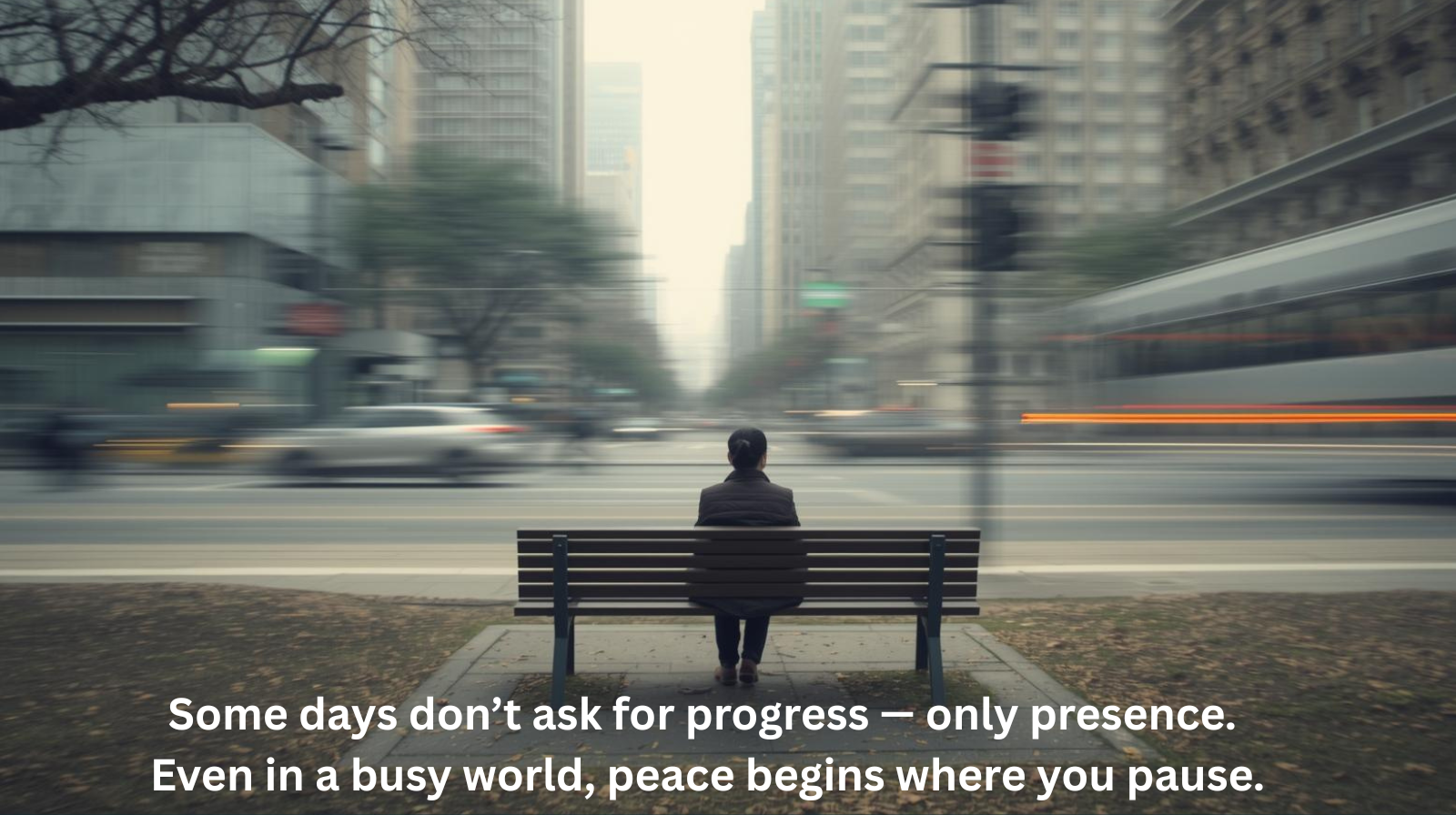
Some days don’t ask for progress , only presence. Even in a busy world, peace begins where you pause.
The world moves quickly, measuring worth in motion , steps taken, goals achieved, deadlines met. But stillness has its own kind of progress.
When we stop, we notice what has been waiting quietly for our attention: a thought, a feeling, a truth that movement hides.
Stillness doesn’t mean giving up on momentum. It means remembering that rest is also part of creation. Growth happens not only in doing, but in being.
So take a seat, take a breath, and let the noise pass. Sometimes the most meaningful movement is learning how to stay.
Positivity, Balance, and What It Means Now

This essay first appeared on my Substack, What Matters, where I share ongoing reflections on presence, interpretation, and the quiet ways meaning takes shape over time.
I’ve spent years writing about presence, change, and how meaning is shaped less by grand moments than by the way we interpret ordinary ones. In recent months, as my writing has resurfaced among people from different seasons of my life—and as the world itself feels more strained than it once did—I’ve found myself returning to a question that seems harder to answer than it used to: What does positivity actually mean now?
This reflection isn’t about motivation or mindset tricks. It’s about how positivity works when life feels heavier, leadership feels quieter, and inspiration is harder to locate.
Positivity is often treated as a direction, something we move toward by turning away from what’s difficult. We’re encouraged to focus on the good, to stay optimistic, to “keep things positive,” as if positivity exists on its own, separate from doubt, loss, or struggle.
But positivity doesn’t live in isolation.
The more I think about it, the more it seems that positivity requires balance—not as a limitation, but as a condition.
Infinity offers a useful metaphor. It feels limitless—expansive, without edges. Yet even infinity has direction. Positive and negative stretch endlessly in opposite ways, mirroring each other. When we consider both together, something subtle appears between them, not emptiness, but balance.
Zero isn’t nothing. It’s a meeting place.
In human terms, positivity works the same way. When positivity ignores difficulty, it risks becoming denial. When it refuses to acknowledge pain, it loses depth. And when it insists on brightness at all costs, it can unintentionally silence real experience.
True positivity isn’t the absence of hardship. It’s the ability to hold hope and realism at the same time.
Every “positive”—joy, growth, success—draws its meaning from the possibility of its opposite. Gratitude deepens when we’ve known loss. Peace feels more honest after turbulence. Growth rarely appears without struggle pushing against it.
This doesn’t mean we dwell on the negative. It means we understand its role.
Positivity isn’t about pretending the shadow isn’t there. It’s about knowing where the light comes from.
In that sense, positive thoughts aren’t fragile ideas we must protect from reality. They’re resilient perspectives shaped by it. They don’t cancel uncertainty—they coexist with it.
Perhaps positivity isn’t something we maintain through constant effort or discipline. Perhaps it’s something that emerges naturally when we allow balance to exist.
In daily life, this kind of balanced positivity shows up in small, ordinary ways. It’s the ability to acknowledge a hard day without letting it define the whole story. To hold disappointment without losing hope. To recognize progress even when the path feels uneven.
Positivity, lived honestly, isn’t about forcing optimism. It’s about staying open—to meaning, to complexity, and to the possibility that clarity doesn’t always arrive loudly.
This reflection connects closely with the themes I explore in What Matters—an ongoing body of writing about presence, interpretation, and the meaning we build through ordinary moments.
Being Yourself Isn’t a Destination
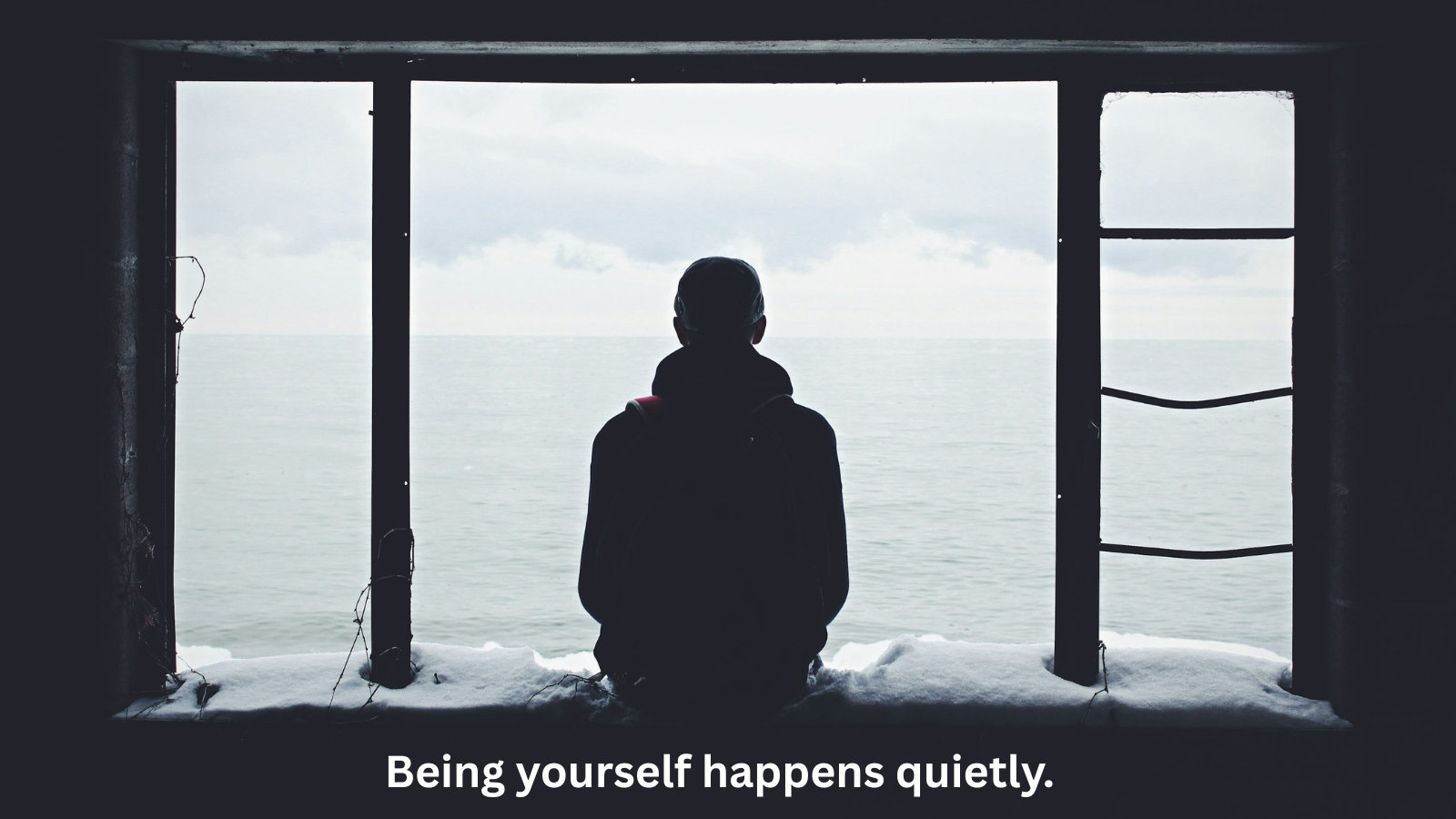
Authenticity doesn’t arrive all at once. It shows up quietly—often after we stop trying so hard to improve ourselves and start paying closer attention to who we already are.
Most of the time, we don’t become less authentic because we’re dishonest. We become less authentic because we’re busy adapting—adjusting to expectations, responding to pressure, or trying to meet a version of ourselves that once made sense but no longer does.
Change plays a role here, but not in the way we often imagine. Growth isn’t always about becoming more. Sometimes it’s about shedding what no longer fits. Letting go of borrowed definitions. Allowing our values, temperament, and deeper motivations to come back into focus.
Self-reflection helps—not to fix us, but to notice us. It creates space to ask quieter questions. Why do certain choices feel heavy now? Why do some conversations drain us while others restore us? What are we protecting, and what are we avoiding?
The work isn’t dramatic. It’s gradual. It happens in small moments of honesty—with ourselves first, and then with others.
Being yourself isn’t a destination. It’s a practice of paying attention.
Be yourself and see who you find.
If this reflection resonates, you may also find meaning in What Matters or The Human Factor, where I explore reinvention and self-understanding more deeply.
People Who Stay, People Who Leave, and the Ones Who Return in Dreams
Looking back at the people in my life, I see a mix of paths. Some are still here. Some were only with me for a season. And others were clearly there for a reason, even if the reasons were not always positive.
What surprises me most are the ones who return. Not in real life, but in my thoughts and dreams. They come back with all the good and all the bad, but dreams rarely keep those things separate. They blend them, stretch them, and amplify them until the emotions feel sharper than anything I ever felt when the moments were real.
There are nights when I am relieved to wake up.
Not because I fear the past, but because sleep has a way of reminding me that unfinished stories never fully go away. They wait. They echo. They hint at the things we still carry, even when we believe we have moved on.
Maybe that is the quiet truth about “reason, season, lifetime.”
The categories are never as clean as we want them to be.
People leave our lives, but the meaning they left behind keeps shifting. Some lessons grow softer over time. Others stay sharp. And some return only when we are ready to understand them differently.
I used to think dreams were just the mind’s way of sorting old memories.
Now I see them as reminders.
Not of the people themselves, but of who we were when we knew them and who we have become since.
Sometimes the most meaningful growth happens long after someone is gone.
When the World Is Quiet Enough to Be Seen
Sometimes a picture stops you—not with drama, but with calm.
This one does that for me.

At first glance it’s just a landscape: bare trees, a still lake, a forgotten boat, all wrapped in mist. But the longer you look, the more you start to notice. The blacks aren’t really black. They’re layers—shadows, depth, texture, and possibility. It’s monochrome on the surface, yet full of varieties that feel almost like they’re waiting to shift into color.
That’s the part that stays with me.
Life is often the same. From a distance it looks simple, maybe even predictable. But when we slow down enough to really pay attention, we discover the quiet layers underneath—the ones we usually race past.
And then there’s the reflection.
The trees double themselves in the water, reminding me that everything carries more than one meaning. What we see… and what we don’t. What we show… and what we keep beneath the surface. Sometimes the reflection is the truer version, the one we only notice after the world gets still enough.
Maybe that’s why this image feels so peaceful. It doesn’t tell a story.It invites one.
And for a moment, you can breathe and simply look—without needing answers, without needing noise. Just a reminder that the world is still beautiful, and that even in black and white, life has more shades than we realize.
The Stories We Tell Ourselves (and the Ones We Rewrite)

We don’t just live our lives, we narrate them. Every decision, every setback, every success becomes part of a story we quietly tell ourselves. Over time, these internal narratives shape what we believe is possible, what we deserve, and where we’re headed.
But here’s the truth most of us overlook: Many of our stories were written long before we had a say.
Some were inherited from the family. Early experiences shaped some. Some were formed by fear, comparison, or the desire to fit in.
And yet we carry them as if they are the absolute truth.
The work of self-reflection isn’t about tearing ourselves apart. It’s about asking:
Is this story still true for me?
Does it still serve me?
Or have I outgrown it without realizing it?
When we begin rewriting our internal narrative, something powerful happens. We start seeing possibilities instead of limits. We soften old self-judgments. We reclaim choices. We make room for new beliefs and new directions.
Our stories don’t define us permanently.
They evolve as we evolve.
And when we consciously reshape them, we begin living with greater clarity, intention, and alignment.
Reinvention Isn’t a One-Time Event
Most people think reinvention comes in dramatic turning points—career changes, new relationships, fresh starts, life pivots. But the truth is quieter and steadier: reinvention is ongoing. It’s not a single transformation. It’s a series of adjustments, insights, and personal awakenings that accumulate over time.
You reinvent yourself every time you choose differently.
Every time you see yourself more clearly.
Every time you update your beliefs to match your current reality.
Yet people often resist the idea of ongoing reinvention because it can feel unstable. We crave certainty—an answer, a finished version, a final identity. But life rarely offers that. What it does offer is the opportunity to grow into a truer version of ourselves continually.
Reinvention isn’t about becoming someone new.
It’s about becoming someone more aligned, more honest, more aware, more intentional.
When we let go of the pressure to have everything figured out, we open ourselves to change that feels organic rather than forced. We stop seeing growth as a disruption and start seeing it as a natural part of living.
You don’t have to get it “right” all at once.
Reflective Nonfiction: A Clear Definition
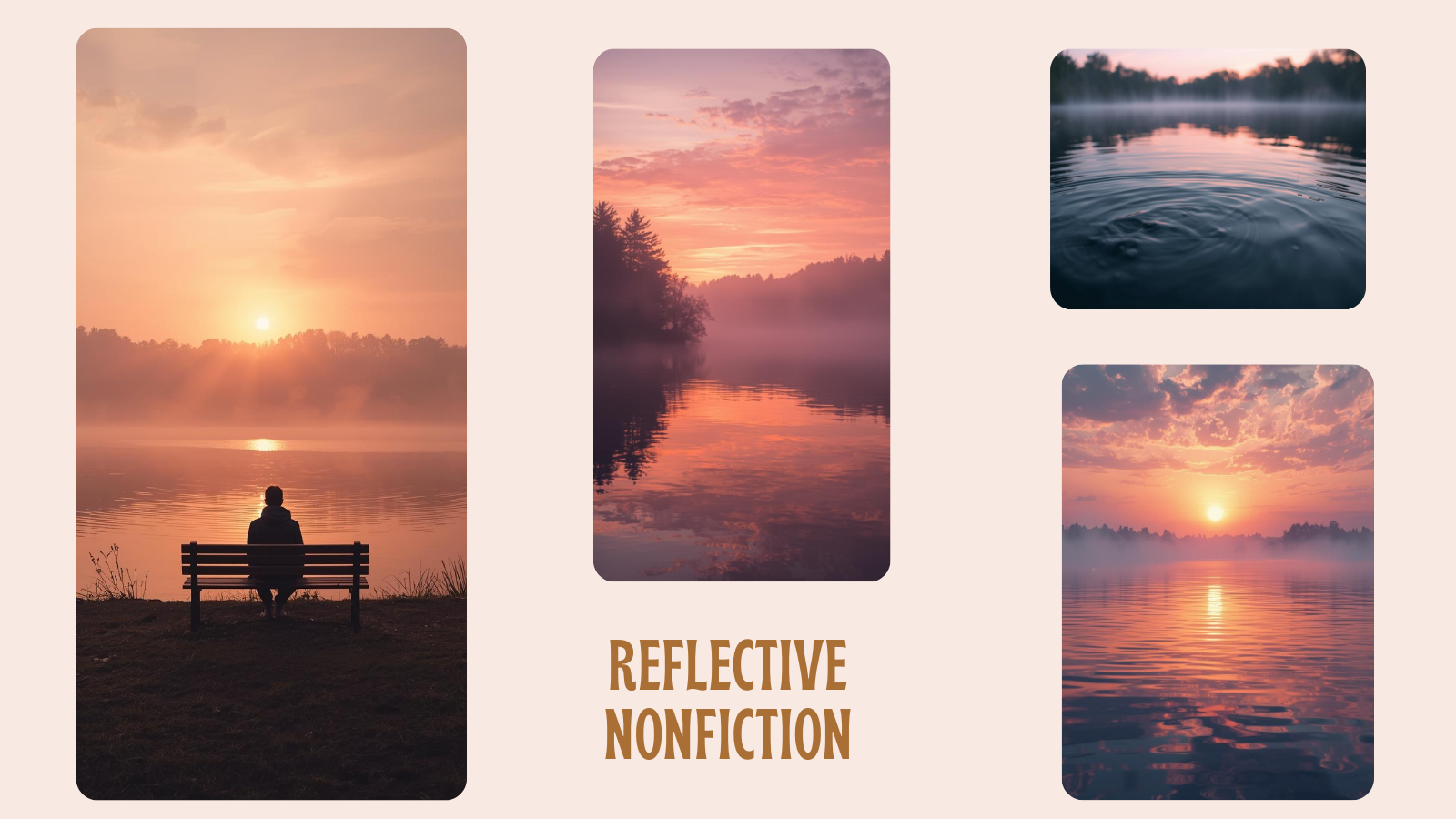
For years, I wrote traditional self-help — the kind that offers steps, answers, and direction. But over time, I realized something important: self-help often pushes people because it presumes to know better. The real answers, at least for me, weren’t hiding in a framework or a formula. They were already there when I slowed down and focused on the questions. What I needed wasn’t more advice. I needed clarity — the ability to make a decision, choose a direction, and act. That shift opened the door to reflective nonfiction.
Reflective nonfiction is absolutely a real and recognized genre — though it often appears under nearby labels like literary nonfiction, creative nonfiction, or personal essays. What distinguishes it is its purpose: not to instruct, but to understand. Not to prescribe, but to illuminate.
Definition
Reflective nonfiction is writing grounded in real experiences, observations, or moments — but shaped by introspection, insight, and meaning-making.
It’s not simply what happened.
It’s what the experience revealed.
Writers in this genre explore:
Inner growth or change over time
Personal or philosophical insights
How meaning shifts as life unfolds
The emotional or moral resonance of real events
How small moments shape identity, belief, or perspective
Reflective nonfiction becomes a conversation between the moment itself and the meaning it holds — a way of understanding not just the world, but our place within it
Reflective Nonfiction: The Art of Seeing Meaning in Everyday Experience
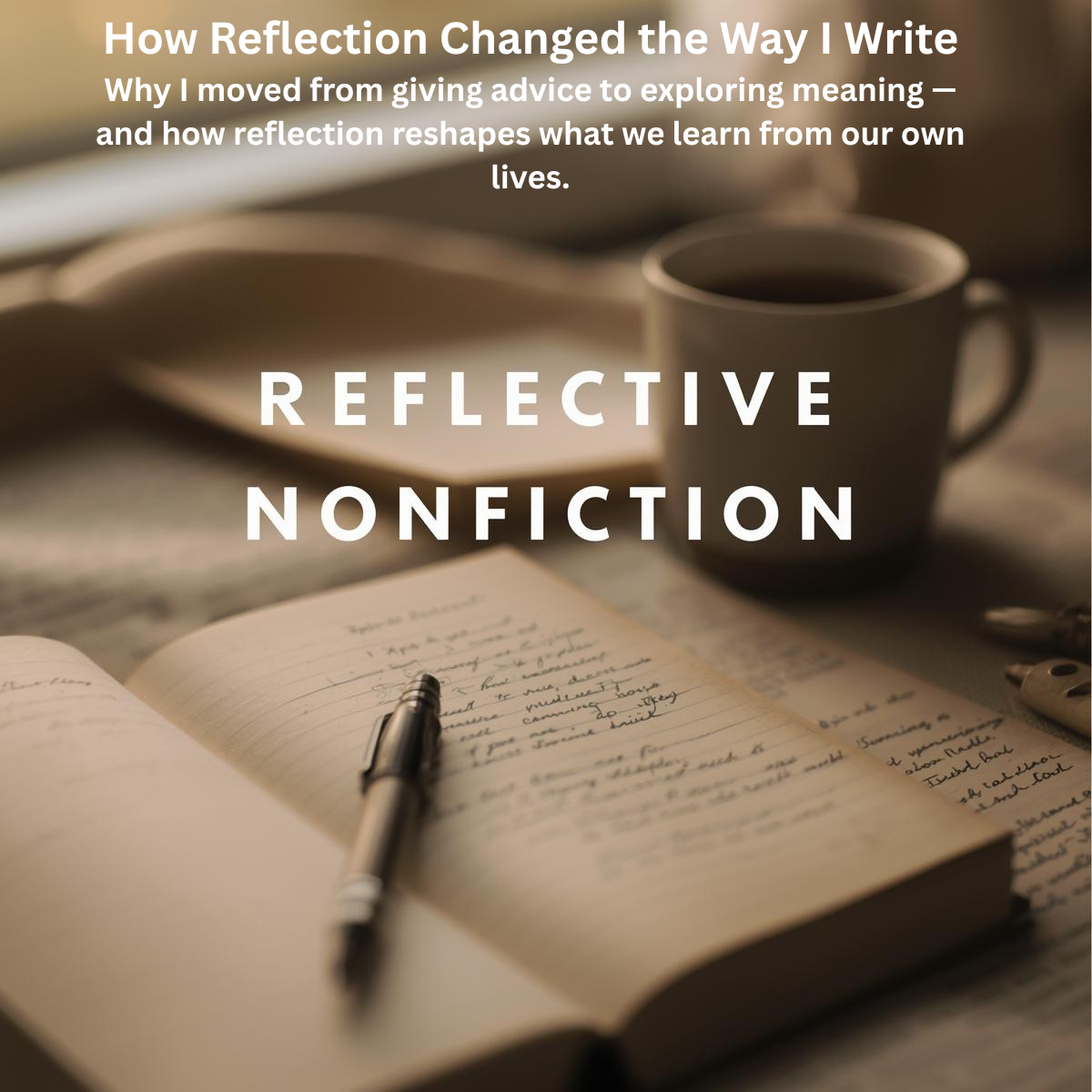
In a world that celebrates productivity and constant motion, reflective nonfiction invites us to pause. It asks us not only to recount what happened, but to explore why it mattered. This form of writing transforms experience into understanding, weaving observation with introspection. It’s where memory meets insight, where a quiet moment can reveal a universal truth.
🧭 Definition
Reflective nonfiction is writing based on real experiences, events, or observations, but shaped by introspection, insight, and meaning-making. It’s not just about what happened; it’s about what it meant.
Writers in this genre use reflection to examine:
Inner growth or change over time
Personal or philosophical insights
The emotional or moral resonance of real events