A lifetime of thinking does not necessarily leave us with more answers.
That seems strange to me because for much of life I thought that was what thinking was supposed to do. We learn. We experience. We make mistakes. We read. We listen. We change our minds. Presumably, all of that should eventually leave us knowing more than we did before.
And in many ways, it does.
But something else happens.
Some things I once thought I understood no longer seem quite so certain. Some questions I once believed had answers now seem larger than the answers I gave them. And some things that once occupied a great deal of my attention simply don't anymore.
I have let go of a lot.
Is that progress?
Not All Uncertainty Is Wisdom
It would be easy to say that growing older has made me more comfortable with uncertainty and leave it there.
There is some truth in that. Experience has taught me to be suspicious of easy answers. I have lived long enough to discover that I could be absolutely certain about something and still be wrong.
But uncertainty is not automatically wisdom.
Sometimes we become uncertain because we have learned enough to recognize complexity. That is intellectual humility.
Other times we haven't changed our minds at all. We have simply decided that something no longer deserves the amount of our life that we once gave it.
Those are very different things.
Politics is one example for me.
I don't spend much time thinking about politics anymore unless the news pushes it in front of me. That doesn't mean I have concluded that politics doesn't matter. Quite the opposite.
I remain concerned about the direction America has taken. Some things that once seemed outside the boundaries of acceptable public behavior have become increasingly normalized, and I don't believe that has been good for the country. I especially think about the kind of America my grandchildren will inherit.
So why don't I spend more time on it?
Because I have also come to recognize how little control I have over most of it.
The familiar answer is that everyone should get involved. Vote. Speak up. Pay attention. Participate.
There is truth in that too.
But there is another truth we don't talk about as much: none of us has unlimited time, energy, attention, or influence.
Eventually we have to decide where to spend them.
Caring Is Not the Same as Carrying
Perhaps that is one distinction I understand better now.
I can care about something without carrying it around with me every day.
I can believe something is wrong without spending hours consuming arguments about it.
I can worry about the world my grandchildren will inherit without believing that watching another hour of political commentary will improve that world.
That raises an uncomfortable question.
When does letting go become wisdom, and when does it become disengagement?
I don't have a clean answer.
"There is nothing I can do about it" can certainly become an excuse. If everyone believed that, nothing would ever change.
But the opposite can also become a trap. We can give enormous amounts of ourselves to things over which we have almost no influence while neglecting the people, relationships, ideas, and small moments where our presence actually does matter.
Maybe part of growing older is becoming more conscious of that tradeoff.
A Different Kind of Sorting
When we are younger, intellectual growth seems mostly about accumulation.
Learn more.
Read more.
Understand more.
Form opinions.
Find answers.
After enough years, growth may involve just as much subtraction.
Some beliefs are discarded because they no longer hold up.
Some answers become questions again.
Some convictions survive and become stronger.
Some things remain important even though we recognize we cannot control them.
And some things we simply decide not to carry any longer.
That doesn't mean they were meaningless.
It means we have made a judgment about what deserves the limited amount of ourselves we have left to give.
Perhaps that is where a lifetime of thinking eventually takes us.
Not toward certainty about everything.
Not toward uncertainty about everything either.
Maybe it takes us toward discernment.
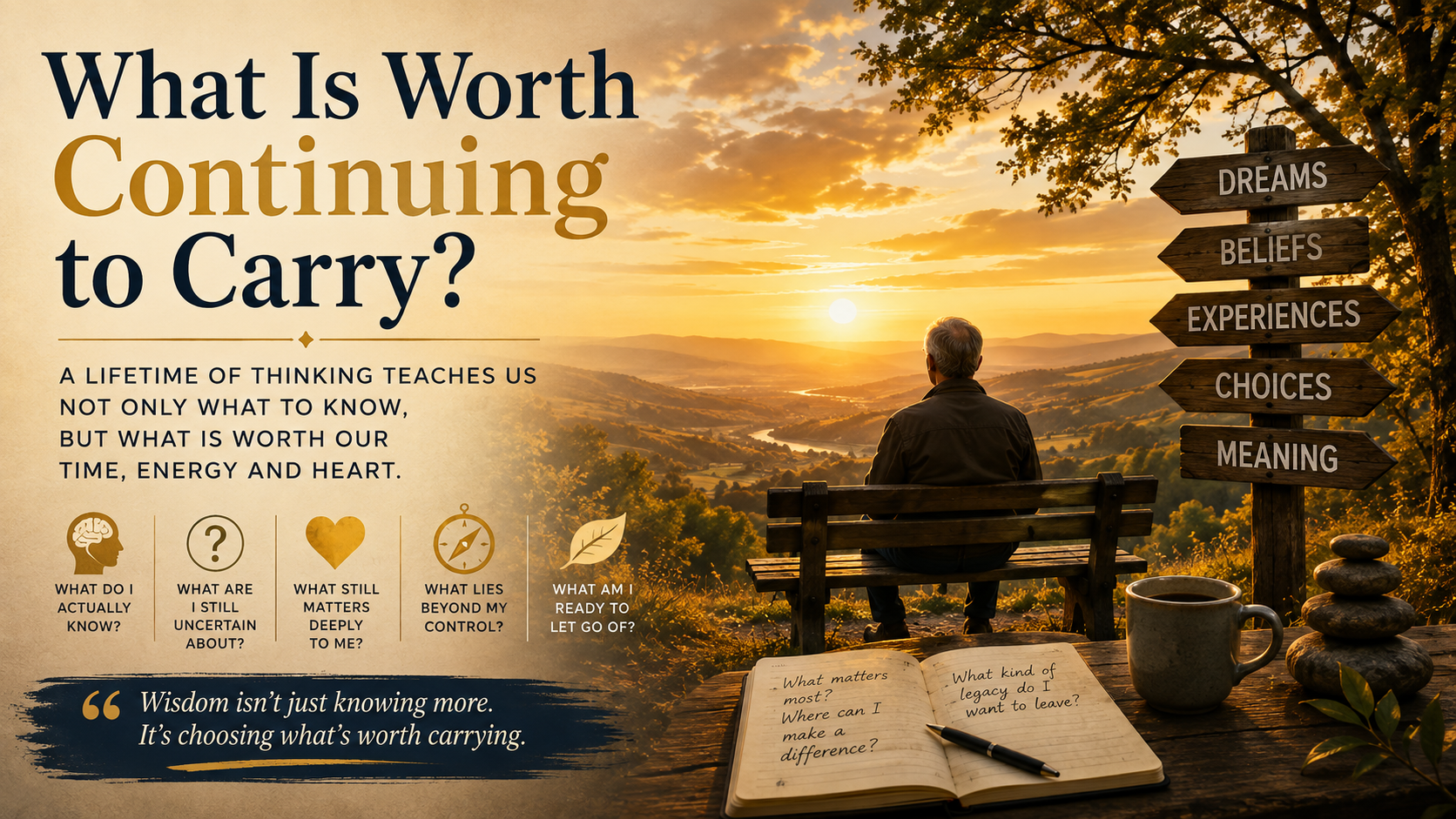
What do I actually know?
What do I only believe?
What have I been wrong about?
What still matters enough for me to stand behind it?
What matters but lies largely beyond my control?
And what have I carried long enough?
Those questions feel different to me now than they would have years ago.
What Deserves the Life We Have Left?
Time changes the question.
When life appears almost unlimited, we can afford to spend enormous amounts of it on things that may or may not matter.
Eventually, time stops looking unlimited.
Then deciding what to think about becomes connected to deciding how to live.
There are still things worth opposing. Things worth defending. People worth helping. Questions worth pursuing.
But there are also arguments I don't need to win, events I don't need to follow, opinions I don't need to have, and uncertainties I don't need to resolve.
Perhaps wisdom is not simply knowing more.
Perhaps part of wisdom is knowing what deserves our certainty, what deserves our attention, and what deserves the limited amount of life we still have available to give it.
A lifetime of thinking may not finally tell us what to think about everything.
It may do something more useful.
It may teach us what is worth continuing to carry.