Exploring the unexpected connections that shape our lives
Book Reviews, Comments & Stories, Quotes, & Poetry & More
"Connections and Why They Matter"
Most of what happens in our life will spark a connection. Life connects with what has been found in books. Books connect with what happens in life. Use the connections to help you see more clearly. A love of reading and writing is what motivated the creation of this blog. Thank you for coming to the blog.
We often assume that if we want a clearer future, we should spend more time looking ahead.
We set goals. We make plans. We imagine where we hope to be in a year, five years, or even decades from now.
Yet some of the greatest clarity about where we are going comes from looking in the opposite direction.
Not because the past predicts the future.
But because the meaning of the past is never fixed.
Every new experience changes how we understand the experiences that came before it.
The events themselves remain the same. What changes is the person remembering them.
That is why two people can experience similar circumstances and tell completely different stories about what happened. It is also why our own life story changes over time, even though the facts do not.
We naturally see our lives as a series of connected events. We weave relationships, successes, disappointments, losses, and unexpected opportunities into a narrative that explains who we believe we are.
That narrative quietly shapes our identity.
Stories of successful leaders often illustrate this point. Many describe setbacks, failures, disappointments, or periods of uncertainty as turning points that ultimately shaped their character and direction. Yet very few recognized the value of those experiences while they were living through them.
Only years later, after new experiences provided perspective, did those difficult moments begin to make sense.
Looking backward gave them a clearer understanding of how they had moved forward.
Several years ago, Julie Beck wrote an article for The Atlantic titled Life's Stories. Its subtitle captured an important truth: How you arrange the plot points of your life into a narrative shapes who you are and is a fundamental part of being human.
She quoted developmental psychologist Monisha Pasupathi, who observed that, "To have relationships, we've all had to tell little pieces of our story."
That simple observation carries an important implication.
If we are constantly telling our story to others, we are also constantly telling it to ourselves.
And as we grow, our understanding of that story evolves.
A disappointment that once felt like failure may later appear as preparation.
A career change that seemed frightening may eventually become the moment that redirected your life toward something more meaningful.
A relationship that ended may later reveal lessons you could not have learned any other way.
The events have not changed.
Your understanding has.
That realization can be surprisingly freeing.
Many people carry an outdated version of themselves because they continue to interpret their past through the perspective they had years ago.
But you are no longer that person.
The experiences you've had since then have given you new knowledge, greater empathy, different priorities, and perhaps a deeper understanding of yourself.
Why shouldn't those changes also reshape how you understand your past?
One practice I have found helpful is periodically writing a summary of my own life.
Not a detailed autobiography.
Just the significant moments.
The forks in the road.
The people who influenced me.
The decisions that altered my direction.
The unexpected opportunities.
The painful disappointments.
Then, months or years later, I revisit that summary and write it again.
What surprises me is not how much the facts have changed.
They haven't.
What changes is what I believe those moments meant.
New experiences illuminate old ones.
Connections I never noticed become obvious.
What once appeared random begins to reveal a pattern.
Looking back does something that constantly looking ahead cannot.
It helps us recognize themes.
It reminds us of strengths we forgot we possessed.
It reveals resilience that was quietly forming long before we recognized it.
And it often uncovers purpose hidden beneath experiences that once seemed meaningless.
If you've never reflected on your own story this way, consider asking yourself a few questions.
Which disappointment ultimately changed your life for the better?
Which success mattered less than you expected?
Which relationship taught you something you still carry today?
Which difficult season made you stronger without you realizing it at the time?
Which event would you describe differently today than you would have five years ago?
The answers may reveal that your life has been telling a richer story than you realized.
Your story is not finished.
Every year adds another chapter, but it also changes the meaning of earlier chapters.
The person you are becoming is quietly rewriting the person you once believed yourself to be.
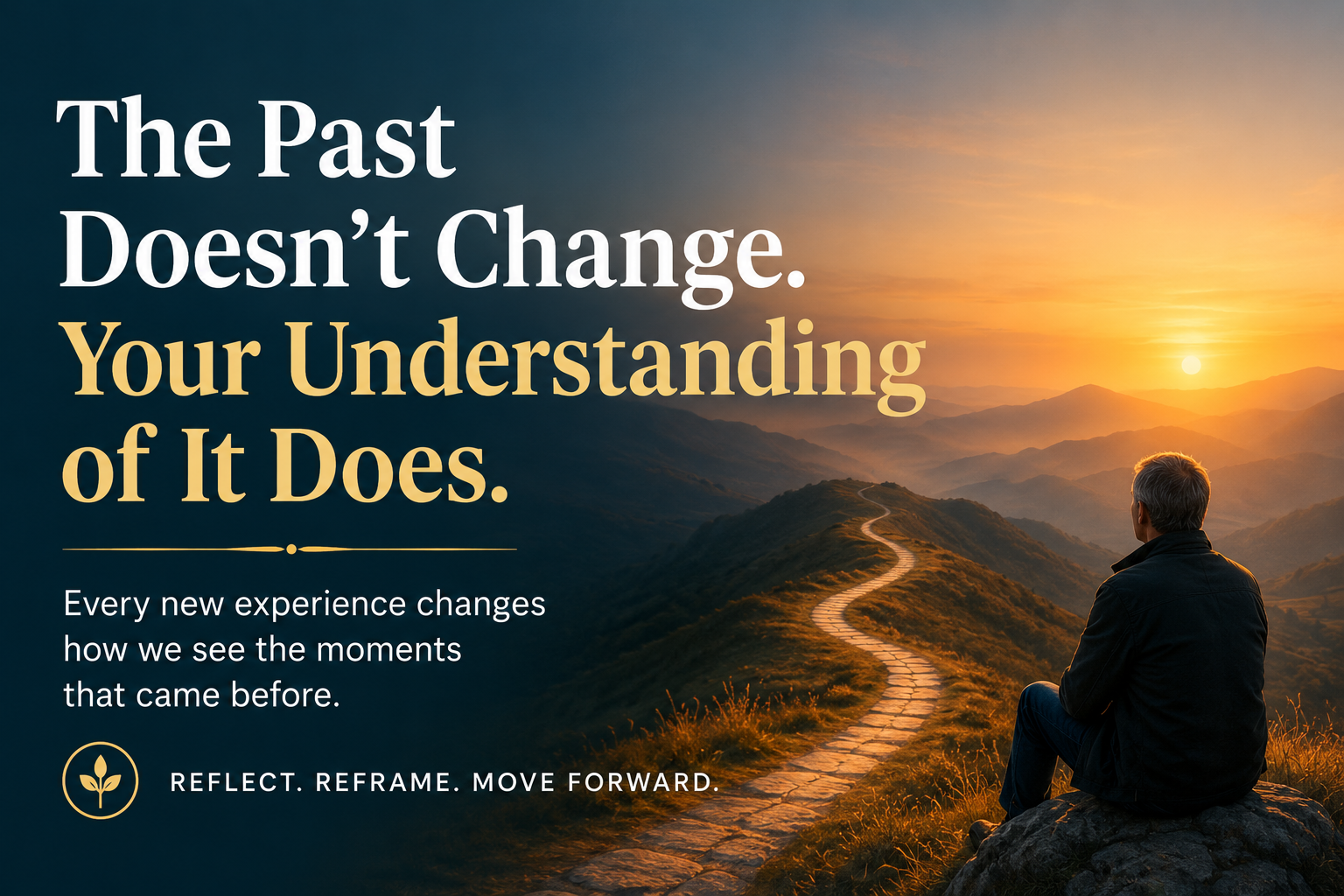
The past does not change.
But your understanding of it does.
And sometimes, that new understanding is exactly what helps reveal the path forward.
Brent M. Jones writes about self-awareness, communication, identity, and the quiet moments that shape our lives. He is the author of What Matters, Why Life Stories Change, Terminology Is More Than Words, and several other books exploring meaning, personal growth, and authentic human connection.