

The Selves We Outgrow Without Noticing

Sometimes I look around and realize the people I once felt aligned with no longer feel like peers. Nothing dramatic happened. No conflict. No clear break. Just a quiet sense that we are no longer standing in the same place.
When that happens, the first instinct is to look outward. To wonder where my people went. To ask where I might find them now. But there are no clear answers, only the feeling of being slightly out of step with the room.
Over time, something shifts. We stop measuring ourselves by who others are becoming and start recognizing who we are becoming. The comparison fades. The roles loosen. What once felt affirming, being one of them, no longer carries the same weight.
There is a strange loneliness in that moment. But there is also relief.
Because the work is no longer about belonging to a group or matching a version of ourselves that once fit. It becomes about finding steadiness in who we are now. Learning to sit with that. Learning to trust it.
Outgrowing people isn’t always about distance or disagreement. Sometimes it’s simply a sign that we’ve stopped borrowing our sense of self from the room we’re in.
And when that happens, even the uncertainty feels lighter.
The Quiet Changes We See Only Afterward
Change rarely announces itself. Most of the time it moves quietly, almost unnoticed, until one day we look back and realize something inside us has shifted.
We grow in small ways first. A different way of responding. A calmer thought. A moment of clarity that feels simple but stays with us.
These quiet changes often matter the most. They shape how we see ourselves.
They help us understand what we value. And they remind us that growth isn’t always loud. Sometimes it is slow and steady, finding its shape only in hindsight.
When we pay attention, we begin to notice the subtle ways we are becoming someone new.
If you found this interesting check out the artlec below
Understanding Isn’t Wisdom

We often confuse understanding with wisdom.
Understanding sees clearly; wisdom acts with clarity.
One explains the world, the other transforms how we live within it.
Understanding allows us to see what’s really happening—how things connect, what causes what, and why events unfold the way they do. Wisdom, however, is what guides our response to that clarity. It’s what turns insight into compassion, and reflection into movement.
Understanding recognizes truth.
Wisdom lives it.
You can understand a person’s pain, yet wisdom reminds you when to speak—and when silence might heal more deeply. You can understand your own emotions, yet wisdom helps you rise above them rather than be ruled by them.
Understanding sharpens the mind, but wisdom softens the heart.
Understanding observes patterns; wisdom interprets purpose.
Knowledge fills the mind.
Understanding shapes’ perspective.
Wisdom refines the soul.
In the end, wisdom isn’t found in knowing more; it’s found in living well with what we already know.
Are We Missing the Meaning of Life by Thinking Too Much About Death?

It’s easy to let our thoughts drift toward what might come after this life—what it means, what it fixes, what it promises. But when we stare too hard at the afterlife, we risk missing what’s unfolding right in front of us.
Life happens here: in small moments, in ordinary days, in the people we meet who frustrate us, challenge us, comfort us, or quietly shape us. Everyone carries their own story, even the ones we label as difficult or strange.
When we focus on this life instead of the next one, something becomes clearer:
meaning shows up in how we show up for each other.
It lives in patience, in kindness, in small gestures that ripple outward. Maybe the meaning of life isn’t waiting on the other side of death—maybe it’s created in the way we treat people while we’re here.
Clarity Isn’t Enough

It’s possible to see clearly and still not move.
Understanding shows us what’s happening — how things connect, why they unfold the way they do. But clarity alone doesn’t change anything.
Something else is required.
Wisdom is the response to what we see.
It’s what turns awareness into direction.
The two work together — one illuminates the path, the other walks it.
This idea — that what we do with what we see matters more than what we know — is something I explore more fully in What Matters: We Are the Sum of Small Moments
#Reflection #Wisdom #Presence
Why the Cars We Wanted Were Never Really About the Cars
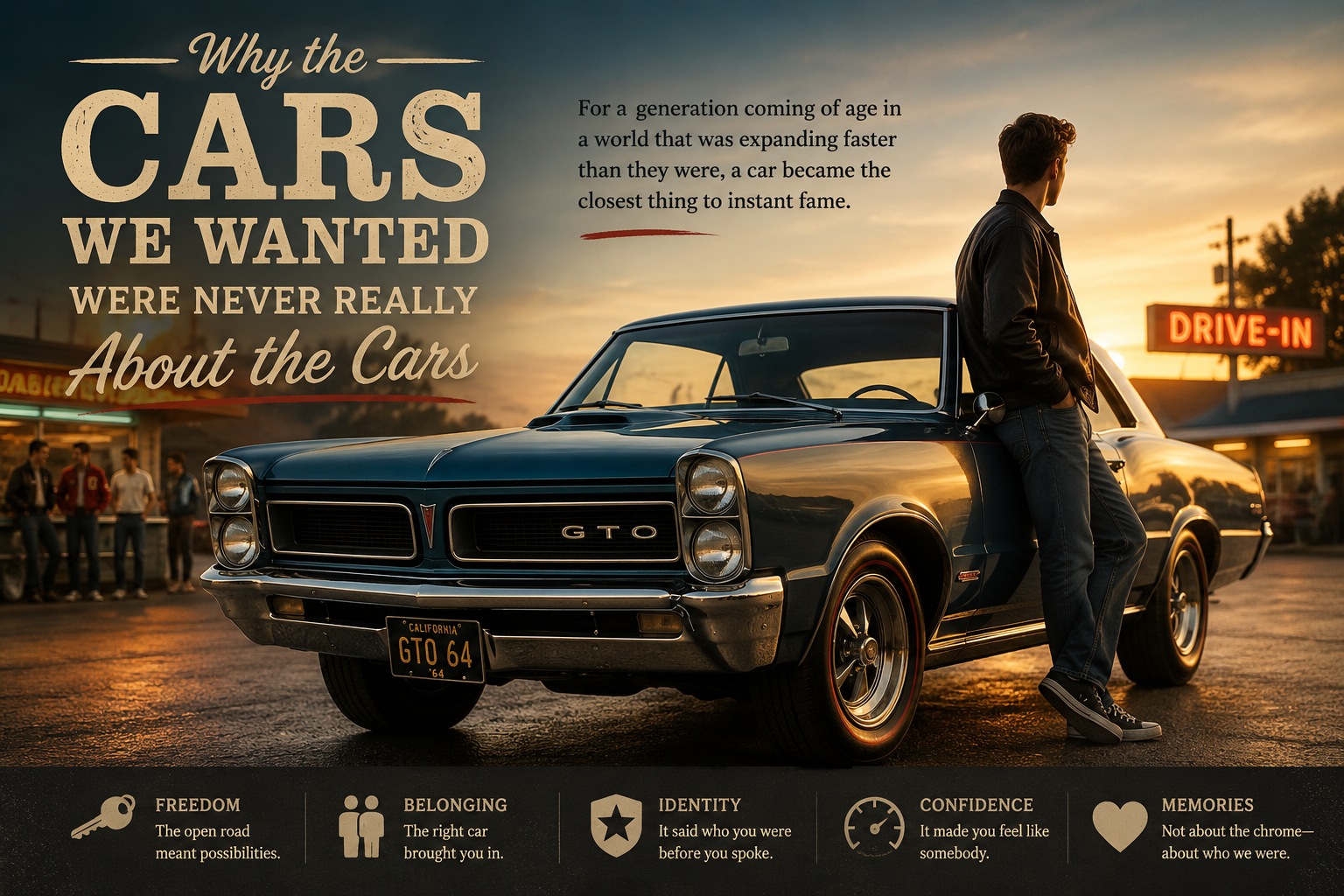
For young men coming of age in the 1950s and 1960s, a car was rarely just a machine.
It was freedom. Status. Independence. Sometimes it was confidence on four wheels.
The right car didn't simply get you around town. It announced something about you before you ever stepped out of it. In the small world of high school parking lots, drive-ins, dates, and weekend cruising, cars became a kind of social currency.
With the right engine rumble and enough shine, you sat a little taller behind the wheel. People noticed. You weren't just driving somewhere. You were making an entrance.
And Then There Was the GTO
For many of us, few cars captured that feeling better than the Pontiac GTO.
GTO stood for Gran Turismo Omologato, a name borrowed from European racing terminology. But you didn't need to understand the Italian to understand what the car represented.
If you had a GTO, you weren't merely cool. You had arrived.
There was something almost mythic about it. The sound, the power, the styling and the reputation all said something about the person behind the wheel. Today we might describe the GTO as the G.O.A.T., the Greatest of All Time.
Back then, there were no followers, likes, or social-media profiles announcing who you were. Sometimes your car did the announcing for you.
But looking back after all these years, I don't think the desire was ever really about the car.
We Were Trying to Say Who We Were
When you're young, identity isn't completely settled. Much of it is still being constructed.
We look for ways to show other people who we are, or perhaps who we hope to become. Clothes can do that. Music can do it. The people we spend time with can do it.
And cars certainly did it.
A car could say you were successful before you'd accomplished very much. It could make you feel independent while you were still figuring out what independence meant. It could give you confidence before you'd developed enough experience to find that confidence within yourself.
Most of all, it could help you belong.
That's easy to dismiss as youthful vanity when viewed from decades later. I don't think that's quite fair.
The desire to belong doesn't disappear when we grow older. Neither does the desire to be noticed, respected, admired, or understood. We simply find different ways to express it.
The object changes. The human need doesn't.
For one generation it was a GTO. For another it might be a particular pair of shoes, a phone, a house, a job title, a vacation destination, or the image presented on social media.
We attach meaning to things because sometimes things become shorthand for something much harder to express:
This is who I am.
Or perhaps more accurately:
This is who I want you to think I am.
Why Do We Still Remember?
That's what makes memories of those cars interesting to me now.
Decades later, why can someone remember the color of a car, the sound of its engine, the feel of the steering wheel, or exactly where it was parked on a particular night when thousands of other details from the same period have disappeared?
Maybe we're not really remembering the car.
We're remembering ourselves.
We're remembering the person who wanted that car. The friendships surrounding it. The places we went. The people we hoped would notice us. The confidence we felt when they did.
The chrome and horsepower became attached to something much more durable: identity.
And memory has an interesting way of preserving objects that become connected to important periods in our lives. An old photograph, a song, a house, a piece of furniture, or a car can suddenly carry far more meaning than the physical object should reasonably possess.
That's because the object has become a doorway.
Walk through it and an earlier version of ourselves is waiting on the other side.
The Car Eventually Disappears. The Meaning Doesn't.
Most of the cars we once desperately wanted are gone now. Some were sold. Some wore out. Some became collectors' items worth far more money than anyone imagined at the time.
But their real value to us was never determined by what they eventually sold for.
Their value was in what they represented when we were young enough to believe that owning the right thing might somehow transform us into the person we wanted to become.
Age gives us a different perspective.
We eventually discover that confidence doesn't come with the keys. Belonging can't really be purchased. Identity takes much longer to build than it takes to buy a car.
But that doesn't make those youthful desires meaningless.
Quite the opposite.
They tell us something about who we were becoming.
And maybe that's why memories of those cars still linger after so many other things have faded. We aren't remembering the chrome.
We're remembering who we were when it mattered.
When the Heart Leads: Kindness, Action, and Living Without Regret

Following your heart isn’t about chasing emotion or ignoring reason. It’s about paying attention to the part of you that knows when something feels true, even before you can explain why. We often try to talk ourselves into or out of choices, but the moment emotion begins steering our reasoning, that’s usually the heart speaking quietly, but clearly.
Listening to the heart doesn’t always guarantee success in the traditional sense. It may not lead to more money, more recognition, or more comfort. But not listening to it almost always carries a cost. That cost shows up later as regret, or as a faint sense that we lived slightly out of alignment with who we were meant to be.
Kindness works the same way.
It’s rarely the result of a purely intellectual decision. Real kindness comes from something more profound, from the heart, pushing us toward action instead of hesitation. Doing nothing isn’t neutral. In many moments, silence or inaction can wound more than we realize. And sometimes, even well-intended action can feel cold when it’s done without heart.
So we’re left with an uncomfortable question: Are humans naturally kind? Or do we become kind only when we choose to act from the heart?
When we respond from that deeper place, we aren’t rising above our humanity, we’re stepping fully into it. Kindness isn’t something extra we add to our lives; it’s something that reveals who we already are at our best.
A few voices have said this more elegantly than most of us can:
“The heart has its reasons of which reason knows nothing.” — Blaise Pascal
“Kindness is the language which the deaf can hear, and the blind can see.” — Mark Twain
“Indifference and neglect often do much more damage than outright dislike.” — J.K. Rowling
“We are made kind by being kind.” — Eric Hoffer
“My religion is kindness.” — Dalai Lama
At the end of the day, following your heart and practicing kindness are not separate choices—they’re part of the same way of living. One guides the other. One strengthens the other. And both help us become the kind of person we won’t regret being.
The Power of Gratitude: A Reflective Nonfiction Perspective

Gratitude is more than a feeling. It’s a practical way of seeing the world that invites us to pause, notice, and appreciate what’s already meaningful in our lives. When we slow down long enough to recognize the people, moments, and experiences that support us, something in us shifts.
Gratitude doesn’t erase difficulties, but it helps balance them. As psychologist Dr. Guy Winch notes, gratitude grounds us, especially in times of uncertainty. It softens negative thinking and reminds us that life is a mix of challenge and goodness.
Gratitude also reconnects us with others. It strengthens relationships, encourages compassion, and gives us healthier reasons to grow. When our motivation comes from fear or comparison, we burn out quickly. When it comes from gratitude, our efforts feel steadier and more sustainable.
Seen this way, gratitude becomes a soft skill — one that can transform how we understand ourselves and the world around us. And often, it’s the small practice of noticing what we already have that makes the most significant difference.
The Human Side of Leadership →

Leadership isn’t a job title or a personality type. It’s the quiet ability to influence, guide, and elevate the people you encounter, coworkers, friends, teams, or communities. Real leadership strengthens connection, clarifies direction, and creates momentum.
Strong plans attract people who genuinely want to help, but leadership is never a solo pursuit. It’s the art of inspiring others so that shared goals feel possible and meaningful.
This sub-section under the Life Development tag explores leadership from a human-centered perspective, less about command and control, and more about awareness, empathy, and growth.”
Core Leadership Characteristics
Integrity — Doing what’s right, even when it’s inconvenient.
Delegation — Trusting others with responsibility and room to grow.
Communication — Speaking clearly, listening fully, and creating understanding.
Self-Awareness — Knowing your strengths, limits, patterns, and impact.
Gratitude — Recognizing contributions and reinforcing what matters.
Learning Agility — Adapting, improving, and staying open to new ideas.
Influence — Guiding others through credibility and example, not pressure.
Empathy — Seeing the human side of every decision.
Leadership is the steady act of helping others see what’s possible and walking toward it with them.
Gratitude proceeds happiness and it is required if we want to achieve it →
Gratitude is the quality of being thankful. It results in being willing and ready to show appreciation for and to return kindness. It brings a warm feeling of thankfulness towards the world or specific individuals. The person who feels gratitude is thankful for what they have received and does not constantly seek more.
Gratitude helps people feel more positive emotions, feel more alive, express more compassion, relish good experiences, improve their health, deal with adversity, and build strong relationships.
We will still have negative thoughts, but gratitude will help balance them out. “Gratitude is an emotion that grounds us and is a great way to balance out the negative mindset that uncertainty engenders,” said Dr. Guy Winch, author of the book Emotional First Aid.
The process of feeling grateful compels us to reflect on our relationships. It makes us feel closer and more connected to others, which helps motivate and sustain our efforts at self-improvement. We won’t be able to maintain our efforts for self-improvement without the help of others, and we will fail when we have the wrong motivation. When we're motivated by negative emotions, it is nearly impossible to sustain efforts to change. Is gratitude a soft skill?
Ask a person who is not grateful for the good things in their life, and you will find an unhappy person, but if you teach yourself or that person to understand and learn gratitude, it will become a life-changing soft skill.
“Gratitude turns what we have into enough.” – Anonymous.
The duties of the Coxswain are to provide leadership →
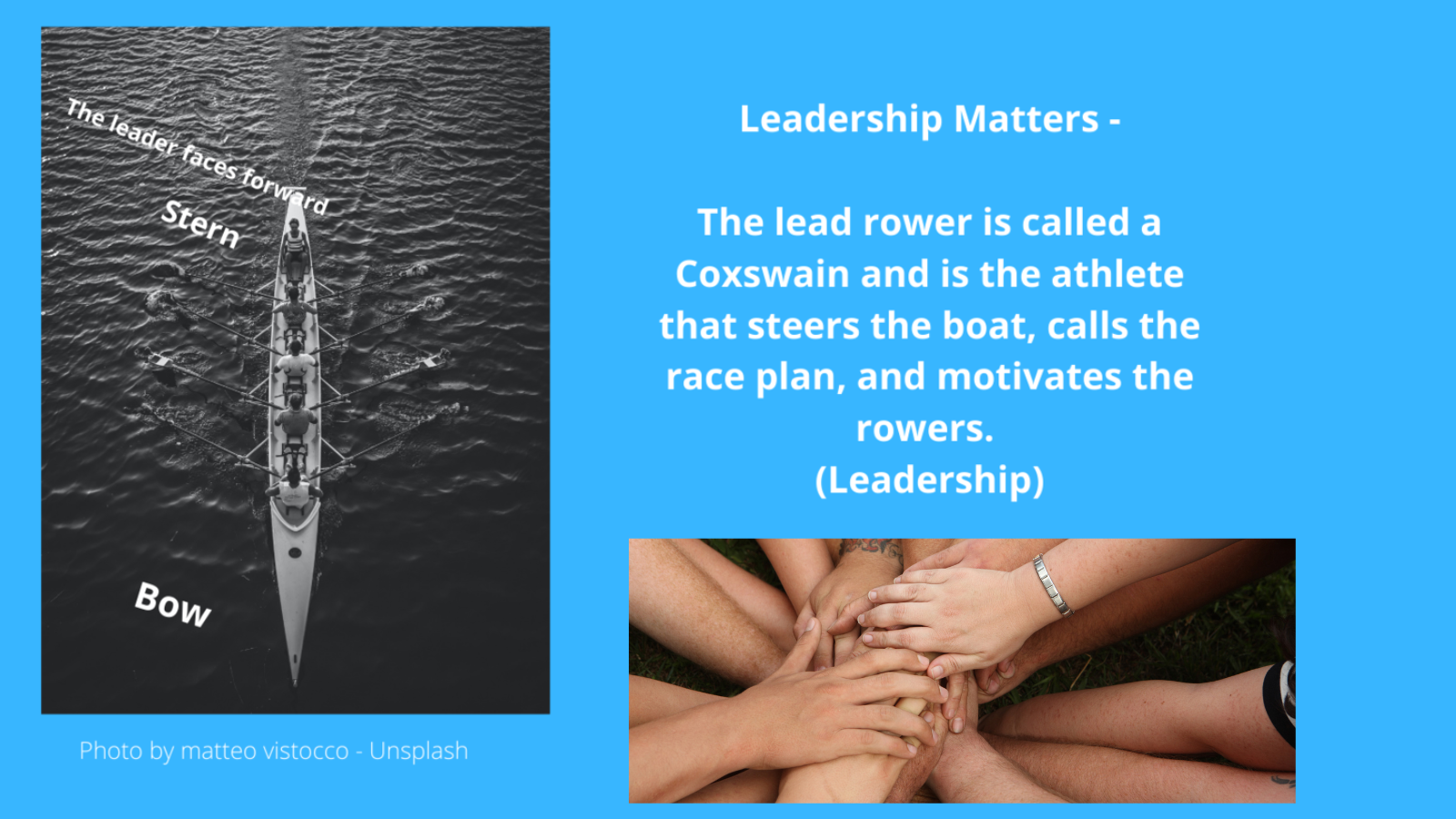
The end of the boat closest to the start line is called the “stern,” and the opposite end pointing toward the finish line is called the “bow.” Coincidentally, the rower closest to the boat’s bow is called the “bow seat.” The seats are numbered from bow to stern, and the bow seat is called the “1 seat.
The leader sits in the stern and is called a Coxswain and is the athlete that steers the boat, calls the race plan, and motivates the rowers. Driving the vessel is done by making minor corrections in the rudder’s direction and ensuring all rowers are equally engaged.
Each rower is numbered by boat position in ascending order from the bow to the stern (except single sculls).
The stroke seat is the most important of the eight rowers. That individual can get everyone behind them and the engine room in a solid rhythm and get them to use their power efficiently. They also have a significant impact on the mentality of the boat.
In an eight-rower boat, each person has one oar—four on port and four on starboard. If one side pulls harder with their oars in the water than the other, the boat turns and tips. The boat tips if one side's oars are raised higher than the other. Every paddler has to drop into the water at the same time.
Self Improvement individually is likely not the key to success for a team; instead, team leadership has more potential value. If one person surprises the others, thinking they are only indulging in self-improvement, they can hurt the team, but the leader can direct coordinated improvement.
Being overwhelmed with stress is a message to find out why you are stressed? →
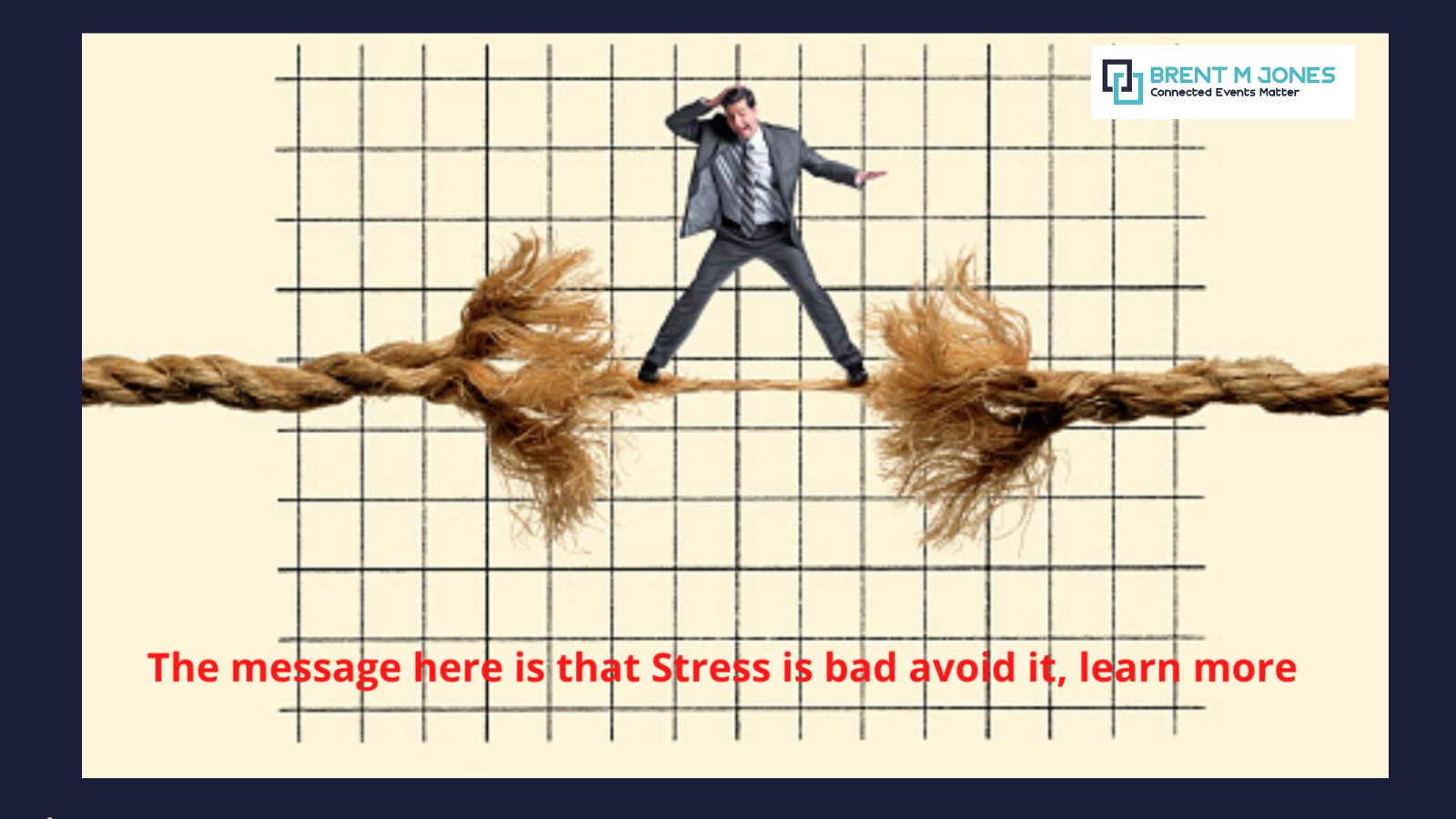
When you feel pressure, your body will send you a message and let you know. The message is referred to as stress. The pressure comes in a variety of ways. Feeling overwhelmed and unable to cope with life events is felt emotionally or even in your physical responses. You will think you can’t cope with what you are facing, and mental health suffers.
Many different situations or life events can cause stress. It can be triggered when we experience somethingnew unexpectede, threatens our sense of self, o feel we have little control over a situation.
Feelings of Stress Include:
afraid
angry
aggressive
sad
Anxious
defensive
irritable
frustrated
depressed.
Recognizing that stress is being caused by pressure is a first step in working through it, but sometimes you will need help to get past it.
Don’t be a Pig (selfish): Pigs get Eaten →

It can send a terrible message if you only feel satisfied if you get everything available in a relationship. Be careful not to send a message to those around you that you’re selfish. This is a trap everyone can fall into.
A salesperson with a perfect relationship with a buyer sometimes will ask for business he doesn’t have, with no apparent benefit offered. It can appear to suggest it is just expected because of the relationship. In a similiar situation, I recall a buyer who told this type of salesman:
“Don’t be a pig: pigs get eaten.”
Our selfishness can mean we hurt others as we ruthlessly strive to satisfy our needs. Self-centeredness can damage our reputation and lead to loneliness. It destroys families. Desire may make it easier for us to fall into traps like an addiction.
Solitude can lead to relaxation and reduced stress →
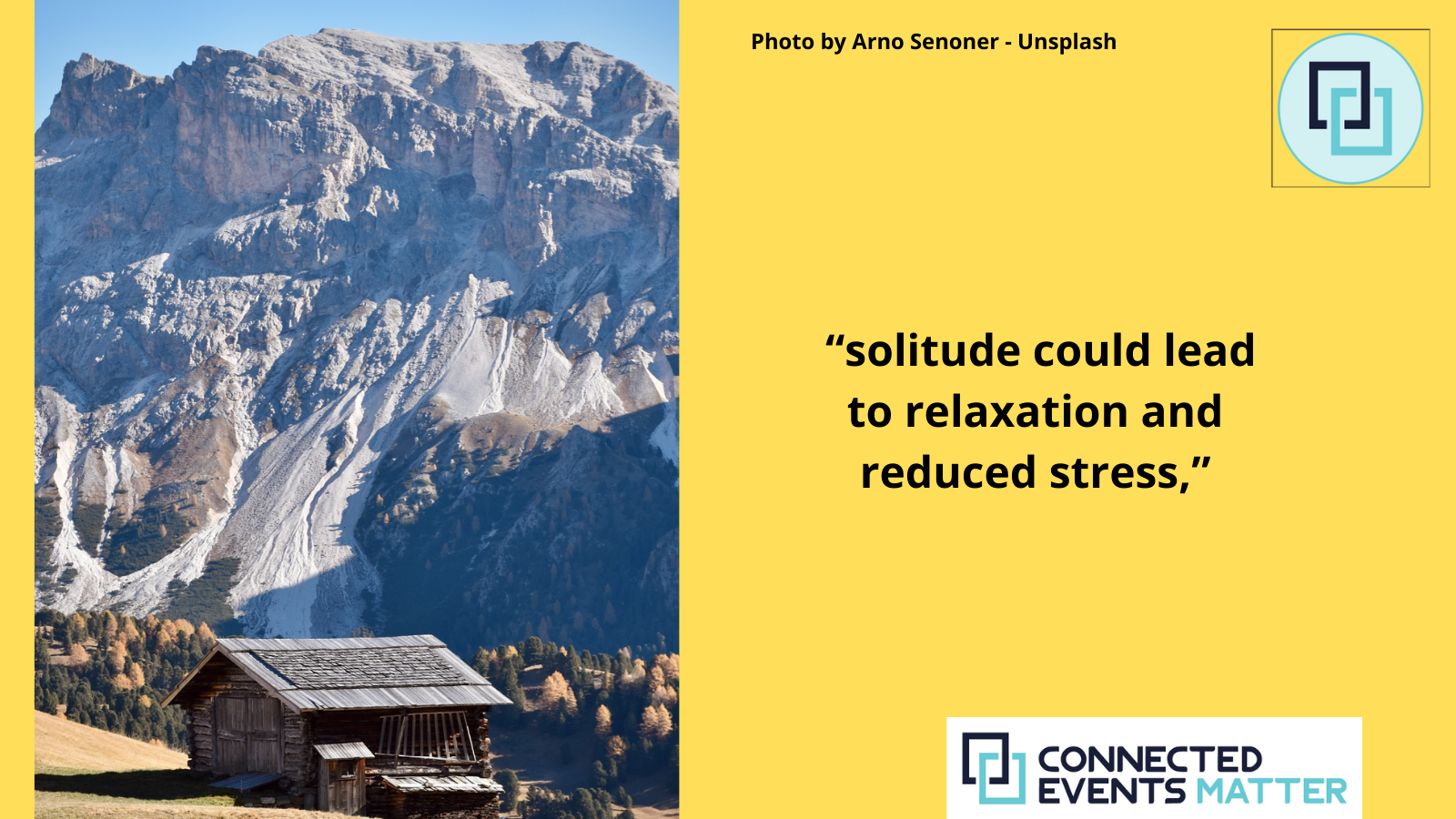
Solitude can lead to relaxation and reduced stress if people choose to be alone. Solitude is the state of being alone without being lonely. Ten minutes a day might be enough to help stress. Living alone in a cabin at the foot of a remote mountain might be too much? ,
“Solitude could lead to relaxation and reduced stress,” a study found, and people who practiced solitude every day for a week experienced a “spillover effect” of having less intense feelings the following week.
Jim Carrey said: “Solitude is dangerous. It's very addictive. It becomes a habit after you realize how calm and peaceful it is. You don’t want to deal with people anymore because they drain your energy.

Nature offers some of the best stress reducing experiences →

Spending time around trees and looking at trees reduces stress, lowers blood pressure, and improves mood. Numerous studies show that exercising in forests and simply sitting looking at trees reduces blood pressure and the stress-related hormones cortisol and adrenaline.
In general, the outdoors has a calming effect on us, and it has to do with the fresh air we're inhaling. Breathing is linked to the production of stress hormones. When breathing rapidly, our sympathetic nervous system is activated, and the body is energized for a "fight or flight" response.
What you are seeing, hearing, and experiencing at any moment changes your mood and how your nervous, endocrine, and immune systems are working.

How do you learn good work ethics and how do you convey that you have them? →

Work ethic is a moral principle based on the idea that hard work is fundamentally valuable and worth pursuing. You likely possess other positive traits such as dependability, respectfulness, productivity, and collaboration if you have a strong work ethic.
Work ethics is one of the most critical factors for any professional's success and is a highly positive soft skill. Learning to have a positive work ethic by having good examples and leaders is the primary way it is developed, even though there is some evidence that it may be partially past on by genetics.
Work ethic is an essential Soft Skill based on hard work and diligence. In other words, work ethic is, for the most part, not something we are born with; it’s a learned behavior that becomes part of an individual's values. Like a company's corporate values, they must be taught and modeled daily.
Saying that your father had a good work ethic could mean that you had it passed on to you genetically, but it probably means that by example, at least, your father taught you about work ethics. Of course, talking about your genetic possibility of having a solid work ethic isn’t a good approach in a job interview.
If you find the occasion to talk about your work ethic, a good approach would be to describe yourself as reliable and consistent. You could add that you enjoy your work, and I find it easy to stay motivated and productive. You have also noticed that you feel better at the end of the day when you have had a great, productive day, and you find that I am that rewarding.

,
What you do today changes who you are tomorrow. →

Deciding to “Be Somebody” will require introspection to discover who you are. Just taking inventory and doing some severe pondering is a good starting point to find out what you are good at and not good at. Don’t confuse your point of view and conclusions with other people's expectations. Finding out who we are means asking ourselves what our values are, what truly matters to us, and then following the principles we believe in.
Build a list and add the things you are passionate about and the things you love to do. Ask someone you trust and respect for feedback on what you have put down. These are the first steps in knowing who you are, and learning what you want from life is itself part of what real success in life is. Knowing yourself will give you purpose, direction, and a true sense of well-being; that knowledge will change some of the things you do today.
Change anything about today, and you will change tomorrow and your life.
Change who you associate with. Surround yourself with people who will tell you the truth.
7 Ways to Increase Self Esteem and Self Confidence →

Having the confidence to proceed in life requires more than just preparation. Of course, that is very important, but you must believe in yourself to value your practice and take the necessary steps.
7 Ways to Increase Self-Esteem and Self Confidence
1. Volunteering your time, money, or energy to help others doesn’t just improve the world but also makes you better. Studies indicate that the very act of giving back to the community boosts your happiness, health, and sense of well-being
2. Avoid dwelling on past negative experiences
3. Express your needs
4. Feel confident
5. Have a positive outlook on life
6. Say "no" when you want to say no.
7. See overall strengths and weaknesses and accept them

2 Most Important Skills for Success →

These skills can be called “Soft Skills,” but they are the most important and often neglected. A person can have many other skills, but these are important.
#1 is showing up!
#2 is showing up on time