Exploring the unexpected connections that shape our lives
Book Reviews, Comments & Stories, Quotes, & Poetry & More
"Connections and Why They Matter"
Most of what happens in our life will spark a connection. Life connects with what has been found in books. Books connect with what happens in life. Use the connections to help you see more clearly. A love of reading and writing is what motivated the creation of this blog. Thank you for coming to the blog.
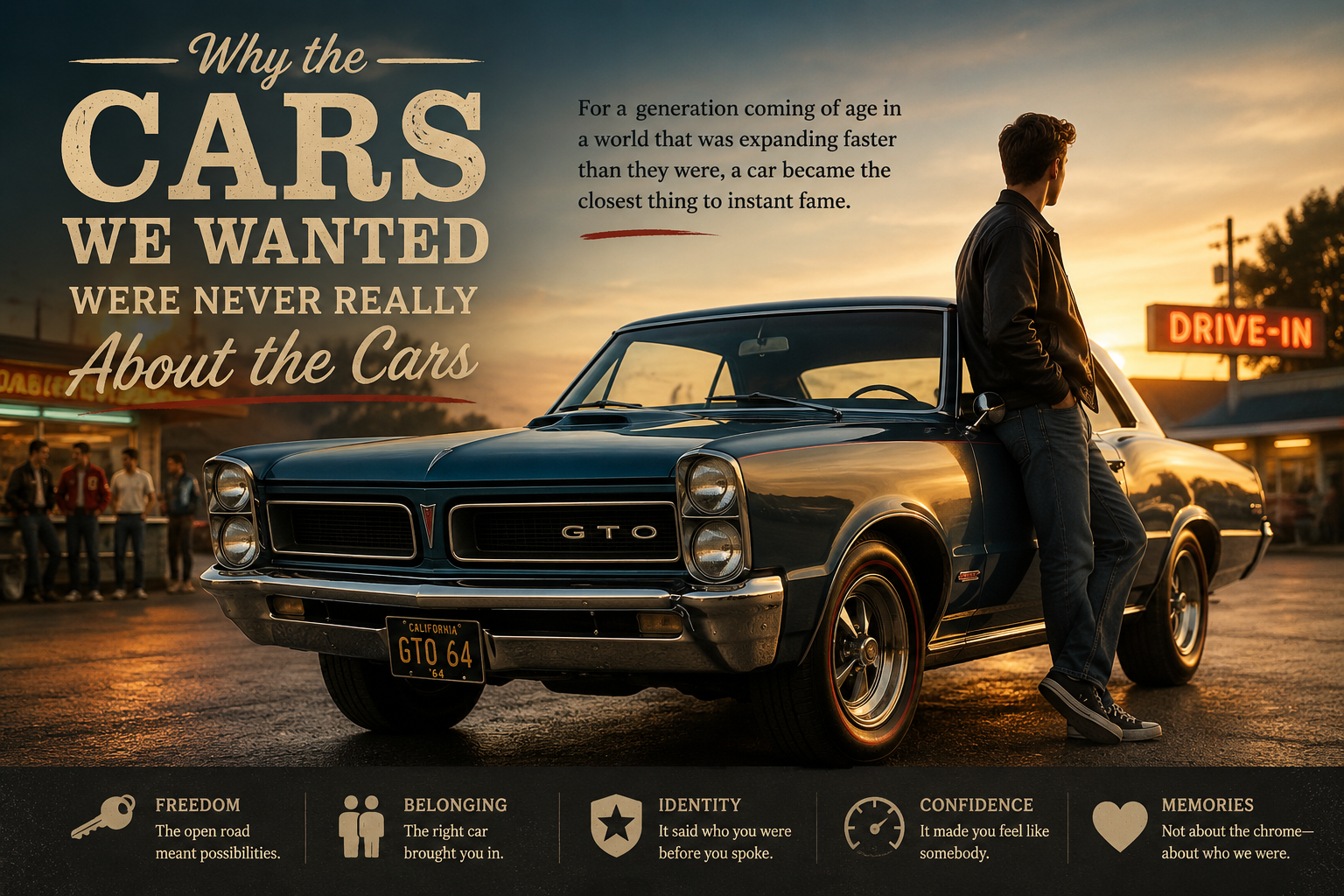
For young men coming of age in the 1950s and 1960s, a car was rarely just a machine.
It was freedom. Status. Independence. Sometimes it was confidence on four wheels.
The right car didn't simply get you around town. It announced something about you before you ever stepped out of it. In the small world of high school parking lots, drive-ins, dates, and weekend cruising, cars became a kind of social currency.
With the right engine rumble and enough shine, you sat a little taller behind the wheel. People noticed. You weren't just driving somewhere. You were making an entrance.
And Then There Was the GTO
For many of us, few cars captured that feeling better than the Pontiac GTO.
GTO stood for Gran Turismo Omologato, a name borrowed from European racing terminology. But you didn't need to understand the Italian to understand what the car represented.
If you had a GTO, you weren't merely cool. You had arrived.
There was something almost mythic about it. The sound, the power, the styling and the reputation all said something about the person behind the wheel. Today we might describe the GTO as the G.O.A.T., the Greatest of All Time.
Back then, there were no followers, likes, or social-media profiles announcing who you were. Sometimes your car did the announcing for you.
But looking back after all these years, I don't think the desire was ever really about the car.
We Were Trying to Say Who We Were
When you're young, identity isn't completely settled. Much of it is still being constructed.
We look for ways to show other people who we are, or perhaps who we hope to become. Clothes can do that. Music can do it. The people we spend time with can do it.
And cars certainly did it.
A car could say you were successful before you'd accomplished very much. It could make you feel independent while you were still figuring out what independence meant. It could give you confidence before you'd developed enough experience to find that confidence within yourself.
Most of all, it could help you belong.
That's easy to dismiss as youthful vanity when viewed from decades later. I don't think that's quite fair.
The desire to belong doesn't disappear when we grow older. Neither does the desire to be noticed, respected, admired, or understood. We simply find different ways to express it.
The object changes. The human need doesn't.
For one generation it was a GTO. For another it might be a particular pair of shoes, a phone, a house, a job title, a vacation destination, or the image presented on social media.
We attach meaning to things because sometimes things become shorthand for something much harder to express:
This is who I am.
Or perhaps more accurately:
This is who I want you to think I am.
Why Do We Still Remember?
That's what makes memories of those cars interesting to me now.
Decades later, why can someone remember the color of a car, the sound of its engine, the feel of the steering wheel, or exactly where it was parked on a particular night when thousands of other details from the same period have disappeared?
Maybe we're not really remembering the car.
We're remembering ourselves.
We're remembering the person who wanted that car. The friendships surrounding it. The places we went. The people we hoped would notice us. The confidence we felt when they did.
The chrome and horsepower became attached to something much more durable: identity.
And memory has an interesting way of preserving objects that become connected to important periods in our lives. An old photograph, a song, a house, a piece of furniture, or a car can suddenly carry far more meaning than the physical object should reasonably possess.
That's because the object has become a doorway.
Walk through it and an earlier version of ourselves is waiting on the other side.
The Car Eventually Disappears. The Meaning Doesn't.
Most of the cars we once desperately wanted are gone now. Some were sold. Some wore out. Some became collectors' items worth far more money than anyone imagined at the time.
But their real value to us was never determined by what they eventually sold for.
Their value was in what they represented when we were young enough to believe that owning the right thing might somehow transform us into the person we wanted to become.
Age gives us a different perspective.
We eventually discover that confidence doesn't come with the keys. Belonging can't really be purchased. Identity takes much longer to build than it takes to buy a car.
But that doesn't make those youthful desires meaningless.
Quite the opposite.
They tell us something about who we were becoming.
And maybe that's why memories of those cars still linger after so many other things have faded. We aren't remembering the chrome.