When is something good enough?
When should we keep working until it becomes excellent?
And when does the pursuit of perfection stop serving the work and begin serving something in ourselves?
I used to think the distinction was fairly simple.
When your contribution is “good enough,” you recognize that it is part of a larger goal. It supports the plan and the other people working toward the same purpose.
When your contribution is “excellent,” you recognize that the quality of your work matters. You want it to stand on its own and strengthen whatever larger purpose it serves.
But perfection is more complicated.
I once thought that pursuing perfection usually meant spending too much time on one part of a larger effort. One person’s insistence on flawless work could delay everyone else, disrupt the larger project, or draw too much attention to one contribution.
I still think that can happen.
But I am no longer sure that the desire for perfection is itself the problem.
There are times when extraordinary care matters. Some work deserves another revision, another examination, another attempt to make it better. A person who takes deep pride in what they do may achieve something that would never have been possible if they had settled for “good enough.”
So perhaps the better question is not whether perfection is good or bad.
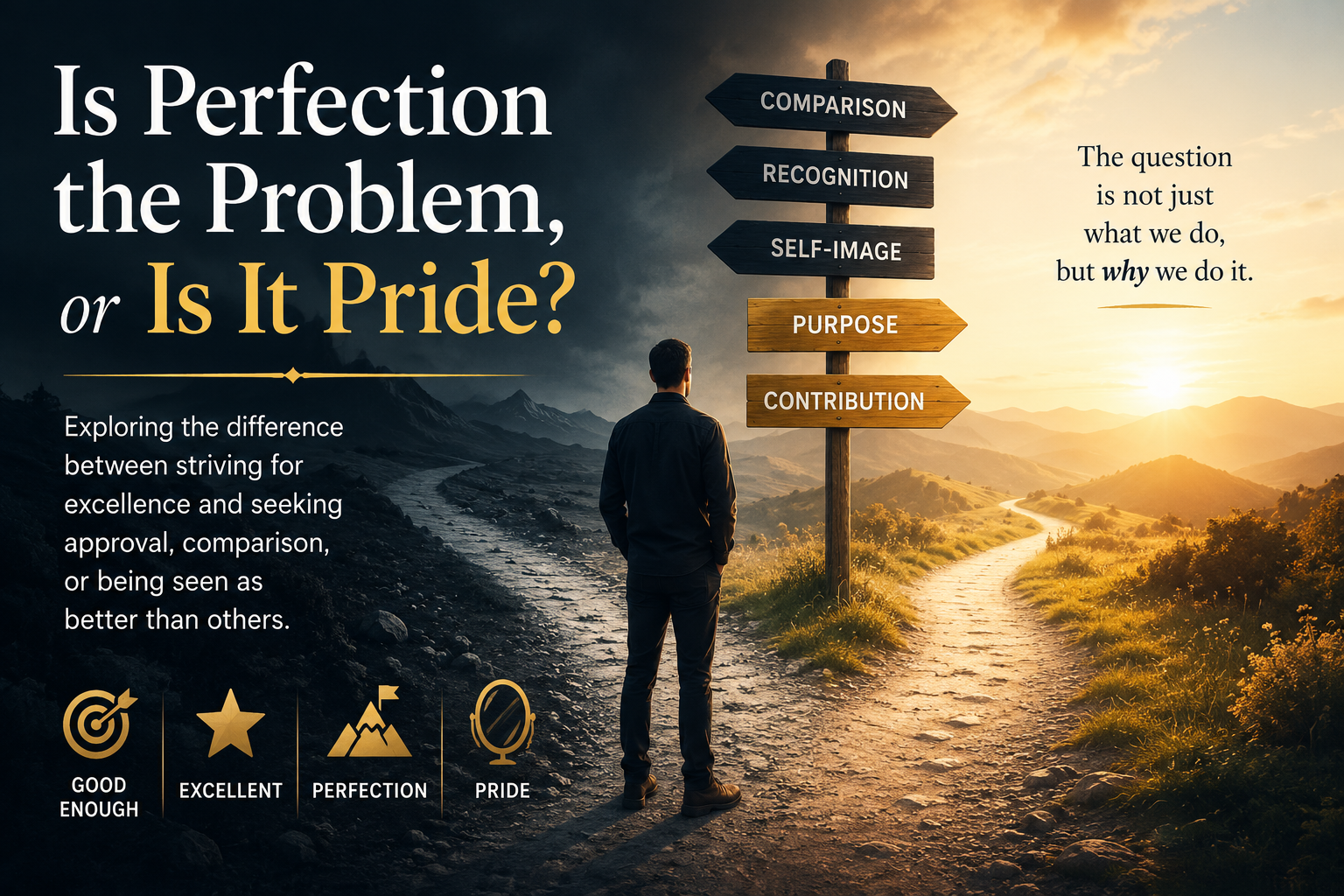
Perhaps the question is: What is driving us toward it?
Pride can be a powerful motive.
But pride itself has more than one face.
There is the pride of doing something as well as we are capable of doing it. That kind of pride can produce discipline, patience, persistence, and excellence. It can keep us working after others might have stopped.
Then there is the pride that depends on comparison.
C. S. Lewis wrote, “Pride gets no pleasure out of having something, only out of having more of it than the next man.”
That is a different motive.
We may tell ourselves we are pursuing excellence when what we really want is recognition. We may continue polishing the work not because it needs improvement, but because we need it to prove something about us.
The work is no longer enough.
We need to be noticed for it.
We need our contribution to stand above the contributions of others.
We need perfection not because the project requires it, but because our self-image does.
That may be where the pursuit of perfection becomes dangerous.
The difference between excellence and unhealthy perfectionism may not be found in the quality of the result. It may be found in the motive behind the effort.
Am I still improving this because the work needs it?
Or because I need something from the work?
Am I trying to make the whole project better?
Or am I trying to make my part of it impossible to overlook?
Am I contributing?
Or am I competing?
These questions become especially important when our work is part of something larger.
If a project depends on many people, the purpose of our contribution should be to strengthen the whole. Excellence should lift the efforts of others, not diminish them. Our desire to make one part flawless should not prevent the larger work from moving forward.
But there are also times when the work points directly to us.
A book. A painting. A performance. A piece of craftsmanship. A decision for which we alone are responsible.
In those moments, the pursuit of perfection may not be prideful at all. It may be an expression of respect for the work, gratitude for our abilities, or a refusal to give less than we know we can give.
And perhaps some pride is necessary.
Without pride in our work, would we care enough to keep improving it?
Without the belief that what we do matters, would we push beyond adequacy toward excellence?
The problem may not be pride itself.
The problem may be what we ask pride to do for us.
Healthy pride says, “I want to do this as well as I can.”
Unhealthy pride says, “I need this to prove that I am better.”
One serves the work.
The other eventually makes the work serve us.
So the choice may not be between good enough, excellence, and perfection.
The more revealing question may be why we need the work to be perfect.
Sometimes the answer will tell us to stop.
Sometimes it will tell us to keep going.