G-7NDSD6WRGQ
  • Home |
  • Signature Essays |
    • Reflective Non-Fiction
    • Personal Reflections & Influences
    • Life Meaning & Presence
    • Authenticity Matters
    • About Attitudes & Feelings
    • Alignment & Self Understanding
    • Creativity and Meaning
    • Influence, Persuasion & Manipulation
    • Finding Inspiration
    • Kindness & Doing Good
    • About Positivity
    • The Stories We Tell Ourselves
    • Personal Reinvention
    • Well-Being Over Time
    • Literature & Meaning
    • Essays & Reflections
    • Philosophy & Meaning
    • Poetry Why it Matters
    • Poetry by Brent M. Jones
    • Poetry Favorites Reviewed
    • Art, Imagery & Reviews
    • Visual Essays
    • Writers Who Shaped How I Think
    • Writer Symbolism
    • Thoughts & Quotes
    • What Matters: We Are the Sum of Small Moments
    • The Power of Authentic Communication: In a World Full of Noise, Authentic Communication Stands Out
    • The Human Factor: Discover Yourself, Clarify Your Purpose, Create Work That Matters
    • Finding the Best Version of Ourselves: The Interview of Self
    • Terminology Is More Than Words
    • Embrace Life’s Randomness: Path to Personal Reinvention
    • Why Life Stories Change Are We a Result of Choice or Circumstance
    • Why Professionals Use LinkedIn
    • Networking With a Purpose: The Informational Interview, It's Use ...................l
    • Work Matters It takes Technology..
    • Philosophers are Self Help Authors
    • Interviewing Yourself and Asking The Right Questions
    • Earlier Edition - The Human Factor
    • Earlier Edition: Work Matters
    • Praise and Reader Reviews
    • Book Reviews
    • Book Review Index A-Z
    • Contact Information
    • Communication
    • Human Connection & Communication
    • Change & Trends
    • Career -Insights
    • Coaching & Mentoring
    • Soft Skills
    • Work & Careers
    • Employment Trends & Thoughts
    • Interviews & Resumes
    • Platforms & Visibility
    • Informational Interviews
    • Marketing - Publishing
    • Jobs
  • Guest Posts
    • About Page
    • “Copyright & Content Use”
Menu

Brent M. Jones - Connected Events Matter

11400 W Olympic Blvd Ste 200
Los Angeles, CA 90064-1584
Phone Number
Exploring the unexpected connections that shape our lives


Book Reviews, Comments & Stories,       Quotes, & Poetry & More


"Connections and Why They Matter"


Most of what happens in our life will spark a connection.  Life connects with what has been found in books. Books connect with what happens in life. Use the connections to help you see more clearly. A love of reading and writing is what motivated the creation of this blog. Thank you for coming to the blog. 


3


ff


Th

Brent M. Jones - Connected Events Matter

  • Home |
  • Signature Essays |
  • Reflective |
    • Reflective Non-Fiction
    • Personal Reflections & Influences
    • Life Meaning & Presence
    • Authenticity Matters
    • About Attitudes & Feelings
    • Alignment & Self Understanding
    • Creativity and Meaning
    • Influence, Persuasion & Manipulation
    • Finding Inspiration
    • Kindness & Doing Good
    • About Positivity
    • The Stories We Tell Ourselves
    • Personal Reinvention
    • Well-Being Over Time
  • Literary |
    • Literature & Meaning
    • Essays & Reflections
    • Philosophy & Meaning
    • Poetry Why it Matters
    • Poetry by Brent M. Jones
    • Poetry Favorites Reviewed
    • Art, Imagery & Reviews
    • Visual Essays
    • Writers Who Shaped How I Think
    • Writer Symbolism
  • Thoughts |
    • Thoughts & Quotes
  • My-Books |
    • What Matters: We Are the Sum of Small Moments
    • The Power of Authentic Communication: In a World Full of Noise, Authentic Communication Stands Out
    • The Human Factor: Discover Yourself, Clarify Your Purpose, Create Work That Matters
    • Finding the Best Version of Ourselves: The Interview of Self
    • Terminology Is More Than Words
    • Embrace Life’s Randomness: Path to Personal Reinvention
    • Why Life Stories Change Are We a Result of Choice or Circumstance
    • Why Professionals Use LinkedIn
    • Networking With a Purpose: The Informational Interview, It's Use ...................l
    • Work Matters It takes Technology..
    • Philosophers are Self Help Authors
    • Interviewing Yourself and Asking The Right Questions
    • Earlier Edition - The Human Factor
    • Earlier Edition: Work Matters
    • Praise and Reader Reviews
  • Book-Reviews |
    • Book Reviews
    • Book Review Index A-Z
  • Substack |
    • Contact Information
  • Professional Insights |
    • Communication
    • Human Connection & Communication
    • Change & Trends
    • Career -Insights
    • Coaching & Mentoring
    • Soft Skills
    • Work & Careers
    • Employment Trends & Thoughts
    • Interviews & Resumes
    • Platforms & Visibility
    • Informational Interviews
    • Marketing - Publishing
    • Jobs
  • Guest Posts
  • About Brent M. Jones |
    • About Page
    • “Copyright & Content Use”
Add a subheading (5).png

.

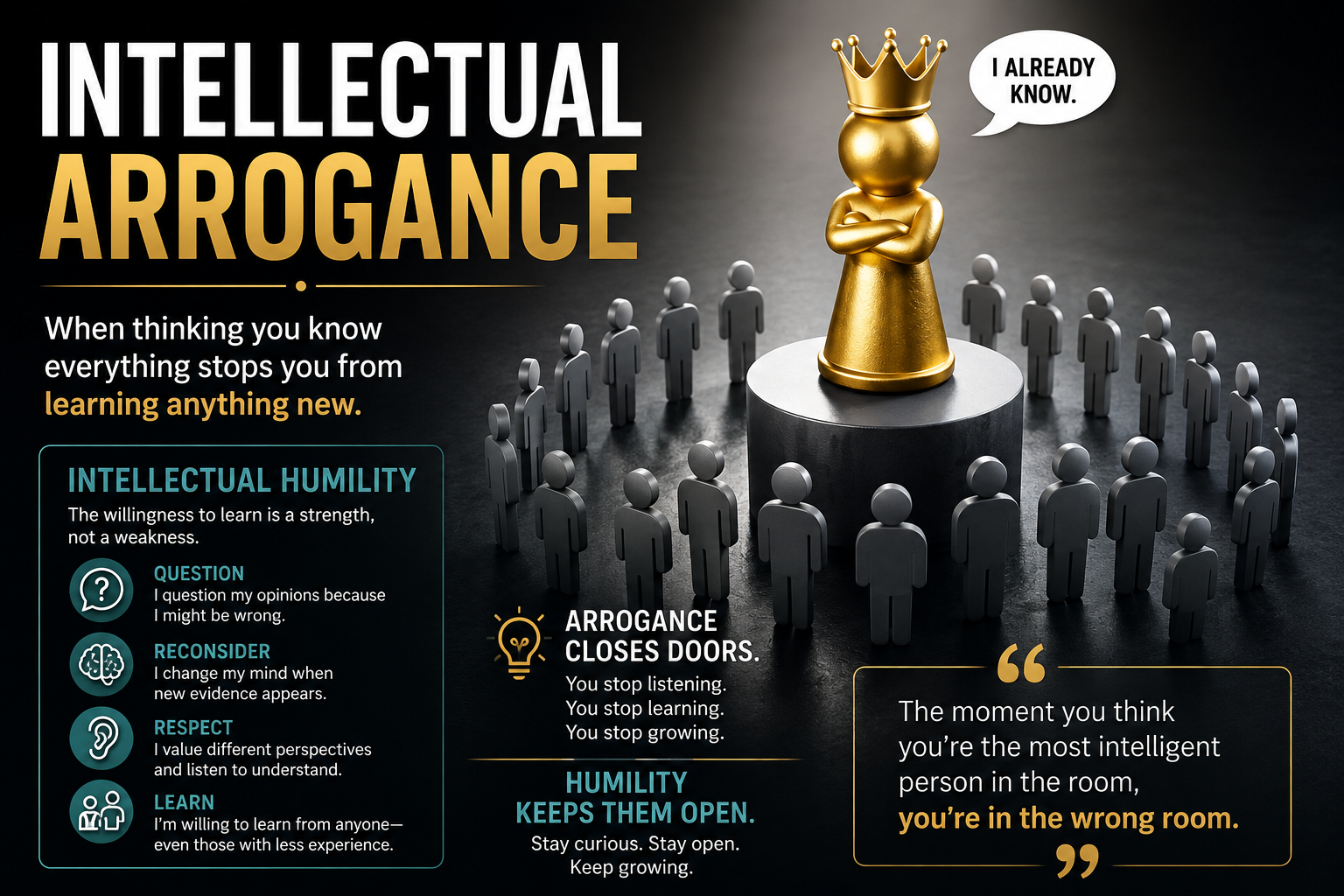
Intellectual Arrogance: When Being Smart Gets in the Way of Learning →

January 20, 2026 Brent Jones
. RSS

Intelligence can help us understand the world, solve problems, and make better decisions. But intelligence can also create a blind spot when we become too confident in what we already know.

Intellectual arrogance is the assumption that our knowledge, judgment, or perspective is superior enough that we no longer need to seriously consider what others might teach us.

The danger isn't simply appearing arrogant. It's becoming harder to teach.

When we're convinced we're right, contradictory information becomes easier to dismiss. We stop asking questions. We listen to respond rather than understand. Eventually, intelligence itself can become an obstacle to learning.

Intellectual Humility Is the Alternative

Intellectual humility begins with a simple recognition:

What I believe could be wrong.

That doesn't mean lacking confidence or constantly doubting yourself. It means recognizing the limits of your own knowledge and remaining willing to reconsider your conclusions when new information deserves consideration.

Our perspective will always be incomplete. No matter how much experience we have, someone else knows something we don't.

That person may be a colleague, an employee, a friend, or someone much younger and less experienced.

The question isn't whether they know more than we do about everything.

It's whether they know something we don't.

What Intellectual Humility Looks Like

Intellectual humility shows up in the way we think and respond to other people.

I can question my opinions because I recognize that they could be wrong.

I can reconsider a position when new evidence challenges it.

I can listen seriously to a viewpoint that differs from my own without immediately trying to defeat it.

I can distinguish between having experience and having all the answers.

And I can learn from someone younger or less experienced when that person has knowledge or skills I don't possess.

This last point is especially relevant in a world where technology and workplace practices change quickly. A younger colleague may have far less professional experience but understand a new technology, platform, or way of working far better than someone who has spent decades in the field.

Sometimes the student should become the teacher.

Intellectual Arrogance Can Hold You Back

The moment you believe you're better or smarter than everyone around you, you create a serious problem:

You no longer know what you don't know because you've stopped allowing other people to teach you.

Intellectual arrogance also damages relationships.

People generally don't enjoy conversations with someone whose primary objective is demonstrating how intelligent they are. Good relationships require curiosity about other people and respect for what they bring to the conversation.

The need to prove that you're the smartest person in the room can eventually leave you with fewer people willing to tell you when you're wrong.

That's particularly dangerous for leaders.

Experience Can Create Its Own Blind Spot

The more experienced we become, the easier it can be to confuse experience with certainty.

Experience has enormous value. It gives us context, pattern recognition, and lessons learned over many years.

But yesterday's experience doesn't automatically provide the answer to tomorrow's problem.

Circumstances change. Technology changes. People change. What worked before may no longer be the best approach.

That's why intellectual humility becomes more important, not less important, as our knowledge and experience grow.

The goal isn't to know less.

It's to remain teachable despite how much we already know.

Intelligence and Curiosity Work Better Together

The smartest people don't need to pretend they know everything.

They ask questions.

They seek out people who know things they don't.

They change their minds when the evidence warrants it.

They can say, I don't know.

And perhaps most importantly, they don't see learning from someone else as a threat to their intelligence.

Intellectual humility doesn't diminish what you know. It prevents what you know from becoming a barrier to what you could learn next.

The better question isn't:

Am I the smartest person in the room?

It's:

What can I learn from the other people in it?

see this related article - Do Your Attitudes Reflect Your Authentic Self?


In Life Stories, Personal Reinvention Tags Arrogance, Intellectual, Self-Awareness
Comment

How You See Yourself Changes Over Time

December 8, 2025 Brent Jones
. RSS

We tell the story of who we are by arranging the events of our lives into a narrative. The Atlantic once described this idea simply: how you shape the plot points of your life becomes a part of your identity. It is a fundamental part of being human.

Monisha Pasupathi, a developmental psychologist at the University of Utah, put it this way. To have relationships, we have to tell pieces of our story. Every introduction is a story we choose. Where we are from. Where we grew up. The paths that brought us to this moment.

Life stories show up in small places.
I once watched a salesperson greet people at the entrance of a store in a local mall. One woman smiled back, and they walked in together. The salesperson asked where she was from. The woman mentioned a town in California, and immediately they recognized streets and places they had both known. Their conversation deepened. They relaxed. A simple exchange of story created connection.

We see our lives as a series of events. We link those events together, and the story that emerges becomes part of our self-identity. But the story is not fixed. It changes every time we tell it.

For more than twenty years, I shared my life story with a group of men at church. I told it at least twenty times. It was never exactly the same. I added details, left out others, or shifted the meaning of certain moments. Each retelling reflected where I was in life at that time. New experiences changed how I understood the old ones.

I have watched the same thing happen with others. I heard dozens of men tell their stories, and then tell them again years later. The emphasis changed. Their conclusions changed. The way they understood their past changed. Their story grew as they grew.

Life stories are like books. They have characters, themes, turning points, and chapters. We choose what matters and what belongs in the narrative. Over time we shape and reshape these pieces, and the story becomes part of how we understand ourselves.

People play roles in our story too. Some stay for a season. Some for a lifetime. Some appear only briefly but leave an influence that lasts. As we age, the importance of certain people shifts. We see them differently when we look back through the lens of memory.

Books, art, music, heritage, and even the places we lived can become woven into our personal story. They stay with us and help us understand the world and our place in it.

There is an old saying that people come into our lives for a reason, a season, or a lifetime. Whether we see this through faith, chance, or circumstance, the idea remains the same. We are shaped by the people and events we encounter.

I believe we have choice in how we put the pieces together. We can decide how to interpret our experiences and what meaning to take from them. We can revisit old moments and see them with new clarity. A better perspective can change the story, and by changing the story, we change ourselves.

Some people argue for a deterministic view of identity. They say we are the product of our genes, our parents, and the circumstances we did not choose. But this view does not tell the whole story.

All you need to do is tell your story today, then tell it again a year from now. You will see it differently. You will understand it differently. And that difference is the proof that we continue to change.

Who we are is not fixed. It is a story we keep rewriting as we grow.

see this article - The Art of Paying Attention
Source: https://connectedeventsmatter.com/personal...
In Life Stories, Personal Reinvention, Reflective Non Fiction Tags identity, reflection, reinvention, meaning
Comment
. RSS

About

Brent M. Jones

Brent writes with quiet confidence and curiosity, exploring communication, reinvention, and what truly matters. His reflections invite readers to slow down, reconsider their stories, and reconnect with the values that guide them. Through books, essays, and his What Matters Substack Articles and Notes, he offers thoughtful writing shaped by observation, experience, and reflection.

Writing that doesn’t shout—but still speaks clearly.

Subscribe to Subtack-Newsletter-What Matters
Author's Page Amazon
Book Review Section
Book Review index
Click to Read the poem -People come into your life ..........

CONNECTED EVENTS MATTER

Because they Explain Who We are and Where We Are Going

 © Copyright 2026 Connected Events Matter

© 2026 Brent M. Jones / Connected Events Publishing. All essays, reflections, poetry, and original content on this site are protected by copyright and may not be reproduced without permission.