Intelligence can help us understand the world, solve problems, and make better decisions. But intelligence can also create a blind spot when we become too confident in what we already know.
Intellectual arrogance is the assumption that our knowledge, judgment, or perspective is superior enough that we no longer need to seriously consider what others might teach us.
The danger isn't simply appearing arrogant. It's becoming harder to teach.
When we're convinced we're right, contradictory information becomes easier to dismiss. We stop asking questions. We listen to respond rather than understand. Eventually, intelligence itself can become an obstacle to learning.
Intellectual Humility Is the Alternative
Intellectual humility begins with a simple recognition:
What I believe could be wrong.
That doesn't mean lacking confidence or constantly doubting yourself. It means recognizing the limits of your own knowledge and remaining willing to reconsider your conclusions when new information deserves consideration.
Our perspective will always be incomplete. No matter how much experience we have, someone else knows something we don't.
That person may be a colleague, an employee, a friend, or someone much younger and less experienced.
The question isn't whether they know more than we do about everything.
It's whether they know something we don't.
What Intellectual Humility Looks Like
Intellectual humility shows up in the way we think and respond to other people.
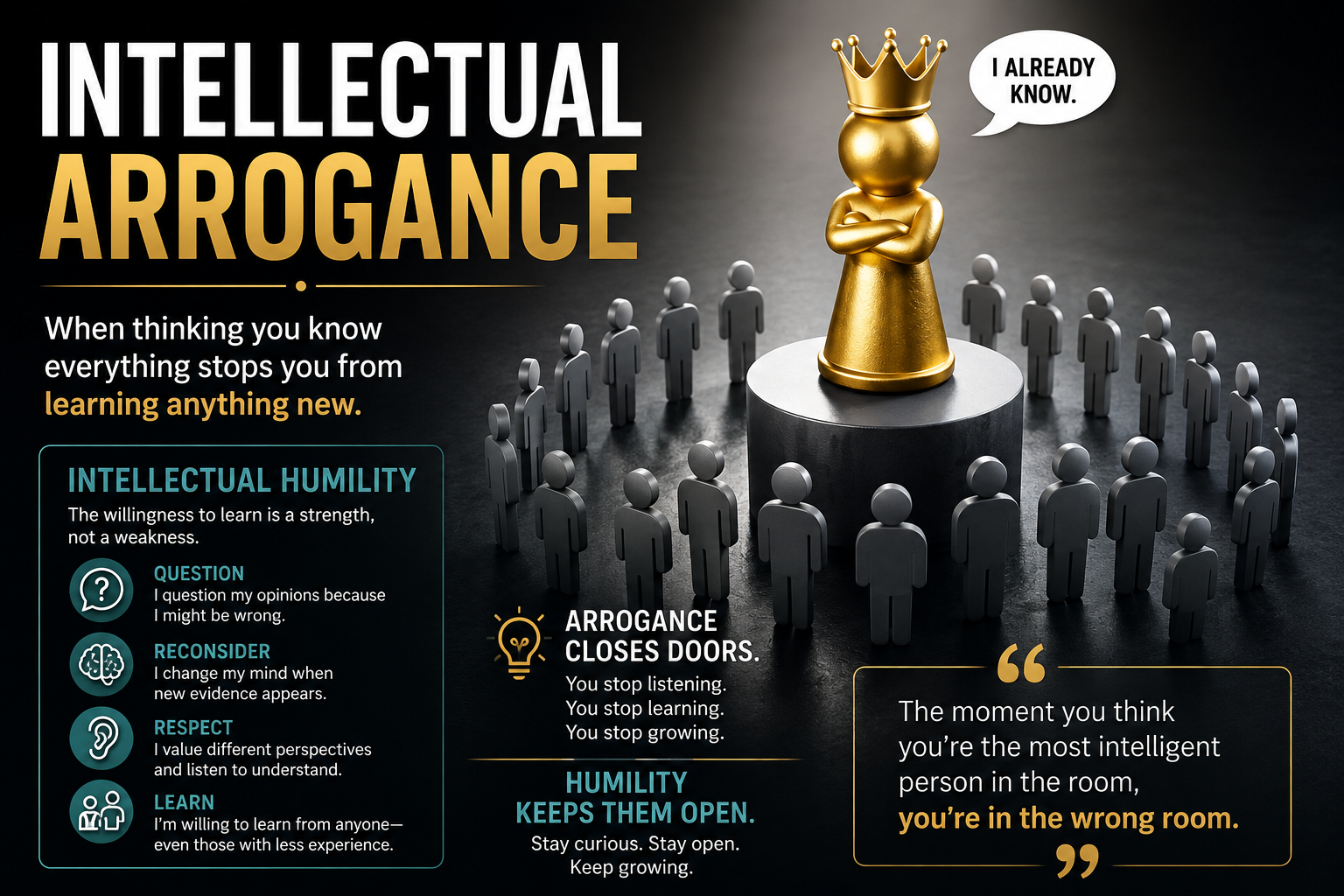
I can question my opinions because I recognize that they could be wrong.
I can reconsider a position when new evidence challenges it.
I can listen seriously to a viewpoint that differs from my own without immediately trying to defeat it.
I can distinguish between having experience and having all the answers.
And I can learn from someone younger or less experienced when that person has knowledge or skills I don't possess.
This last point is especially relevant in a world where technology and workplace practices change quickly. A younger colleague may have far less professional experience but understand a new technology, platform, or way of working far better than someone who has spent decades in the field.
Sometimes the student should become the teacher.
Intellectual Arrogance Can Hold You Back
The moment you believe you're better or smarter than everyone around you, you create a serious problem:
You no longer know what you don't know because you've stopped allowing other people to teach you.
Intellectual arrogance also damages relationships.
People generally don't enjoy conversations with someone whose primary objective is demonstrating how intelligent they are. Good relationships require curiosity about other people and respect for what they bring to the conversation.
The need to prove that you're the smartest person in the room can eventually leave you with fewer people willing to tell you when you're wrong.
That's particularly dangerous for leaders.
Experience Can Create Its Own Blind Spot
The more experienced we become, the easier it can be to confuse experience with certainty.
Experience has enormous value. It gives us context, pattern recognition, and lessons learned over many years.
But yesterday's experience doesn't automatically provide the answer to tomorrow's problem.
Circumstances change. Technology changes. People change. What worked before may no longer be the best approach.
That's why intellectual humility becomes more important, not less important, as our knowledge and experience grow.
The goal isn't to know less.
It's to remain teachable despite how much we already know.
Intelligence and Curiosity Work Better Together
The smartest people don't need to pretend they know everything.
They ask questions.
They seek out people who know things they don't.
They change their minds when the evidence warrants it.
They can say, I don't know.
And perhaps most importantly, they don't see learning from someone else as a threat to their intelligence.
Intellectual humility doesn't diminish what you know. It prevents what you know from becoming a barrier to what you could learn next.
The better question isn't:
Am I the smartest person in the room?
It's:
What can I learn from the other people in it?