Exploring the unexpected connections that shape our lives
Book Reviews, Comments & Stories, Quotes, & Poetry & More
"Connections and Why They Matter"
Most of what happens in our life will spark a connection. Life connects with what has been found in books. Books connect with what happens in life. Use the connections to help you see more clearly. A love of reading and writing is what motivated the creation of this blog. Thank you for coming to the blog.
Many people think networking means knowing more people.
It doesn't.
Most of us already know plenty of people through work, school, family, social media, professional organizations, former employers, and everyday life. But knowing someone and having a meaningful professional connection with that person are very different things.
A network is not simply a collection of names. Its real value comes from the relationships within it and from what people are willing to learn from and do for one another.
That is where networking with a purpose begins.
Networking Should Begin With Learning, Not Asking
One of the biggest mistakes people make when they need a job is beginning their networking with a request:
Do you know anyone who is hiring?
There is nothing necessarily wrong with asking that question, but it may be much too early.
A better starting point is curiosity.
What do I need to understand about this industry?
What skills are employers really looking for?
How has this profession changed?
What terminology do people inside the industry use?
Which companies should I be learning about?
Who else should I talk with?
Those questions change networking from asking people for something into learning from people who know something you need to understand.
That's one reason I have long considered the informational interview such a valuable career tool.
What an Informational Interview Can Do
An informational interview is not a job interview.
You aren't meeting with someone primarily to convince that person to hire you. You are there to learn.
Suppose you're considering changing industries. You can read job descriptions, visit company websites, study LinkedIn profiles, and research the industry online. All of that is useful.
But then talk with someone who has spent ten years working inside that industry.
The conversation can reveal things your online research didn't.
You might discover that a skill you considered unimportant is highly valued. You might learn that your experience from another industry is more transferable than you thought. You might discover that the position you intended to pursue isn't really the best fit for you.
And you may learn about opportunities, companies, people, and career paths you didn't even know existed.
That's information you can use before submitting an application or sitting down for a formal interview.
The Difference Between Contacts and Connections
A contact is someone you know.
A connection is someone with whom you've developed enough of a relationship that meaningful communication can take place.
That distinction matters.
If you have 1,000 LinkedIn connections but couldn't comfortably contact most of them with a genuine question, you don't necessarily have 1,000 useful professional relationships.
The number isn't the point.
The quality of the connection is.
Real networking happens when people exchange knowledge, ideas, introductions, experiences, and assistance. Sometimes you receive the benefit. Sometimes you provide it.
The strongest professional relationships often include both.
Don't Wait Until You Need a Job
Networking becomes much harder when desperation enters the conversation.
If the first time someone hears from you in five years is when you've lost your job and need help, you're asking a dormant relationship to suddenly become an active one.
That doesn't mean the person won't help. Many will.
But there's a better approach.
Maintain relationships while things are going well.
Congratulate someone on a new position. Send an article you think would interest them. Ask how their industry is changing. Introduce two people who might benefit from knowing one another. Answer a question when you're the person with useful information.
You aren't doing these things because you're accumulating favors.
You're building relationships.
Then networking becomes something you do throughout your career rather than something you suddenly begin when you need something.
Are You Talking to the Right People?
A quotation attributed to Eleanor Roosevelt has stayed with me for years:
“Never allow a person to tell you no who doesn't have the power to say yes.”
I think there is an important networking lesson in that idea, although I would take it a little further.
The person you're speaking with doesn't always need the power to say yes.
They may know the person who does.
Or they may help you understand what you need to learn before approaching that person.
Someone may not have the authority to hire you, but they may understand the company exceptionally well. They may know which department is expanding, which skills are difficult to find, how hiring decisions are made, or whom you should speak with next.
So the better networking question isn't simply:
Can this person help me get what I want?
It's:
What can I learn from this person, and where might this conversation lead next?
That is a very different way to build a network.
The Hidden Value of a Conversation
Some career opportunities are advertised. Others develop through relationships, referrals, recommendations, and conversations.
That doesn't mean networking is a shortcut around qualifications. A relationship cannot substitute for the ability to do the work.
But information can help you position those qualifications more effectively.
Imagine two people applying for the same position.
One reads the job posting and submits a résumé.
The other has spent time learning about the industry, understands the company's challenges, knows the terminology, has spoken with people doing similar work, and has a clearer understanding of what the employer actually needs.
Those two candidates may have similar experience on paper, but they aren't equally prepared for the conversation that follows.
That's one of the practical benefits of networking.
Better information creates better preparation.
Your Network Can Also Help People Find You
Networking doesn't operate in only one direction.
The way you present yourself online can help other people understand what you know, what you've accomplished, and where your interests lie.
Your LinkedIn profile, professional biography, website, articles, comments, and other public material create signals about your expertise.
Be specific.
Instead of simply describing yourself as “an experienced professional,” explain what you have actually done.
What problems have you solved?
What industries do you understand?
What responsibilities have you handled?
What skills can you transfer from one role or industry to another?
What subjects do people regularly ask you about?
Clarity makes it easier for someone to recognize a reason to contact you.
Sometimes the next useful connection doesn't begin because you found someone.
It begins because the right person found you.
Generosity Is Part of Good Networking
There is another side to networking that is sometimes overlooked.
What can you give?
You may have information someone else needs. You may know a person they should meet. Your experience may help someone avoid a mistake. You might be able to answer a question that took you years to understand.
Networking works better when we stop viewing every relationship according to what we can get from it.
Generosity builds trust.
And trust is what turns a collection of professional contacts into an actual network.
Build the Network Before You Need It
The best time to develop a professional network is not the day you lose your job.
It's years earlier.
Have conversations. Ask good questions. Stay curious about what other people do. Learn how industries and organizations actually work. Maintain relationships. Help people when you can.
Then, when circumstances change, you aren't beginning from zero.
You already have relationships with people who know you, understand something about what you can do, and may be willing to share what they know.
That is the real purpose of networking.
It isn't about accumulating contacts.
It isn't about asking everyone you know for a job.
And it isn't about using people to get somewhere.
It's about building genuine professional relationships, gaining knowledge, sharing what you know, and creating connections that can lead in directions neither person could necessarily predict when the first conversation began.
About Networking With a Purpose
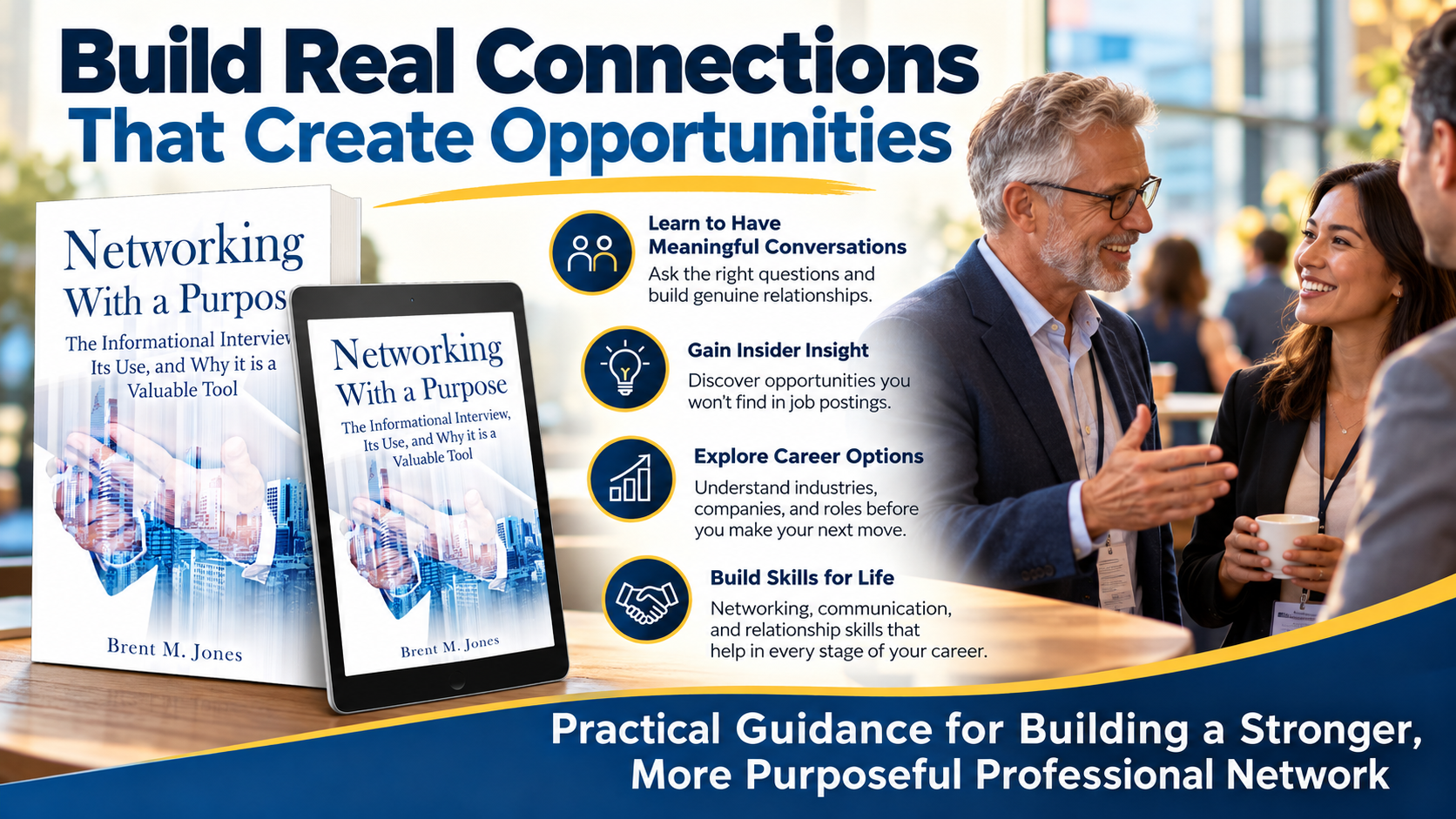
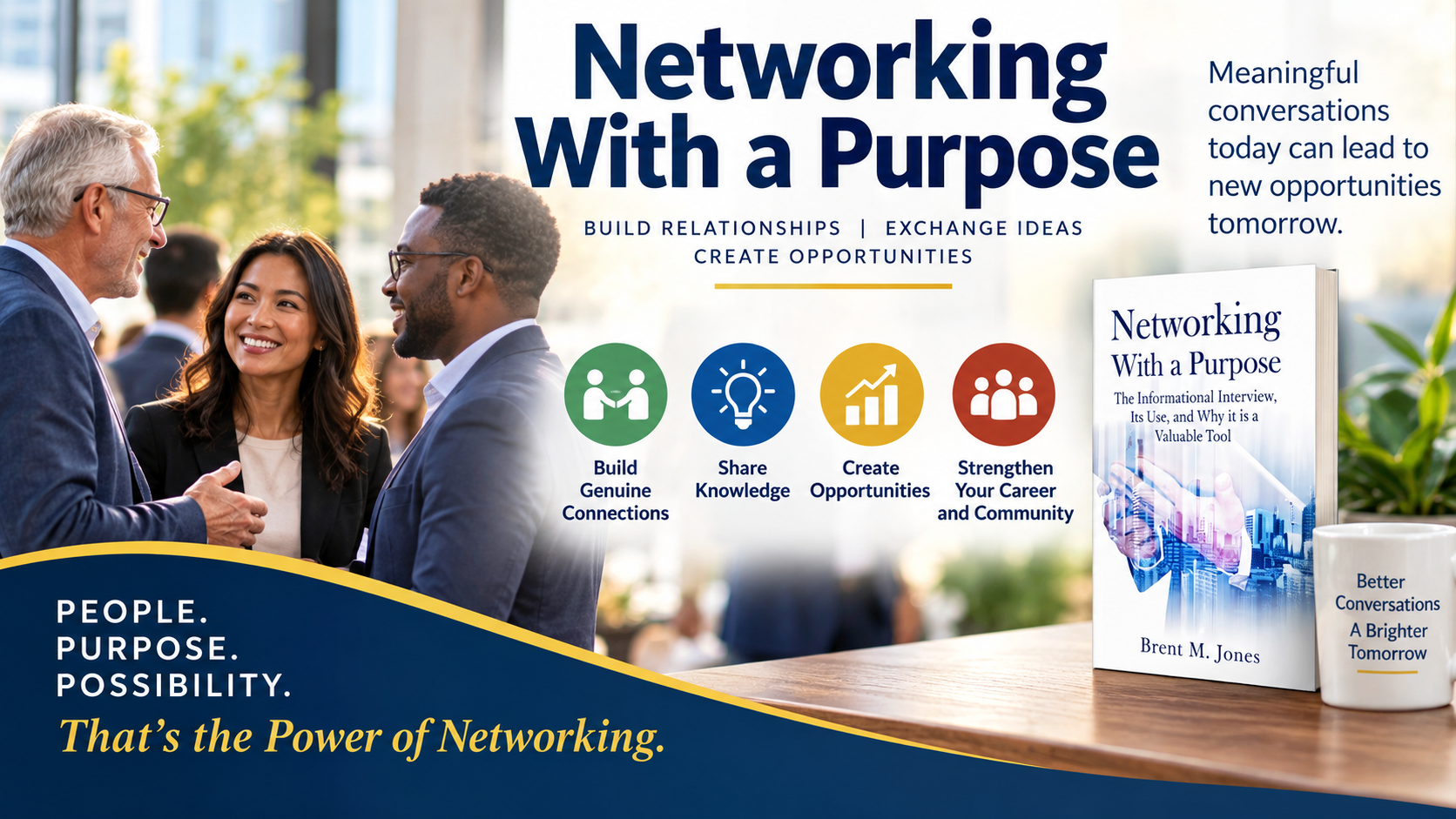
In Networking With a Purpose: The Informational Interview, Its Use, and Why It Is a Valuable Tool, I explore how informational interviews and professional relationships can help people better understand careers, companies, industries, and opportunities.
The objective isn't simply to become better at “networking.” It's to have better conversations, ask better questions, make better-informed career decisions, and build professional relationships that remain useful long after a particular job search has ended.
Networking With a Purpose by Brent M. Jones is available on Amazon in Kindle and paperback edition
It is easy to mistake having a large network for having a strong one.
We count contacts, connections, followers, and names in a database. But knowing someone exists and having a genuine relationship with that person are very different things.
You may have hundreds or even thousands of professional contacts. The people who really make up your network are usually a much smaller group. They know something about you. You know something about them. Some level of trust has developed between you.
That difference matters.
A Contact Is Not Yet a Connection
Networking is often treated as an activity: attend an event, introduce yourself, exchange information, connect on LinkedIn, and move on to the next person.
Those actions may begin a network, but they don't create much value by themselves.
A connection develops through what happens afterward.
Do you listen? Do you remember what matters to the other person? Do you share information that might help them? Do you stay in touch when you don't need something?
Those behaviors turn a name into a relationship.
This is why some people with relatively small networks seem remarkably well connected, while others accumulate thousands of contacts and still struggle to find anyone willing to help when they need it.
The Currency of Networking Is Generosity
One of the biggest mistakes in networking is approaching another person by asking, consciously or unconsciously, "What can this person do for me?"
People recognize that attitude surprisingly quickly.
A better question is, "What can I contribute?"
Generosity doesn't require money or grand gestures. In a professional network, it can mean making an introduction, sharing useful information, offering encouragement, recommending someone's work, answering a question, or simply giving someone your full attention.
The important part is that the contribution isn't merely a disguised transaction.
If every favor comes with an expectation of repayment, it isn't generosity. It is an exchange.
Real generosity changes the character of a relationship because the attention moves outward. You begin noticing what other people need instead of constantly measuring what they can provide for you.
Over time, that builds something much more valuable than a list of contacts. It builds goodwill.
Networking Depends on Human Skills
We sometimes call communication, listening, empathy, and interpersonal awareness "soft skills." There is nothing particularly soft about their effect.
They determine whether people trust us.
Good networking requires being able to listen rather than simply waiting for your turn to speak. It requires understanding that different people communicate differently. It requires recognizing what someone else may need from a conversation rather than concentrating exclusively on what you want from it.
Those abilities become especially important during career transitions, when networking can easily become overly transactional.
If every conversation begins with your need for a job, referral, introduction, or opportunity, people can feel the pressure behind the interaction.
A relationship established before you need something is very different.
Contribution Demonstrates Authenticity
There is another reason contribution matters.
It tells people something about who you are.
Anyone can say that relationships matter. Anyone can describe themselves as generous, helpful, collaborative, or trustworthy.
Behavior provides the evidence.
When you share what you know, help someone make a useful connection, follow through on a promise, or offer assistance without immediately asking for something in return, people don't need to be told about your character. They experience it.
That is one of the overlooked purposes of networking.
A network doesn't simply connect us to opportunities. It allows other people to learn who we are.
Reciprocity Doesn't Mean Keeping Score
Strong professional relationships usually contain some form of reciprocity, but reciprocity isn't the same as keeping score.
You may help someone today and receive nothing from that individual in return. Years later, someone else may help you because of a reputation or relationship that grew from completely different circumstances.
Networks rarely operate in straight lines.
That is why approaching networking as a series of transactions can actually limit its value. We cannot predict which conversation, introduction, piece of advice, or act of generosity will eventually matter.
The return on a genuine relationship may not even be something we can measure.
Your Network Reflects Your Character
Perhaps that is the larger point.
Networking is usually discussed as something we build around ourselves. But over time, a network also becomes a reflection of how we have treated other people.
Were we present only when we needed something?
Did we listen?
Did we contribute?
Did we share what we learned?
Did we help other people make connections of their own?
Did people come away from their interactions with us feeling that the relationship mattered?
The strongest networkers aren't necessarily the people with the most contacts. They are the people others trust, remember, and are willing to engage with again.
That kind of network isn't built by collecting people.
It is built one relationship at a time.
And perhaps the best measure of a network isn't how many people are willing to help us.
It is how many people we have been willing to help along the way