
Why Readers Matter More Than Ever


In a world built for distraction, choosing to read is an act of attention.

Book lovers are often described as collectors, bibliophiles, or voracious readers. But what unites them is not quantity. It is willingness.

Willingness to slow down. To sit with complexity. To enter another mind.

Reading does more than improve vocabulary or reduce stress, though it does those things. It trains interpretation.

When we follow a character through conflict, we practice empathy.
When we hold multiple perspectives in tension, we practice nuance.
When we return to a sentence because it unsettles us, we practice reflection.

These habits do not remain on the page.

They shape how we see people. How we respond in conversation. How we construct our own narrative.

A reader is not just someone who consumes books.

A reader is someone who allows stories to influence how they interpret life.

And interpretation, over time, becomes identity.

Source: https://connectedeventsmatter.com/litera/w...

The Universal Language of Story


Some books travel further than their authors ever imagined.

The Bible has been translated into more than 3,000 languages.
The Little Prince into over 300.
Pinocchio into more than 250.
The Harry Potter series into over 80.

These numbers are impressive. But what makes them meaningful is not scale. It is reach.

A story that crosses language crosses interpretation. It enters cultures shaped by different histories, beliefs, and assumptions. Yet something within it resonates.

Why?

Because story precedes language.

Before we translate words, we recognize experience — loss, wonder, courage, doubt, love. The details may shift across cultures, but the emotional architecture remains.

When a book survives translation, it proves something quiet but powerful: meaning is portable.

And perhaps that is why books endure long after trends fade. They carry not just information, but reflection. They allow us to see our lives through another lens, then return to our own with greater clarity.

Translation does more than spread a story.

It reminds us that what shapes us is often shared.

Source: https://connectedeventsmatter.com/litera/u...

From Shakespeare to BookTok: How Stories Travel Across Time


William Shakespeare and Agatha Christie have each sold an estimated two billion copies of their works. They lived centuries apart. They wrote in different genres. Yet their stories persist.

Today, books travel differently.

A viral video on BookTok can revive a forgotten novel overnight. A short clip can introduce millions of readers to a story published decades earlier.

The medium changes.

The mechanism remains the same.

Stories move because they resonate.

Shakespeare endured because his characters wrestled with ambition, jealousy, doubt, and love. Christie endures because mystery satisfies our desire for order and revelation. BookTok thrives because readers want to share the experience of being moved.

What we are witnessing is not a replacement of tradition. It is continuation.

From stage to print to algorithm, stories have always found ways to travel.

The question is not how they spread.

The question is why we still need them.

Because every era, no matter how technologically advanced, still asks the same human questions.

Who am I? What matters? How do I make sense of this moment?

Books do not answer these questions permanently.

But they help us refine how we ask them.

Source: https://connectedeventsmatter.com/litera/s...

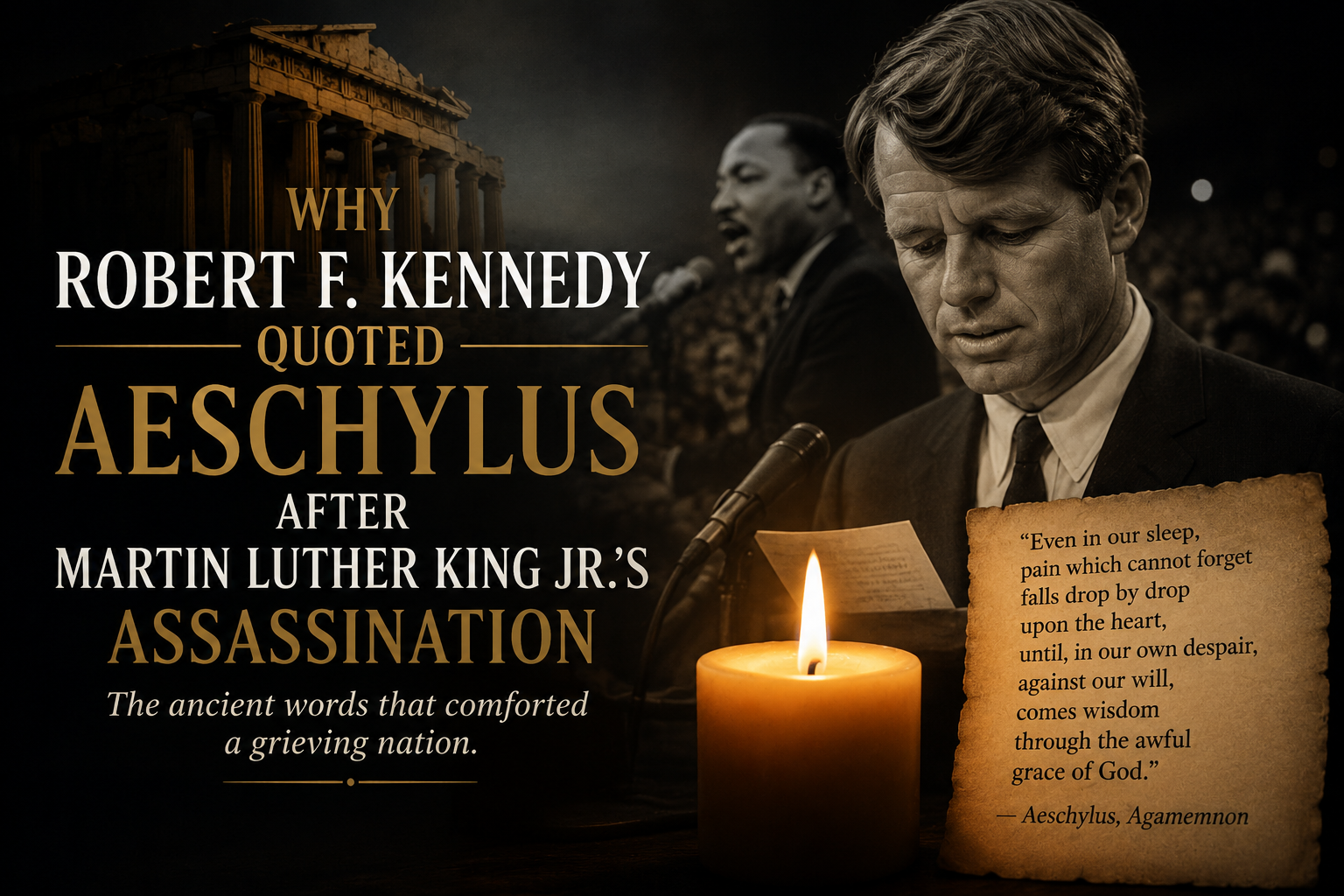
Aeschylus was quoted by Robert Kennedy at Martin Luther King, Jr's death


“What we need in the United States is not division; what we need in the United States is not hatred; what we need in the United States is not violence and lawlessness, but is love, and wisdom, and compassion toward one another, and a feeling of justice toward those who still suffer within our country, whether they be white or whether they be black.”

The quote appears in Robert F. Kennedy’s impromptu speech delivered in Indianapolis, Indiana, on the evening of April 4, 1968, after the assassination of Martin Luther King, Jr. (JFK Library and Museum, and The Library of Congress)

  1. In the John F. Kennedy Library’s archive, it’s part of his “Statement on Assassination of Martin Luther King, Jr., Indianapolis, Indiana, April 4, 1968.” JFK Library and Museum

  2. The full line is included in published transcripts such as Voices of Democracy under “Kennedy Speech Text Rally in Indianapolis.” Voices of Democracy

  3. Wikipedia also cites it in its article on “Robert F. Kennedy’s speech on the assassination of Martin Luther King Jr.” as one of his best known lines.

“Even in our sleep, pain which cannot forget

falls drop by drop upon the heart,

until, in our own despair,

against our will,

comes wisdom

through the awful grace of God.”


Thoughts about this Poem


Robert F. Kennedy also quoted these lines from the poem in his impromptu speech announcing the assassination of Martin Luther King Jr. on April 4, 1968. That moment—raw, unrehearsed, and spoken from the heart—remains one of the most powerful examples of public grief met with quiet strength.

The same lines were later inscribed on Kennedy’s tombstone at Arlington National Cemetery. He once said, “My favorite poet was Aeschylus. In turning to poetry during one of the nation’s darkest moments, Kennedy reminded us that words—even ancient ones—can still speak into the present.

About Aeschylus

Few reliable sources exist for the life of Aeschylus. He was born around 525 BCE in Eleusis, a town northwest of Athens. As a young man, he worked in a vineyard until, according to tradition, the god Dionysus appeared to him in a dream and inspired him to write for the stage.

At just 26, Aeschylus had his first play performed (499 BCE). Fifteen years later, he won his first prize at the Dionysia festival, Athens’ most prestigious playwriting competition. Often regarded as the father of tragedy, Aeschylus wrote with a depth and weight that transcends centuries. The lines Kennedy quoted come from one of his surviving works, Agamemnon—a meditation on suffering, wisdom, and the human condition.

Why These Lines Still Matter

In moments of loss, words often fail. But sometimes, they also hold us. The fact that a 2,000-year-old line could resonate with the grief of 1968—and still echo today—speaks to poetry’s enduring role: not to solve pain, but to give it shape.

Originally published in 2022. Revised and relocated.

Source: https://connectedeventsmatter.com/litera/l...