Exploring the unexpected connections that shape our lives
Book Reviews, Comments & Stories, Quotes, & Poetry & More
"Connections and Why They Matter"
Most of what happens in our life will spark a connection. Life connects with what has been found in books. Books connect with what happens in life. Use the connections to help you see more clearly. A love of reading and writing is what motivated the creation of this blog. Thank you for coming to the blog.
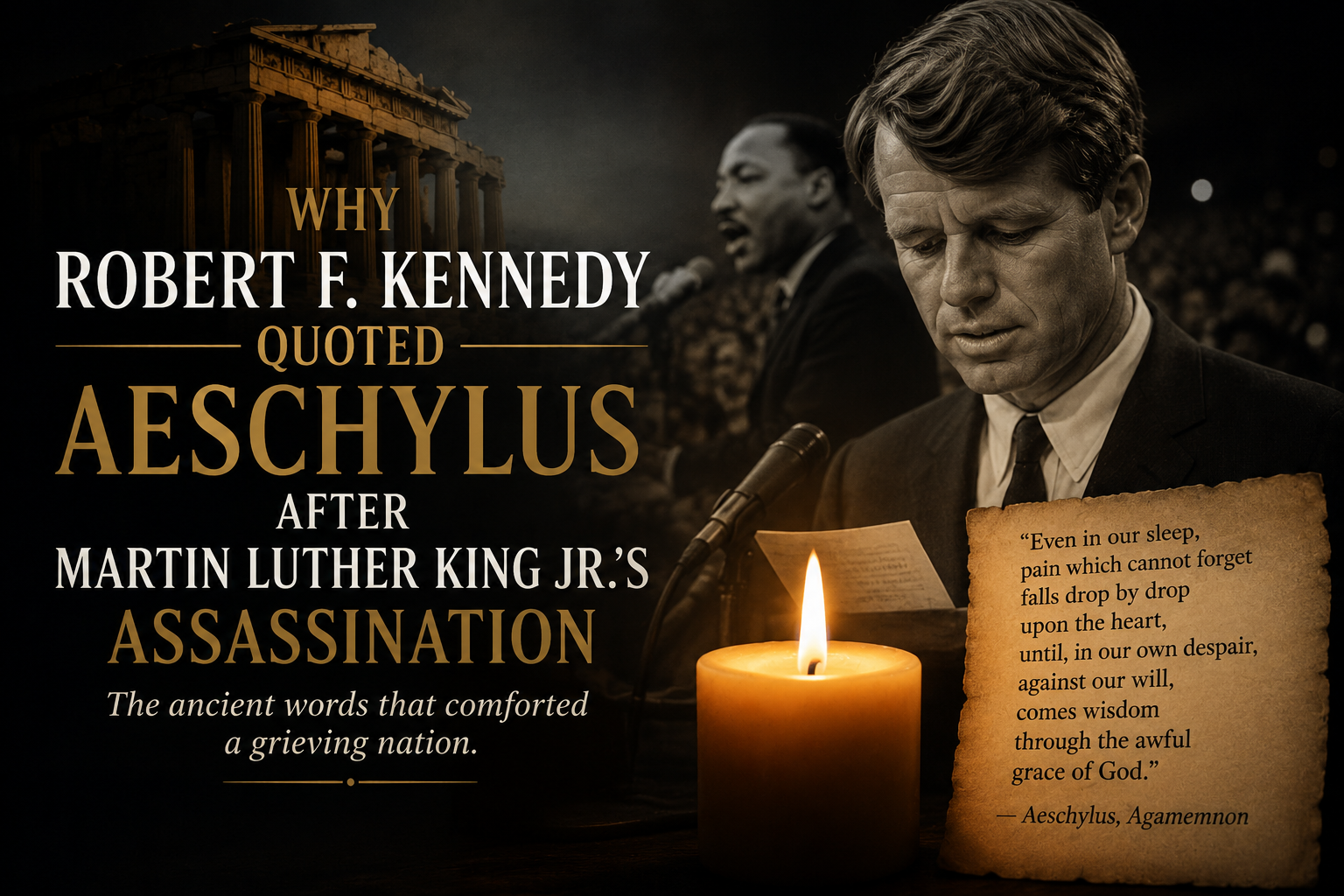
On the evening of April 4, 1968, Robert F. Kennedy stood before a crowd in Indianapolis with devastating news. Dr. Martin Luther King Jr. had been assassinated.
Kennedy had no prepared speech.
Rather than respond with anger or political rhetoric, he reached back more than two thousand years to the words of the Greek playwright Aeschylus. In one of the most memorable speeches in American history, he reminded a grieving nation that wisdom often grows from suffering.
These ancient lines have continued to comfort readers ever since
“What we need in the United States is not division; what we need in the United States is not hatred; what we need in the United States is not violence and lawlessness, but is love, and wisdom, and compassion toward one another, and a feeling of justice toward those who still suffer within our country, whether they be white or whether they be black.”
The quote appears in Robert F. Kennedy’s impromptu speech delivered in Indianapolis, Indiana, on the evening of April 4, 1968, after the assassination of Martin Luther King, Jr. (JFK Library and Museum, and The Library of Congress)
In the John F. Kennedy Library’s archive, it’s part of his “Statement on Assassination of Martin Luther King, Jr., Indianapolis, Indiana, April 4, 1968.” JFK Library and Museum
The full line is included in published transcripts such as Voices of Democracy under “Kennedy Speech Text Rally in Indianapolis.” Voices of Democracy
Wikipedia also cites it in its article on “Robert F. Kennedy’s speech on the assassination of Martin Luther King Jr.” as one of his best-known lines.
“Even in our sleep, pain which cannot forget
falls drop by drop upon the heart,
until, in our own despair,
against our will,
comes wisdom
through the awful grace of God.”
Why These Lines Still Matter
More than two thousand years separate Aeschylus from Robert F. Kennedy, yet both understood something that every generation eventually discovers.
Suffering changes us.
We rarely welcome it, yet many of life's deepest lessons emerge from experiences we never wanted. Loss can deepen compassion. Grief can broaden understanding. Pain can teach us to recognize the suffering of others.
That is why Kennedy chose these words on one of America's darkest nights. He wasn't offering easy optimism. He was reminding people that tragedy does not have to be the final chapter.
The same truth still speaks today. Whether we experience personal loss, national tragedy, or unexpected change, these ancient lines invite us to believe that wisdom can emerge even from heartbreak.
Why did Robert F. Kennedy quote Aeschylus?
Kennedy quoted Aeschylus because he believed poetry could express grief more honestly than political language. Speaking without prepared remarks only hours after Martin Luther King Jr.'s assassination, he chose words that acknowledged suffering while pointing toward compassion rather than anger.
His decision helped calm the crowd in Indianapolis, making the speech one of the most remembered moments in American political history.
Thoughts about this Poem
Robert F. Kennedy also quoted these lines from the poem in his impromptu speech announcing the assassination of Martin Luther King Jr. on April 4, 1968. That moment—raw, unrehearsed, and spoken from the heart—remains one of the most powerful examples of public grief met with quiet strength.
The same lines were later inscribed on Kennedy’s tombstone at Arlington National Cemetery. He once said, “My favorite poet was Aeschylus.” In turning to poetry during one of the nation’s darkest moments, Kennedy reminded us that words—even ancient ones—can still speak into the present.
About Aeschylus
Few reliable sources exist for the life of Aeschylus. He was born around 525 BCE in Eleusis, a town northwest of Athens. As a young man, he worked in a vineyard until, according to tradition, the god Dionysus appeared to him in a dream and inspired him to write for the stage.
At just 26, Aeschylus had his first play performed (499 BCE). Fifteen years later, he won his first prize at the Dionysia festival, Athens’ most prestigious playwriting competition. Often regarded as the father of tragedy, Aeschylus wrote with a depth and weight that transcends centuries. The lines Kennedy quoted come from one of his surviving works, Agamemnon—a meditation on suffering, wisdom, and the human condition.
Why These Lines Still Matter
In moments of loss, words often fail. But sometimes, they also hold us. The fact that a 2,000-year-old line could resonate with the grief of 1968—and still echo today—speaks to poetry’s enduring role: not to solve pain, but to give it shape.
Originally published in 2022. Revised and relocated.