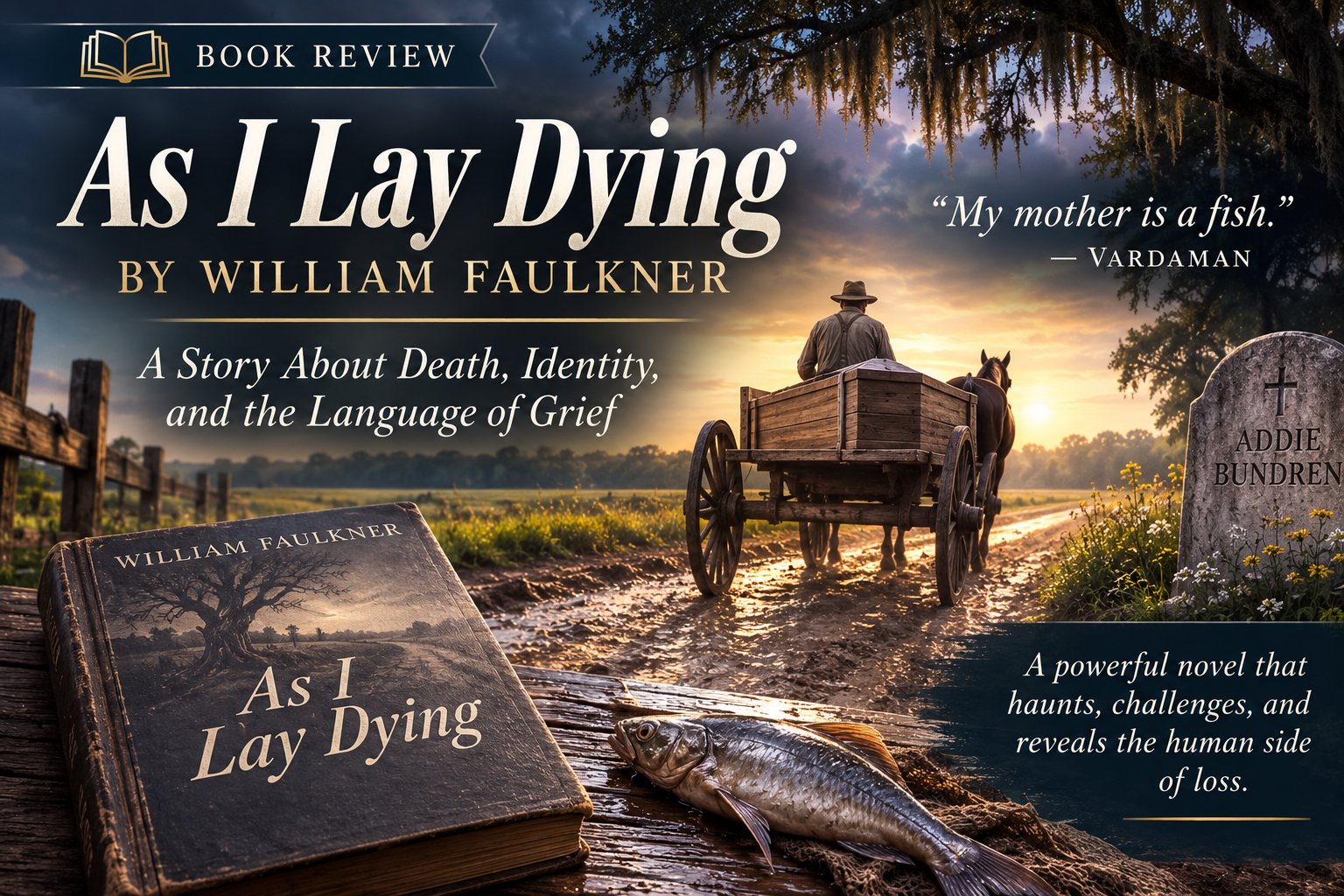
As I Lay Dying by William Faulkner

A Story About Death, Identity, and the Language of Grief

William Faulkner's As I Lay Dying is unlike almost any other novel in American literature. At its simplest, it tells the story of the Bundren family as they attempt to honor Addie Bundren's dying wish to be buried nearly thirty miles from home. What should be a straightforward journey becomes a remarkable exploration of grief, identity, family relationships, and the often irrational ways people respond to loss.

The novel opens as Addie lies dying while her son Cash builds her coffin outside her bedroom window. The steady sound of sawing and hammering becomes one of the novel's first unforgettable images, quietly preparing both the family and the reader for the journey ahead.

After Addie dies, her husband, Anse, and their five children load the coffin onto a wagon and begin a difficult trip across rural Mississippi. Flooded rivers, fire, exhaustion, pride, and conflicting personal motives all threaten to derail their promise to bury Addie where she wished.

Yet the journey itself is only part of the story.

The Characters Matter More Than the Plot

Each member of the Bundren family experiences Addie's death differently.

Jewel expresses grief through fierce loyalty and action. Cash approaches life with careful craftsmanship and quiet dignity. Vardaman struggles to understand death through the limited perspective of childhood, leading to one of the most famous lines in American literature:

"My mother is a fish."

Darl, perhaps the novel's most fascinating character, views the world with extraordinary perception while gradually losing his grip on reality. His philosophical questions about identity, existence, and death often blur the line between insight and madness.

Faulkner never tells us how we should judge these characters. Instead, he allows each voice to reveal its own truth.

A Remarkable Writing Technique

One of the novel's greatest achievements is its structure.

Rather than following a single narrator, As I Lay Dying unfolds through 59 short chapters told from the perspectives of 15 different narrators, including Addie herself after her death.

Each narrator sees the same events differently. Gradually, the reader pieces together the story from conflicting memories, emotions, assumptions, and misunderstandings.

The result is a novel that rewards careful reading. No single narrator possesses the complete truth.

Language That Becomes the Story

Faulkner's prose can be challenging.

The dialogue is fragmented. Thoughts shift unexpectedly. Sentences sometimes flow like streams of consciousness rather than conventional conversation.

For new readers, this style can initially feel disorienting. Eventually, however, it becomes clear that the language itself reflects the emotional lives of the characters. We experience their confusion, grief, pride, fear, and isolation not simply through what they say but through the way they think.

This is one of the reasons the novel remains so influential.

Why It Still Matters

Although the novel centers on one family's attempt to bury their mother, it is ultimately about much more than death.

It asks enduring questions.

How do we understand loss?

How do families carry both love and resentment at the same time?

What happens when language can no longer fully explain what we are experiencing?

Few novels examine these questions with as much originality or emotional honesty as As I Lay Dying.

Favorite Quotes

"It takes two people to make you, and one people to die."

"The reason for living was to get ready to stay dead a long time."

"People to whom sin is just a matter of words, to them salvation is just words too."

"Memory believes before knowing remembers."

My Rating

★★★★★ (5/5)

As I Lay Dying is not an easy novel, but it is an extraordinary one. Faulkner asks readers to work harder than most authors, yet the reward is a story that continues to reveal new meaning with each reading. It is a powerful meditation on grief, family, identity, and the limits of language, and it deserves its place among the gre.at works of American literature


Source: https://connectedeventsmatter.com/blog/201...

The Library Book by Susan Orlean

The Library Book by Susan Orlean


Libraries are inherently interesting, so it's no surprise that a story about a great library, a catastrophic library fire, a peculiar character accused of arson, and a deep dive into the day-to-day operations of a great library would be even more enjoyable. Susan Orlean’s book The Library Book was not just a surprise, but a truly delightful read that will leave you intrigued and eager to explore its pages.

”On 29 April 1986, Los Angeles Central Library was engulfed in flames. The fire, originating in the fiction stacks, swiftly ascended the staircases, gaining momentum as it collided with ceilings. The intense heat, reaching a staggering 1370C, transformed the metal shelves from a dull grey to a blinding white before they collapsed in a tangle of cherry red.”

All the staff and visitors displayed remarkable courage, evacuating the building safely. However, the same could not be said for the books. By the time the fire and the high-pressure hoses had completed their destructive dance, half a million volumes were declared lost, with an equal number on the brink of survival.

Citizen: My Life After The White House by Bill Clinton

Citizen: My Life After The White House by Bill Clinton

"On January 21, 2001, after twenty-five years in politics and elected office, eight as president, I was a private citizen again," was an opening remark in this book. What follows is a fantastic focus on helping people in trouble. It is too bad that those accomplishments will be viewed through lifelong assumptions about Clinton's view with a partisan lens. Much was accomplished working with George W. Bush and George H.W. Bush, clearly showing how influential good leaders can be even when they don't have to be.

The accomplishments seemed neverending, but it would be hard to complain about too much good work. Some will, I expect.