• Home |
  • Signature Essays |
    • Reflective Non-Fiction
    • Personal Reflections & Influences
    • Life Meaning & Presence
    • Authenticity Matters
    • About Attitudes & Feelings
    • Alignment & Self Understanding
    • Creativity and Meaning
    • Influence, Persuasion & Manipulation
    • Finding Inspiration
    • Kindness & Doing Good
    • Positivity
    • The Stories We Tell Ourselves
    • Personal Reinvention
    • Well-Being Over Time
    • Literature & Meaning
    • Essays & Reflections
    • Philosophy & Meaning
    • Poetry Why it Matters
    • Poetry by Brent M. Jones
    • Poetry Favorites Reviewed
    • Art, Imagery & Reviews
    • Visual Essays
    • Writers Who Shaped How I Think
    • Writer Symbolism
    • Thoughts & Quotes
    • Explore My Books: Find Your Next Read
    • What Matters: We Are the Sum of Small Moments
    • The Power of Authentic Communication: In a World Full of Noise, Authentic Communication Stands Out
    • The Human Factor: Discover Yourself, Clarify Your Purpose, Create Work That Matters
    • Finding the Best Version of Ourselves: The Interview of Self
    • Terminology Is More Than Words
    • Embrace Life’s Randomness: Path to Personal Reinvention
    • Why Life Stories Change Are We a Result of Choice or Circumstance
    • Why Professionals Use LinkedIn
    • Networking With a Purpose: The Informational Interview, It's Use ...................l
    • Work Matters It takes Technology..
    • Interviewing Yourself and Asking The Right Questions
    • Philosophers are Self Help Authors
    • Earlier Edition - The Human Factor
    • Praise and Reader Reviews
    • Books Reviews
    • Book Review Index A-Z
    • Books Read but Not Reviewed
    • Communication
    • Human Connection & Communication
    • Work, Change & Growth
    • Career -Insights
    • Coaching & Mentoring
    • Soft Skills
    • Work & Careers
    • Employment Trends & Thoughts
    • Interviews & Resumes
    • Platforms & Visibility
    • Networking & Informational Interviews
    • Marketing - Publishing
    • Jobs
  • Guest Posts |
    • Contact Information
    • About Page
    • “Copyright & Content Use”
Menu

Brent M. Jones - Connected Events Matter

11400 W Olympic Blvd Ste 200
Los Angeles, CA 90064-1584
Phone Number
Exploring the unexpected connections that shape our lives


Book Reviews, Comments & Stories,       Quotes, & Poetry & More


"Connections and Why They Matter"


Most of what happens in our life will spark a connection.  Life connects with what has been found in books. Books connect with what happens in life. Use the connections to help you see more clearly. A love of reading and writing is what motivated the creation of this blog. Thank you for coming to the blog. 


3


ff


Th

Brent M. Jones - Connected Events Matter

  • Home |
  • Signature Essays |
  • Reflective |
    • Reflective Non-Fiction
    • Personal Reflections & Influences
    • Life Meaning & Presence
    • Authenticity Matters
    • About Attitudes & Feelings
    • Alignment & Self Understanding
    • Creativity and Meaning
    • Influence, Persuasion & Manipulation
    • Finding Inspiration
    • Kindness & Doing Good
    • Positivity
    • The Stories We Tell Ourselves
    • Personal Reinvention
    • Well-Being Over Time
  • Literary |
    • Literature & Meaning
    • Essays & Reflections
    • Philosophy & Meaning
    • Poetry Why it Matters
    • Poetry by Brent M. Jones
    • Poetry Favorites Reviewed
    • Art, Imagery & Reviews
    • Visual Essays
    • Writers Who Shaped How I Think
    • Writer Symbolism
  • Thoughts |
    • Thoughts & Quotes
  • My Books |
    • Explore My Books: Find Your Next Read
    • What Matters: We Are the Sum of Small Moments
    • The Power of Authentic Communication: In a World Full of Noise, Authentic Communication Stands Out
    • The Human Factor: Discover Yourself, Clarify Your Purpose, Create Work That Matters
    • Finding the Best Version of Ourselves: The Interview of Self
    • Terminology Is More Than Words
    • Embrace Life’s Randomness: Path to Personal Reinvention
    • Why Life Stories Change Are We a Result of Choice or Circumstance
    • Why Professionals Use LinkedIn
    • Networking With a Purpose: The Informational Interview, It's Use ...................l
    • Work Matters It takes Technology..
    • Interviewing Yourself and Asking The Right Questions
    • Philosophers are Self Help Authors
    • Earlier Edition - The Human Factor
    • Praise and Reader Reviews
  • Book Reviews |
    • Books Reviews
    • Book Review Index A-Z
    • Books Read but Not Reviewed
  • Professional |
    • Communication
    • Human Connection & Communication
    • Work, Change & Growth
    • Career -Insights
    • Coaching & Mentoring
    • Soft Skills
    • Work & Careers
    • Employment Trends & Thoughts
    • Interviews & Resumes
    • Platforms & Visibility
    • Networking & Informational Interviews
    • Marketing - Publishing
    • Jobs
  • Guest Posts |
  • Contact |
    • Contact Information
  • About Author |
    • About Page
    • “Copyright & Content Use”

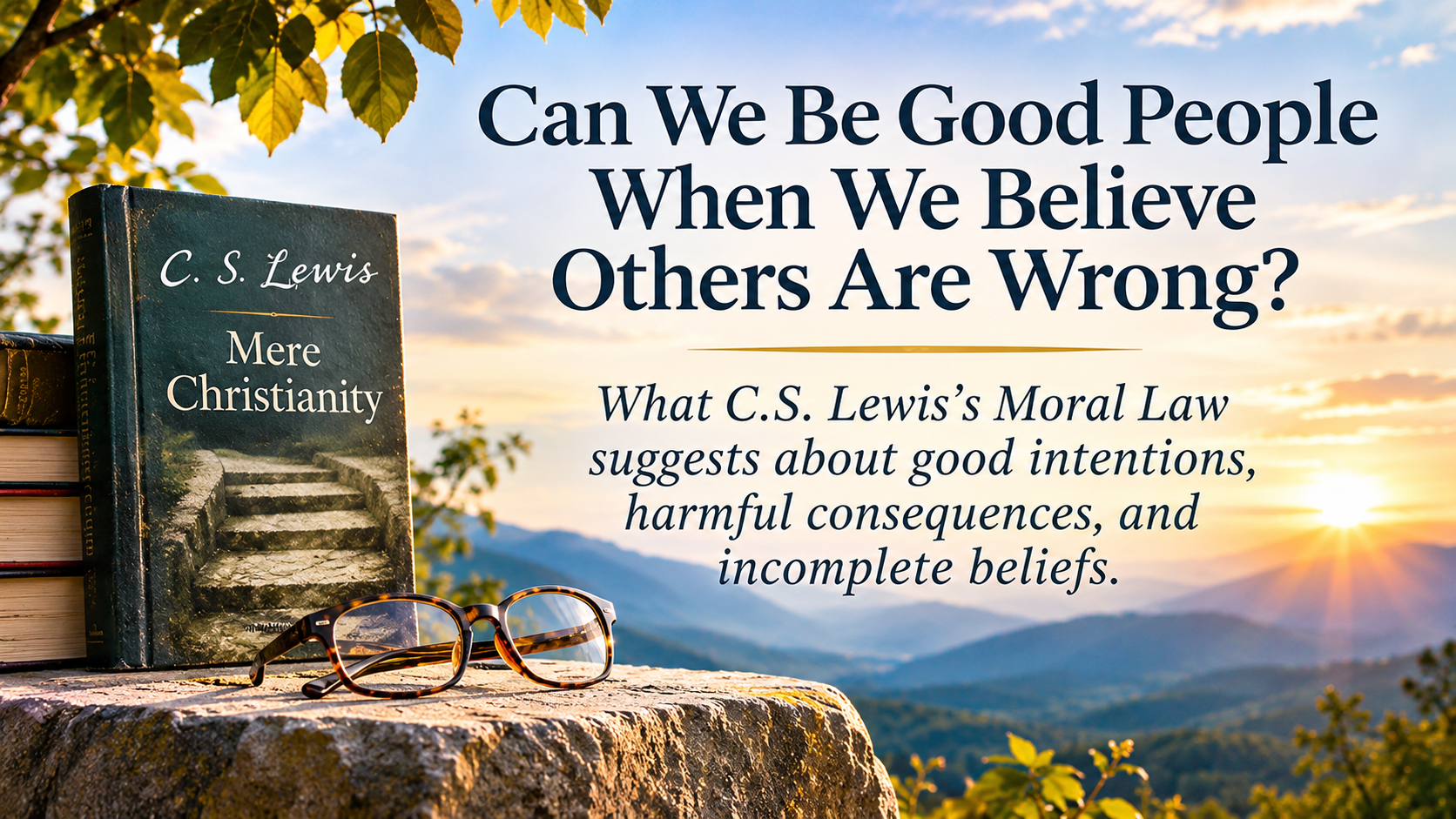
Can We Be Good People When We Believe Others Are Wrong?

November 9, 2026 Brent Jones
Alignment & RSS

Why good intentions, harmful consequences, and incomplete beliefs should make us reconsider how we judge one another.

Reading C.S. Lewis's Mere Christianity recently brought me back to a question I've considered in different ways over the years: What actually makes a person good?

Lewis discusses what he calls the Moral Law, the idea that human beings possess an underlying awareness of right and wrong. Although we frequently disagree about moral questions and often fail to live according to our own standards, he argues that this shared sense of moral obligation points toward something beyond individual preference or social convention.

I find that argument compelling, but it also raises questions about how we evaluate goodness, particularly when intentions and consequences don't agree.

If someone intends to do harm, but something good results, does that make the person good?

I would say no. The fortunate outcome doesn't change the original intention.

But consider the opposite.

If someone genuinely intends to do good, but harm results, does that make the person bad?

That question is much harder to answer.

We might reasonably conclude that the person's intentions were good, even though the consequences were not. But we also have to consider whether the person understood the risks, ignored warnings, or refused to recognize the harm after it occurred.

This suggests that goodness cannot be determined entirely by either intentions or outcomes.

And perhaps the question becomes even more complicated when we consider the beliefs that motivate our actions.

Can a Good Belief Produce a Bad Outcome?

Suppose someone sincerely believes that protecting another person is a moral responsibility.

That seems like a good belief.

But what if their efforts to protect someone interfere with that person's independence, prevent them from learning through experience, or cause unintended harm?

Does the harmful outcome make the original belief bad?

I don't think it necessarily does.

Perhaps the belief was good but incomplete.

Protecting others can be a worthy moral principle. But it may need to be balanced with another principle, such as respecting their freedom to make decisions for themselves.

The original belief doesn't have to be abandoned. It may need to become more complete.

Perhaps moral understanding develops not simply by replacing wrong beliefs with right ones, but by discovering what our existing beliefs have failed to consider.

That possibility changes how I think about disagreements between people who sincerely believe they are doing what is right.

When We Confuse Being Right With Being Good

I see people condemning one another over their beliefs, often with little apparent interest in understanding why those beliefs are held.

Each side may feel morally justified in its conclusions. Each may believe the other is failing to recognize something obvious.

But there is a difference between believing someone is wrong and concluding that the person is bad.

Two people can share a concern for human well-being, fairness, or compassion and still reach opposing conclusions about what those principles require.

They may disagree about the facts, the likely consequences, or which moral obligation deserves greater consideration.

Sometimes one person's conclusion may be better supported than the other's. Sometimes both may have overlooked something important.

But disagreement alone tells us surprisingly little about the character or intentions of either person.

I wonder how often we judge ourselves by what we intended while judging others by the consequences we associate with their beliefs.

When our own actions cause harm, we explain what we were trying to accomplish.

When someone else's actions cause harm, we may assume the harm reveals what that person wanted all along.

We give ourselves the benefit of understanding our motives while denying that same consideration to others.

Being right about something does not necessarily make us good. And being wrong does not necessarily make someone else bad.

Are Our Beliefs Wrong or Simply Incomplete?

This distinction interests me because we often approach beliefs as though they must be either right or wrong, with little room for anything in between.

Certainly, some beliefs are mistaken. Others may be harmful in their underlying purpose, not merely in their consequences.

But many beliefs begin with a legitimate moral concern and become problematic because they fail to account for other considerations.

A commitment to honesty may overlook the importance of kindness.

A desire for fairness may fail to recognize differences in individual circumstances.

A belief in personal responsibility may underestimate the limitations people face.

In each case, the original principle may retain its value while requiring a broader understanding.

Perhaps the problem isn't always that we believe the wrong things.

Sometimes it is that we believe something good without recognizing what else must be considered.

And that raises a difficult question about our own convictions.

How can we know whether a belief we consider firmly established is actually incomplete?

We may discover its limitations through experience, through unexpected consequences, or through listening seriously to someone who sees the same issue differently.

But that requires a willingness to consider that our understanding may have limits.

Understanding Is Not the Same as Agreeing

There is an important distinction here.

Recognizing that someone may have good intentions does not require us to accept harmful behavior.

Nor should good intentions excuse a refusal to acknowledge consequences.

If a person continues causing harm after becoming aware of it, their responsibility changes. Their willingness to learn and reconsider becomes part of how we evaluate their actions.

But understanding someone's motives can still matter, even when we strongly disagree with their conclusions.

It allows us to distinguish between someone who intends harm and someone whose efforts to do good have failed.

Those are not morally identical situations.

And perhaps understanding that difference gives us a better opportunity to respond constructively rather than simply condemn.

We can challenge a belief without attacking the worth of the person who holds it.

We can recognize harmful consequences without assuming malicious intentions.

We can defend our convictions while remaining willing to discover something we haven't considered.

None of this requires moral indifference. It requires greater care in making moral judgments.

Does Wisdom Come From Certainty or Understanding?

I've been thinking lately about why some people become increasingly certain of their beliefs as they grow older, while others become more aware of how much they don't know.

Experience can reinforce our convictions. Sometimes it should.

But experience can also reveal that questions we once considered settled were more complicated than we understood.

I don't believe wisdom requires abandoning our beliefs or treating every opinion as equally valid.

It may require something more difficult: maintaining our convictions while recognizing that even our strongest beliefs may not contain the whole truth.

This brings me back to Lewis and his Moral Law.

Perhaps human beings do share an underlying awareness that goodness matters. But recognizing the importance of goodness is not the same as understanding everything goodness requires.

Our intentions matter because they reveal what we are trying to accomplish.

Our actions matter because they reveal how we put our beliefs into practice.

And consequences matter because they may show us what our beliefs and intentions have failed to consider.

Each contributes something to our understanding of moral responsibility.

Perhaps goodness is not simply a condition we achieve by holding the right beliefs. It is also reflected in how we respond when experience challenges those beliefs.

A Question Worth Asking Ourselves

I find myself returning to one thought.

We are often quick to recognize the limitations in someone else's beliefs and much slower to consider the limitations in our own.

We may assume that because our intentions are good, our conclusions must also be right.

But good intentions do not guarantee complete understanding.

And recognizing that possibility in ourselves may help us recognize the sincerity of others, even when we disagree with them.

Perhaps one of the greatest challenges in being a good person is not simply knowing the difference between right and wrong.

It is recognizing that someone who sees the world differently may be acting from motives just as sincere as our own.

Understanding those motives doesn't require us to agree with their conclusions. But it may require us to reconsider how confidently we judge their character.

Maybe wisdom is not measured only by how firmly we hold our beliefs, but also by how willing we are to recognize what those beliefs may have overlooked.

And perhaps that willingness is itself an important part of being good.

What do you think? Can a belief be morally good but incomplete? And how should that possibility influence the way we judge people whose beliefs differ from our own?

See book review: Mere Christianity by C.S. Lewis: Exploring Faith, Reason, and the Moral Law
Source: https://connectedeventsmatter.com/alignmen...
In Alignment of self Tags Moral Philosophy, C.S. Lewis, Mere Christianity, Moral Law, Good Intentions, Personal Beliefs, Self-Reflection, Wisdom, Right and Wrong, Human Nature, Moral Judgment, Personal Growth, Understanding Others, Faith and Reason
Comment

Why Does Experience Make Some People More Judgmental and Others More Understanding?

October 21, 2026 Brent Jones
Alignment & RSS

We often assume that growing older makes us wiser. After all, we have accumulated years of experiences, made mistakes, learned lessons, and watched our understanding of life change.

But experience doesn't always lead people in the same direction.

Some people grow older and become increasingly certain that their understanding of the world is the correct one. Their beliefs become more firmly established, and they may become less tolerant of anyone who sees things differently.

Others seem to move in the opposite direction. They may hold their convictions just as strongly, but become more willing to consider different perspectives and recognize that other people's experiences can lead to different conclusions.

Why does a lifetime of experience produce such different results?

Perhaps the answer has less to do with what we believe than with how we understand the limits of those beliefs.

Experience Doesn't Speak for Itself

We often treat experience as though it automatically produces wisdom. But experiences don't arrive with explanations attached. We interpret them through what we already know, what we believe, and what we expect to find.

Two people can experience similar events and reach very different conclusions.

One may see an experience as confirmation of something they have always believed. Another may see the same experience as a reason to reconsider an earlier assumption.

Neither response is necessarily wrong.

The more interesting question is whether we recognize that our interpretation is just that: an interpretation.

Over time, repeated experiences can make our convictions stronger. But they can also make us more aware of exceptions, contradictions, and unanswered questions.

Perhaps experience doesn't determine whether we become more understanding. What matters is what we allow experience to teach us.

Strong Beliefs Don't Have to Exclude Other Perspectives

Consider religious belief.

A person may believe deeply in God, having experienced events throughout life that reinforce that conviction. Those experiences may be meaningful, consistent, and personally convincing.

There is no reason that growing older should require that person to abandon or discount those beliefs.

But there is a difference between believing something deeply and assuming that everyone else should reach the same conclusion.

Another person may have lived an equally thoughtful life, encountered different circumstances, and arrived at a different understanding of God, religion, or the purpose of existence.

Recognizing that difference doesn't diminish the first person's faith.

It simply acknowledges that personal experience, however convincing, isn't the entirety of human experience.

We can respect the sincerity of another person's beliefs without agreeing with every conclusion they draw.

And we can remain committed to our own beliefs without condemning those who understand the world differently.

Conviction and understanding are not opposites.

Where Does Certainty End?

This raises a question that may be more important than whether we are certain of what we believe.

Shouldn't genuine certainty require us to understand its boundaries?

We might be convinced that something is true while remaining uncertain about many things connected to it.

Someone who believes in God, for example, may be certain of God's existence while having unanswered questions about God's nature, intentions, or relationship with humanity.

Those unanswered questions don't necessarily invalidate the central belief.

They define the boundaries of what the person believes they know.

The same principle applies beyond religion.

We may be confident in our understanding of a relationship while recognizing that we cannot fully know another person's thoughts.

We may understand much about our own life story while acknowledging that our memories, interpretations, and perspectives have changed over time.

We may have strong opinions about how people should live while recognizing that we haven't experienced the circumstances in which others must make their decisions.

Perhaps genuine certainty isn't the absence of uncertainty. It is knowing which conclusions we can reasonably support and where the unanswered questions begin.

When Certainty Becomes Judgment

There is a subtle transition that can occur when people become increasingly confident in their beliefs.

They may stop distinguishing between what their experiences have taught them and what those experiences establish about everyone else.

A personal conviction becomes a universal expectation.

Disagreement begins to feel like evidence of ignorance, poor judgment, or even moral failure.

But why should another person's different experience automatically invalidate our own?

And why should our experience invalidate theirs?

Of course, conflicting conclusions cannot always be equally correct. Some beliefs can be tested against evidence, and some interpretations are better supported than others.

Understanding doesn't require pretending that every conclusion is true.

It requires recognizing that disagreement can be examined without dismissing the person who disagrees.

There is a difference between questioning someone's conclusion and discounting the value of their experience.

Perhaps judgment becomes most dangerous when we lose sight of that distinction.

Does Aging Make Us Wiser or Simply More Certain?

As we grow older, we accumulate experiences that can reinforce our understanding of life.

But the passage of time doesn't guarantee that we become better at recognizing the limits of that understanding.

For some people, years of experience may become evidence that their beliefs no longer need examination.

For others, those same years may reveal just how complicated life is and how much remains beyond their understanding.

One person may conclude, "I've lived long enough to know."

Another may conclude, "I've lived long enough to recognize how much I still don't know."

Neither statement tells us everything about the person making it.

There are things we can know with considerable confidence. And there are lessons that decades of experience can teach us more effectively than any explanation.

But perhaps wisdom requires more than accumulating those lessons.

It may require recognizing that our experiences are only part of a much larger human story.

The Boundaries of What We Know

I've become increasingly interested in how our understanding of our own lives changes over time.

We remember experiences differently. Events that once seemed insignificant can become meaningful years later. Things we thought we understood may look different when considered alongside everything that happened afterward.

Our past doesn't necessarily change, but our understanding of it often does.

If we can discover new meaning in our own experiences, shouldn't we recognize that other people may be doing the same with theirs?

And if our understanding of our own life remains incomplete, how certain can we be that we fully understand someone else's?

This doesn't mean that we should abandon our convictions or live without conclusions.

It means that we can hold our beliefs while remaining curious about what lies beyond them.

We can recognize what experience has taught us without assuming it has taught us everything.

We can become more certain about some things while becoming more aware of the uncertainty surrounding others.

Perhaps Wisdom Is Knowing the Difference

I don't think wisdom necessarily requires becoming less certain of what we believe.

It may require becoming more precise about what our certainty actually includes.

There is nothing inherently wrong with strong convictions. They can give our lives direction, meaning, and continuity.

But conviction becomes something less admirable when it prevents us from recognizing the experiences and perspectives of others.

Perhaps the people who become more understanding with age aren't necessarily those who have changed their beliefs.

They may simply have learned that believing something deeply doesn't require everyone else to believe it too.

And perhaps the people who become more judgmental have allowed their accumulated experiences to become a boundary beyond which they are no longer willing to look.

We spend much of our lives trying to understand what is true.

Maybe one of the most important lessons experience can teach us is that understanding what we know also requires recognizing what we don't.

Wisdom may not be measured by how firmly we hold our beliefs, but by how thoughtfully we understand their boundaries.

And perhaps the greatest evidence of that wisdom is our willingness to recognize that other people have lived lives just as real, meaningful, and complicated as our own.

Related Reflections That Might Be of Interest

If It's My Life Story, Why Does It Change Every Time I Tell It?
Now is full of then
Source: https://connectedeventsmatter.com/alignmen...
In Alignment of self Tags Wisdom, Aging and Perspective, Personal Beliefs, Self-Awareness, Open-Mindedness, Life Experience, Understanding Others
Comment
. RSS

About

Brent M. Jones

Brent writes with quiet confidence and curiosity, exploring communication, reinvention, and what truly matters. His reflections invite readers to slow down, reconsider their stories, and reconnect with the values that guide them. Through books, essays, and his What Matters Substack Articles and Notes, he offers thoughtful writing shaped by observation, experience, and reflection.

Subscribe to Subtack-Newsletter-What Matters
Author's Page Amazon
Book Review Section
Book Review index
Click to Read the poem -People come into your life ..........

CONNECTED EVENTS MATTER

Because they Explain Who We are and Where We Are Going

 © Copyright 2026 Connected Events Matter

© 2026 Brent M. Jones / Connected Events Publishing. All essays, reflections, poetry, and original content on this site are protected by copyright and may not be reproduced without permission.

See more information about Copyright & Content Use