


It is what we love that is open to new connections. (The Good Wolf) →

What is it that you love? Which wolf do you feed? Are your heart and soul the actual residence of your passion? Does loving what you do or what you are working on attract creativity? Does it feed your soul? Something has to happen that adds to what you have for creativity to begin and whatever it is that feeds your soul opens the door to creativity becoming a "link in a chain' that the next artist will be able to build on.
What is it that we love the key question? Another critical question is, why is it that we love it? What does that love feed within us?
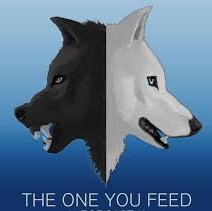
The story of the good wolf and the bad wolf is an excellent beginning to find out. There are two wolves in this story, one good and one bad. The good wolf is patient, kind, unselfish, loving, loyal, honest, and all those good things we know are good.
The bad wolf is the opposite, not patient, hateful, jealous, dishonest, mean, and all those things we know are wrong.
Each of us goes through life influenced by one of these wolves. Whichever one we choose will live with us and affect all we do. So the critical question is, which one, and how is it that we are the one that makes a choice. The answer is that the wolf that stays with you is the one you feed.
The bad wolf wants hateful things, not good. This wolf isn't patient or kind. The bad wolf is not interested in new things and won't attract creativity, and doesn't want you to succeed.
The good wolf wants to learn and is hungry for knowledge. He wants to see new things and read and learn new things. He loves books and likes reading your daily journal and to-do list. The good wolf attracts more good, and new ideas are drawn to what you already know.
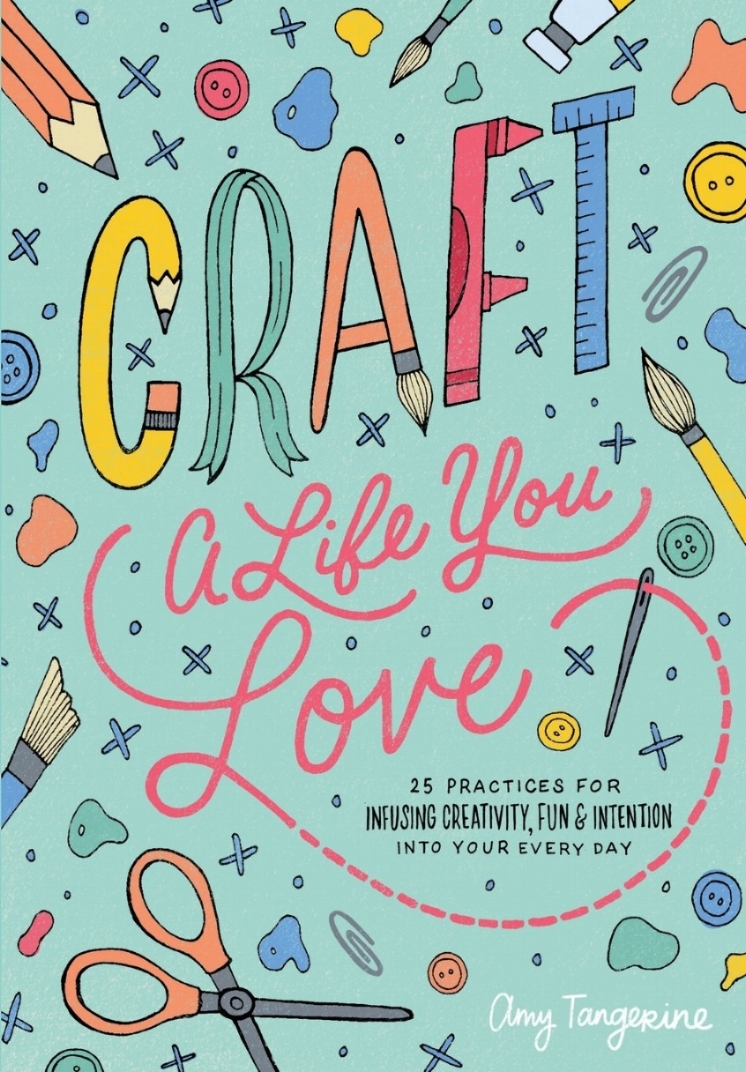
The book "A Life You Love by Amy Tangerine” discusses how to “craft a life and soul that you love.” Amy asks, “what is it that we love?”
A writer may love the characters in a story. A painter may love the object being painted. When something new is added, creativity happens. A nonfiction story can become fiction when even just one of the characters becomes a product of the writer’s imagination. Then when that new character interacts with the others, the writer will have to listen to find out what happens next in the plot, and creativity takes place.
Sometimes the writer's emotions and feelings about the current characters become the motivation to find a new character. The bad wolf doesn't want to let you look inside your subconscious for ideas and teaches you to look instead for who to blame and hate.
The artist who only sees things as not good enough will never listen close enough to have the art inform of what may not be seen at first. The good wolf will teach you to look deeper than the surface and listen.
When we connect all that we have learned to our experiences and listen, the doors open.
Thoughts about the Painting Nighthawks by Edward Hopper →
By Brent M. Jones

"Nighthawks, a 1942 oil on canvas painting, was inspired by Hemingway's short story 'The Killers,' which Hopper read in Scribner's magazine. Some consider Edward Hopper the most critical realist painter of the 20th century in America. His vision was selective & reflected his temperament.
The painting, Nighthawks, tells its own story of loneliness.
The diner is a stand-alone building with long front windows with rounded corners on the glass, giving the glass a thicker and more confining look. It is late at night, and the streets and other buildings appear empty, their darkened windows seeming more than just closed.
Silence is part of the painting's message and is reflected both inside and outside the diner. The diner has no visible doors or thick glass, which suggests that those inside are trapped. Unsettling are the yellow, faded, and peeling walls. The use of green outside on the reflected walk and around the window suggests unnatural light. The pale green fades to dark green near the buildings, confirming that the building is isolated and the people are alone. The people inside the diner are not talking, and they are not looking at each other.
Most of Hopper’s paintings are about how loneliness feels. Loneliness connects to depression and anxiety, both of which Hopper suffered from. Being alone is not loneliness, but having no connection with others is.

Hopper, a tall, lonely man, said that he declared himself in his paintings. In the diner, tall men in suits bend over, but still look tall.
Being alone in a city is something we all can relate to. Those feelings are captured and used by the author of this book, The Lonely City: Adventures in the Art of Being Alone, by Olivia Laing
The book begins by saying, "Imagine standing by a window at night, on the sixth or seventeenth or forty-third floor of a building." The book also mentions this painting and the author to explain the feeling.
See the Review of Olivia Laing’s The Lonely City, click here.
I have experienced that feeling 30 floors up, at night in a hotel room. When I looked out the window, I could see all the other tall buildings and the lights in their windows, and could see people in the closer windows. You knew you were surrounded by people, but you had no connection with any of them. You were alone.

Do We See the Homeless—Or Just the Art? →

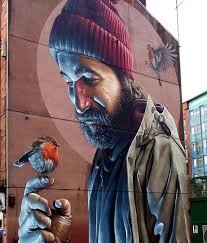

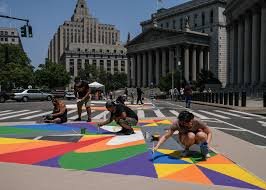
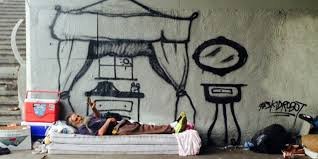
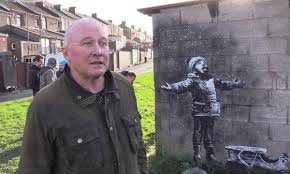



Street art has become common in cities, with the walls of buildings transformed into modern canvases. Photographers who capture these murals often frame more than the paint—they capture the people, too. In many cases, those people are the unhoused, blending into the backdrop of urban expression. But when that happens, what are we really seeing?
Street art includes both the image and the environment. So when someone living on the street is framed within the art, do they become part of it? Has the unnaturalness of their setting turned them into something symbolic rather than human?
Art and photography often reflect emotion and experience. But if a homeless person becomes part of the composition, part of the “story” the artist or photographer is telling—do they lose their individuality? Their humanness? Or worse, has the image taken it from them?
Colette Brooks, in In the City: Random Acts of Awareness, writes:
“A city person does not feel the need to finish a jigsaw puzzle, who relishes jagged edges and orphaned curves, stray bits of data, stories parsed from sentences half overheard on the streets.”
She was likely referring to how city dwellers learn to live amid fragmentation—coming and going, always surrounded by others yet rarely connected.
But when a homeless man appears beneath a mural in a photograph, we have to ask:
Has he become part of the art, less important as a human being than as a visual element?
Is he still seen—as an individual—or merely absorbed into the larger composition?
Will the art outlive him? Will it spark more conversation than his life ever did?
Was he included to highlight a reality, or simply to help the photographer convey a message?
In capturing the image, did we erase the man?
The question remains:
Do we truly see the homeless—or just the art?
There is no easy answer. But maybe the most important thing is that we keep asking.


Our Life Story Creates our Identity →

Whenever I think about my life story, I rethink what happened and draw new conclusions. The following story didn’t happen in a boxing ring. I wish it had because I might have done better, but the story has stuck with me throughout my life.
When I was about eleven years old, I had the unfortunate experience of being chased home each day after school by a kid called Allen, who was much bigger than me. One day my mother met me as I was running into the yard. She had probably noticed I was out of breath on my return each day. That day she asked why I was running so hard, and I told her Allen was chasing me. I could have said, “I was running to avoid getting pounded.” That would have been an honest answer.
We lived by a river, and crossing the bridge in front of our house meant I was home. The next day my mother was out front, waiting for my arrival as I crossed the bridge. She stopped me there, and when shortly Allen came thundering across, she called him over and announced to us both that the following day we would meet right there in the park across the street from my house and fight. The announcement surprised me. What surprised me even more, was my mother setting this fight up. Looking back, it also amazes me that I didn’t try to get out of it or worry about it. I just figured that was what I had to do. I had to fight him.
The next day at school, word got out. Some asked me the kids if I was going to fight him. I said yes, I was. After school, Allen arrived at the park with a crowd of kids from school, some even before I arrived. My mother was there, waiting. She had all the kids that had shown up from a big circle. Allen and I entered the ring with fists, ready to start swinging, and Mom was the referee. I still remember looking at Allen, who was much taller and heavier than I was, and not feeling afraid.
The fight began, and I danced around with my fists, trying to land some punches and trying harder to avoid getting punched. I hit him as hard as I could a few times. I had boxed with my dad in the evenings and understood a little about the process, but Allen didn’t look like he even felt my punches. He wasn’t very good at boxing and preferred to push and shove, several times jostljoltingo the ground before jumping on and pounding me. Even lying flat on my back, I would hit whatever part of his body I could connect with. Each time we landed on the ground, my mother had us get back up and continue boxing. It wasn’t a fight; I stood a chance of winning. Finally, my mother held Allen’s hand and said, “There you go, Allen, you won!”
What has always surprised me most then, and ever since, is that I wasn’t scared. I felt like I did my best and didn’t hurt too badly. I lost my fear of failing. Life went on. I did get into a fight or two in later years at school and did much better.
When I tell this part of my life story, it seems to be a meaningful connection and even explains many of the future challenges and changes I have had in my life. I have not been afraid of failures but have worked through them over the years. I learned that when you get knocked down, you get back up, you keep fighting, and when it is over, life goes on.
By the way, a side note. I have always loved boxing. Watching it, in particular. Muhammad Ali is my favorite boxer, and this quote of his has specific relevance for me:
“Only a man who knows what it is like to be defeated can reach down to the bottom of his soul and come up with the extra ounce of power it takes to win when the match is even.”
Entering the Universe on the Pipeline Trail →

John Muir said, “The clearest way into the Universe is through a forest wilderness.” Muir's writings often expressed his love of nature and inspired people to protect wild places. He believed that humans were a small part of nature and that wild spaces should be preserved for everyone to enjoy.
The picture above is one I took a few years ago. The trail's name is the "Pipeline," which clarifies Muir's statement. It runs from the top of Grandeur Peak, where you can look West and see the Salt Lake Valley below, and then on the East, to near the top of the Millcreek Canyon, where you can see Park City if you know where to look.
My preferred way to enter this trail is at Rattlesnake Gulch. I drive up the canyon, not too far past the entrance booth, to a parking area where the Rattlesnake Gulch trail begins. It goes up the side of the mountain, gains about 600 feet in elevation, and is about 0.8 miles up to when you can get on the Pipeline Trail. You can then head east to the left to Grandeur or west to the right to Church Fork.
I tried to run that trail as often as possible for many years, and I have run both in winter and summer. I look forward to following it. The trail is hardly a wilderness. It is, however, the first step out of our day-to-day world into a place where nature’s natural order surrounds you.
This trail was less than 4 miles from where I lived, and I was always in awe of how different I felt when I left the day-to-day world for this special place.
I often saw snakes jumping over them as they stretched across the trail. I saw bobcats and deer and heard larger animals back in the brush.
I have read a book about wolves and their lives after being reintroduced into Yellowstone Park. It shows that the balance between the Elk and the Wolves is accurate, and changes in the balance have consequences.
The wilderness and its balance point the way to understanding much more. Even more about the universe itself, as Muir said.
I loved my years running on the Pipeline Trail. I have run it both winter and summer. I look forward to following and at least walking it again.
A Thanksgiving Story →
by Brent M. Jones
Each Thanksgiving, I get excited. Sometimes I think back to 1957 to a special Thanksgiving day and dinner. My sister was born that year on Tuesday the 26th of November, two days before the holiday. My mother and new sister were, of course, still in the hospital, and my father, brother, and I had to figure out what to do for a meal on Thanksgiving Day, and I was worried.
This story of that day is one that I have told, over and over again, for the last 60+ years. Looking back at the event, this year seems different, and it occurs to me that I have been in a rut. For too long, the story has just been focused on our special Thanksgiving meal. I have been missing the bigger picture. I should have seen how repetitious my account had become.
Oral histories have been a common way families have passed on their life stories. My father gave his history and much of his extended family’s stories this way. He never could seem to remember that he had told us the stories before. Later in his life, I just reached a point where I felt it was important to listen to him, so I didn't say anything and just listened.
Looking back now, I realize that his repetition imprinted those stories into my memory. So why I have retold the Thanksgiving story of 1957 so many times to my sister is something I really can't explain?
It was Thanksgiving that year, and after some concern, I learned that a neighbor had invited us guys over for dinner. Even then, I wondered why our Aunts, uncles, or even Grandparents didn't ask us? Maybe they did, and maybe my dad thought it would be easier to go almost next door rather than across town. I remember worrying about the dinner. At 11 years old, I thought having a sister was fine, but I have always remembered how much I had looked forward to turkey day.
When the time for the big meal came, I remember that we were at the neighbors all sitting around the living room table. We waited at the table for what seemed like a long time. The table didn't seem like the Thanksgiving day dinners I was used to. I figured that when the turkey arrived, it would make it all good. Our neighbor, Mrs. Zelner, announced that it was ready and coming. She carried the main course on a large silver tray with a silver dome cover. I had never seen a large silver serving tray with a body like this, which seemed exciting. She had left the center of the table open with a place to put the special silver tray and carefully set it down.
She stood up, and I wondered if she would carve the turkey first, but she just reached for the silver dome lid. It seemed like she was building up to the big moment; I know I was, and then she lifted the dome. The tray was stacked high and full of hamburgers.
Yes, I was disappointed and a little shell-shocked. The rest of the dinner seems like a blur as I try to recall it. I know I was crushed. I was enough to repeat this story repeatedly, primarily to my sister Trudy over many years. I guess I figured I was passing on my oral tradition memories to her. I knew I had told her the story before, so I wasn't just retelling it because I couldn't remember. Maybe I have always been trying to get over it.
Since then, every Thanksgiving dinner has been spent with family. In the case of my wife's parents, those dinners were also finished with a day of football.
One year we found ourselves alone in Albuquerque, New Mexico. Each of our now-grown children and their spouses had other plans. A member of our church who knew we would be alone invited us over for dinner. At that time, it seemed to hit me how nice it was to have someone do that. Thinking of others is important; perhaps you notice it more when you’re on the receiving end.
I have realized that I had much to be thankful for so many years ago. A new sister, overlooked at the time, was a neighbor who wanted to help.


Thanksgiving
If it really was my life story why does it change each time I tell it? →

There is no one whose story I am as familiar with as my own. The same is true for you. This seems obvious, but what surprises me is how I see my story differently almost every time I tell it.
Connections that seemed important when I told my story seemed less critical over time. Coincidences and perspectives have become more apparent over time. When I see those changes, the story changes as I retell it, and I find that it changes me. I become different because of how I see the story differently. We continually create who we are but use the same events to shape our conclusions.
Author Pat Conroy said: “The most powerful words
in the English language tell me a story.”
I have witnessed others change their conclusions about themselves using the same facts from participating in an event at my local church.
Over about 35 years, a men's group I participated in met once a month, and each time one person would take about 45 minutes and tell the group their life story.
The initial purpose of doing this was to help us get to know each other. We believed that men didn't get bonded quickly and were usually shy in this setting. So we felt it was essential to show appreciation and love for each other.
People moved in and away over this time, but somehow we could keep this going. After a few years, it led to recycling some of us by repeating our stories, and we would hear the life stories again. I have some memory issues, but I can usually remember the details of these stories clearly. What was interesting is that sometimes the events of a story heard before were viewed differently by the presenter when retold. I had occasions retelling my life experiences that I felt were important, and it was clear that the same events looked different in the retelling. There were times when I wondered if a person who seemed to see the same event differently when retold was doing so because, having told the story, he then found new connections to the events. I also wondered if the changes and different emphasis were on purpose, just reshaping an image.
People come and go in our lives, and it takes some time to see the reasons. When a new person comes, we take the influence and unique perspective for granted as coincidence. When we look back and see the full impact of the people and recent events in our lives, we see our own experiences differently, and as a result, the past looks different, and our common destiny feels changed by the events.
MY STORY: AS LISTED UNDER AUTHOR
By Brent M. Jones
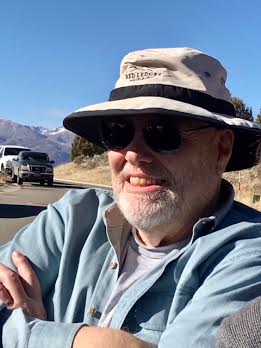
I am a reader, writer, author, listener, and seeker of knowledge. I ponder books, art, authors, music, poetry, service, kindness, and most of all, "people." These influences help us form our identity, change it, or even reinvent it as we go through life.
I have spent my career as an entrepreneur and a business executive, working with companies and employee groups of various sizes, some large ones. I successfully built my own company from an idea to a functioning business. For 22 years, it was a strong sales company covering 15 Western States and helping hundreds of companies grow their business.
As an employed top manager, I helped build several independent and corporate companies and helped bring about significant progress in their growth. The people always made a difference in results and made my efforts rewarding. Those years presented me with some excellent teaching and learning opportunities. They confirmed my belief that people can reshape themselves as they rethink their actions and lives. People want to learn. They are not just programmed to be what they always have been and will grow and rise according to their opportunities.
This website, “Connected Events Matter,” is an effort to explore the influences from our lifetime connections and how they change and impact our development and identity. The impact is ongoing and is always life-altering.
We have both a physical and spiritual self-image. We have our intellectual growth. As we look at our experiences and grow with them, we give purpose to our lives.
Reading and the Arts have a significant influence on our growth. This blog will look closely at these influences and present relevant book reviews. The events in our lives connect us, and we are connected.