There is no story I know better than my own.
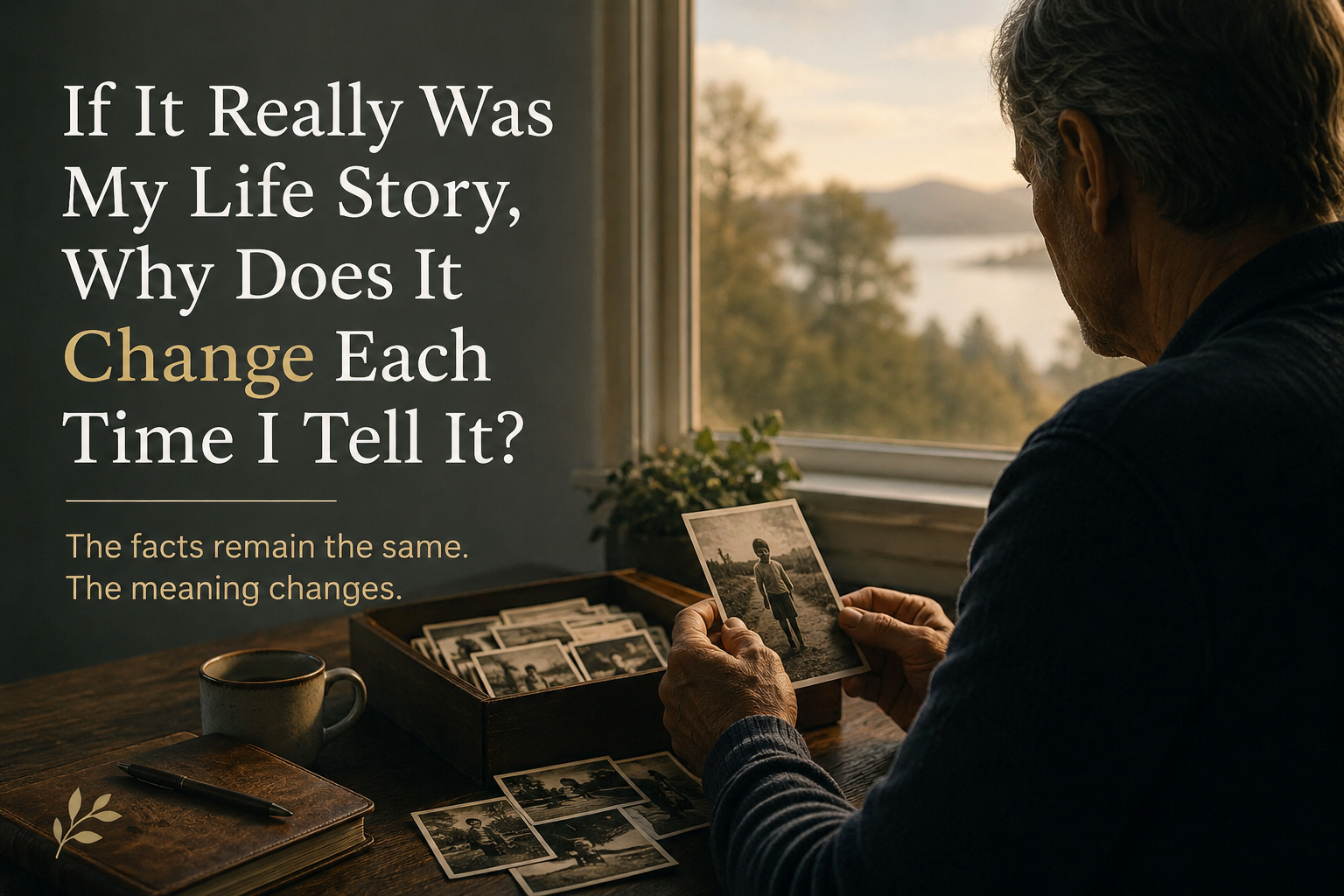
And yet, almost every time I tell it, something changes.
Not the major events. Not the people or places. The facts remain mostly the same. What changes is the meaning I attach to them. Connections that once seemed important begin to fade. Small moments I barely noticed at the time suddenly feel central. Coincidences become patterns. Losses become turning points. Conversations I once dismissed quietly reshape the entire narrative.
Over time, I’ve realized something unsettling and strangely comforting:
We do not simply remember our lives.
We reinterpret them.
And in doing so, we slowly reinterpret ourselves.
Author Pat Conroy once wrote:
“The most powerful words in the English language are: Tell me a story.”
But stories are never completely fixed. They continue evolving because we continue evolving.
For more than 35 years, I participated in a monthly men’s group through my church. Each month, one person would spend about 45 minutes telling the story of his life. The purpose was simple: to know each other more honestly. We believed men often stayed guarded, even among friends, and that listening deeply to another person’s story created trust, understanding, and connection.
Over the years, people moved away, new people joined, and eventually some of us began repeating our stories.
That’s when something fascinating happened.
The same events often carried different meanings the second or third time they were told.
A painful moment that once sounded unresolved later carried acceptance. A disappointment became a lesson. A coincidence became a defining turning point. Sometimes the facts barely changed at all, but the interpretation changed completely.
I noticed this in others, and eventually I noticed it in myself.
The retelling itself seemed to create new understanding.
It was as though people were discovering the meaning of their lives while speaking out loud.
I began to wonder whether this is true for all of us.
Perhaps we are not only shaped by what happens to us, but by the meaning we continue assigning to those events over time.
People come and go in our lives, often without us fully understanding their impact until much later. Some relationships seem temporary until we look back and realize they quietly changed our direction. Other moments feel insignificant at the time but later become impossible to separate from who we became.
As we change, our stories change with us.
And maybe that is not inconsistency at all.
Maybe it is growth.
This idea—that identity is shaped quietly through interpretation, relationships, memory, and reflection—eventually became one of the central themes in my book What Matters: We Are the Sum of Small Moments.
Because sometimes the meaning of our lives is not found in dramatic events, but in the gradual understanding of moments we once overlooked.