
Socratic Irony: When Asking Questions Becomes a Tool for Understanding or Manipulation →
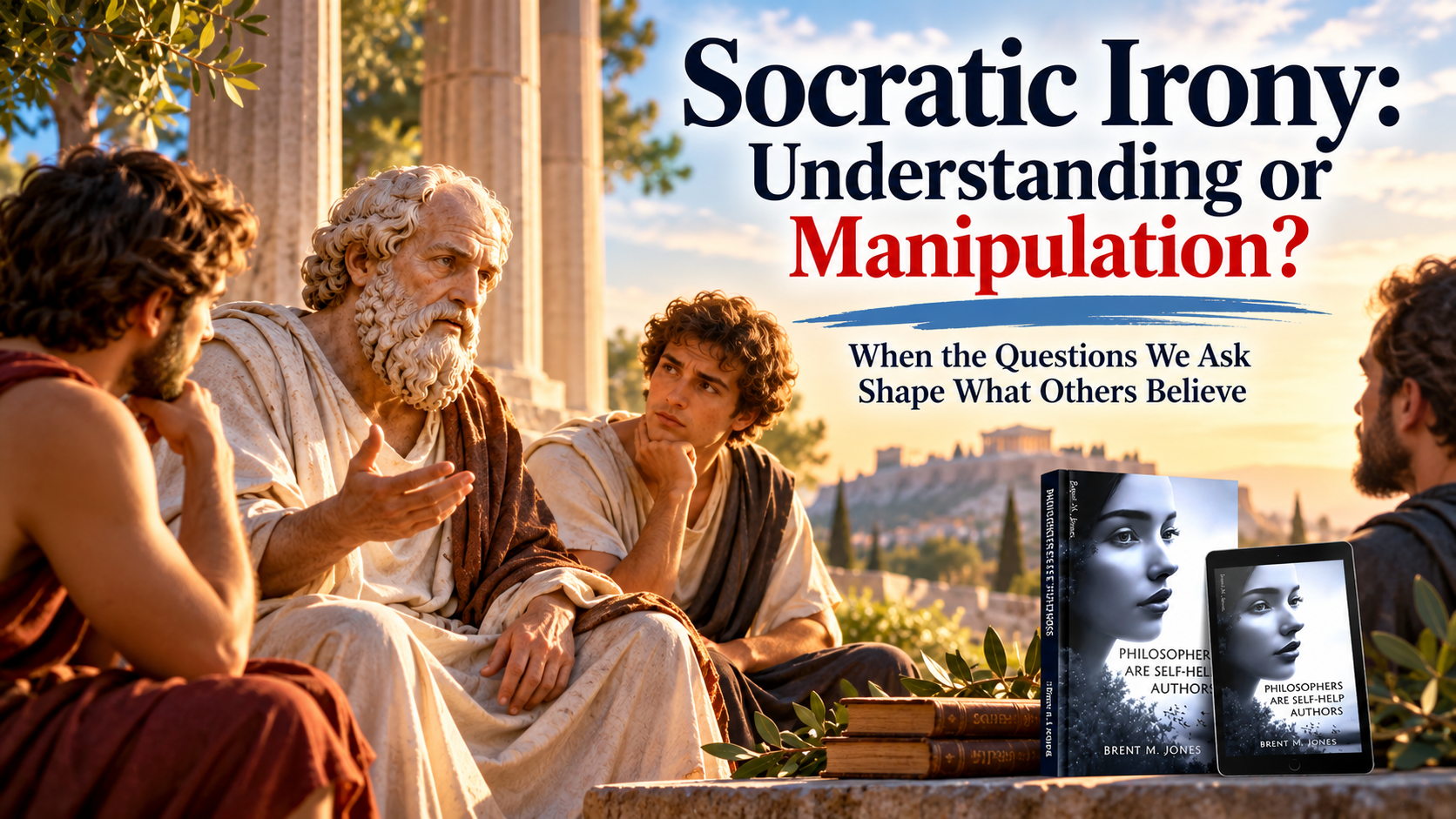
The questions we ask can reveal the truth, challenge assumptions, or quietly influence what others believe.
Socrates is remembered as one of history's most influential philosophers, yet much of his teaching was built around something surprisingly simple: asking questions.
Rather than presenting himself as someone who possessed all the answers, Socrates often approached conversations as though he had something to learn.
He would ask people to explain their beliefs, define their assumptions, and consider whether their reasoning was consistent.
This approach became associated with Socratic irony, a technique in which someone professes ignorance, sometimes deliberately, to encourage another person to explain what they believe they know.
But there is an interesting question beneath this method.
When does asking questions become a sincere search for understanding, and when does it become a strategy for influencing or manipulating others?
The distinction matters as much today as it did in ancient Greece.
Socratic Irony and the Appearance of Not Knowing
Socrates frequently engaged people who were confident in their knowledge of subjects such as justice, courage, virtue, and morality.
Rather than directly challenging their conclusions, he often began by asking apparently simple questions.
What is courage?
What makes an action just?
How do we know that something is good?
As the conversation continued, additional questions sometimes revealed contradictions or weaknesses in the original answers.
A person who began the discussion certain of what they believed might eventually recognize that the issue was more complicated than expected.
This process was not simply about winning an argument.
At its best, it encouraged intellectual humility, the recognition that our understanding may be incomplete.
Socratic irony is closely related to the broader Socratic method of questioning, although they are not identical. Socratic irony involves an apparent lack of knowledge, while the Socratic method uses systematic questioning to examine ideas and assumptions.
Both approaches remind us that a thoughtful question can accomplish something a direct statement often cannot.
A statement tells someone what we think. A question invites them to examine what they think.
Why Questions Can Be More Powerful Than Answers
We often assume that effective communication means explaining our position clearly and persuading others to accept it.
But questions work differently.
When someone asks us a meaningful question, we must consider our own reasoning. We may discover assumptions we have overlooked or recognize that our conclusions are based on incomplete information.
Consider a conversation about an important career decision.
Someone might say:
"You should find another job."
That is advice, and it may or may not be useful.
But consider a different approach:
"What is it about your current work that makes you unhappy?"
"Would changing employers solve that problem?"
"What would you want your next opportunity to provide that your current position does not?"
These questions encourage the individual to examine the situation rather than simply accept someone else's conclusion.
The answers may lead to a different decision than the questioner expected.
And that is an important distinction.
Questions intended to encourage understanding leave room for answers we may not anticipate or agree with.
When Questioning Becomes Manipulation
The same technique can be used for less constructive purposes.
A person may ask questions not because they want to understand another perspective, but because they already have a particular conclusion in mind.
The questions may be carefully arranged to lead someone toward that conclusion while making it seem as though the other person reached it independently.
For example, imagine a manager who wants an employee to accept additional responsibilities without additional compensation.
Rather than making a direct request, the manager might ask:
"Don't you want to be seen as someone who goes above and beyond?"
"Wouldn't taking on this work demonstrate your commitment?"
"Do you think people who turn down opportunities are considered for advancement?"
These questions invite reflection, but they also assume loyalty, ambition, and professional opportunity.
The employee may feel pressured to agree without realizing the conversation is structured around the manager's desired outcome.
This is where questioning can become manipulation.
The problem is not necessarily the wording of any individual question. It is the intention behind the questions and whether the other person is genuinely free to disagree.
The Difference Between Persuasion and Manipulation
Persuasion is part of ordinary human communication.
We persuade others when we explain our reasoning, present evidence, or encourage them to consider an alternative perspective.
There is nothing inherently wrong with trying to influence someone's thinking.
In fact, education, leadership, negotiation, and meaningful conversation all involve some degree of influence.
Manipulation becomes a concern when influence depends on concealed intentions, misleading assumptions, emotional pressure, or the deliberate restriction of another person's choices.
Questions can serve either purpose.
A thoughtful teacher may use questions to help students discover weaknesses in their reasoning.
A skilled negotiator may use questions to understand the other party's priorities and identify possible agreements.
But someone seeking control may use similar questions to create uncertainty, encourage self-doubt, or guide another person toward a predetermined decision.
The difference often lies in whether the questioner respects the other person's independence.
Good questioning encourages people to think for themselves. Manipulative questioning attempts to control what they think.
Why Feigned Ignorance Can Be Effective
There is another interesting aspect of Socratic irony.
When someone appears not to know the answer, the other person may feel more comfortable explaining their position.
This can lower defensiveness and encourage a more open conversation.
It can also reveal information that might remain hidden in a direct argument.
In a constructive discussion, admitting uncertainty can demonstrate humility and genuine curiosity.
But deliberately pretending not to understand can also be used strategically.
Someone might repeatedly ask for explanations to expose another person's uncertainty, avoid taking responsibility for their own position, or create an advantage in a disagreement.
This does not mean that every expression of ignorance is dishonest.
Sometimes we genuinely do not understand. Sometimes asking someone to explain their thinking is the most respectful response we can offer.
The important question is whether the apparent uncertainty is sincere or being used to achieve an undisclosed purpose.
What Socratic Questioning Can Teach Us About Ourselves
Socratic questioning is not limited to conversations with other people.
We can apply the same approach to our own assumptions.
Many of the beliefs guiding our decisions have become so familiar that we rarely examine them.
We may believe that we understand our motivations, recognize our limitations, or know what will make us happy.
But what happens when we begin questioning those conclusions?
Why do I believe this?
What evidence supports my assumption?
Could there be another explanation?
Am I considering the facts, or am I protecting a belief I don't want to change?
What would cause me to reconsider my position?
These questions may not produce immediate answers.
Their value lies in helping us recognize that our first interpretation is not necessarily the only reasonable one.
This is one reason ancient philosophy remains relevant to modern personal development.
Self-understanding requires more than examining what we think. It also requires examining why we think it.
The Responsibility That Comes With Asking Questions
Questions are powerful because they influence the direction of a conversation.
The person asking the questions often determines which subjects receive attention, which assumptions are challenged, and which possibilities are considered.
That creates a responsibility.
If our purpose is understanding, we should be willing to listen carefully, acknowledge uncertainty, and accept answers that differ from our expectations.
If our purpose is persuasion, we should be reasonably transparent about the position we are advocating.
And when someone questions us, we should recognize that we are not obligated to accept the assumptions built into every question.
Sometimes the most useful response is another question:
"Why are you asking me that?"
"What assumption are we making?"
"Is there another way to look at this?"
These responses can help restore balance to a conversation and encourage more thoughtful communication.
Ancient Philosophy and Modern Communication
Socrates lived more than two thousand years ago, but the challenges surrounding questioning, influence, and understanding remain familiar.
We encounter them in professional relationships, political discussions, personal disagreements, education, and everyday conversations.
Questions can open the door to understanding.
They can help people reconsider assumptions, recognize contradictions, and discover possibilities they had overlooked.
But people can also use them to pressure, confuse, or manipulate.
The technique itself does not determine the outcome.
Much depends on the asker's intentions, the circumstances of the conversation, and everyone's willingness to consider different perspectives.
Perhaps the most enduring lesson of Socratic irony is that wisdom does not always begin with knowing the answer.
Sometimes it begins with recognizing that we need to ask a better question.
Perhaps the most important question of all is whether we are asking to understand or to control.
About the Book: Philosophers Are Self-Help Authors
In Philosophers Are Self-Help Authors, I explore how ancient philosophical ideas still shape modern approaches to personal growth, communication, and self-understanding.
From Socratic questioning to Aristotle's emphasis on character and the Stoic approach to resilience, the book examines how philosophical wisdom can help us think more carefully about the choices we make and the lives we lead.
Ancient philosophers’ ideas remain valuable not because they provide simple answers, but because they encourage us to question our assumptions and develop a deeper understanding of ourselves and others.
Reader Reviews for Philosophers Are Self-Help Authors: What Readers Are Saying About the Wisdom Within
Reader Reviews
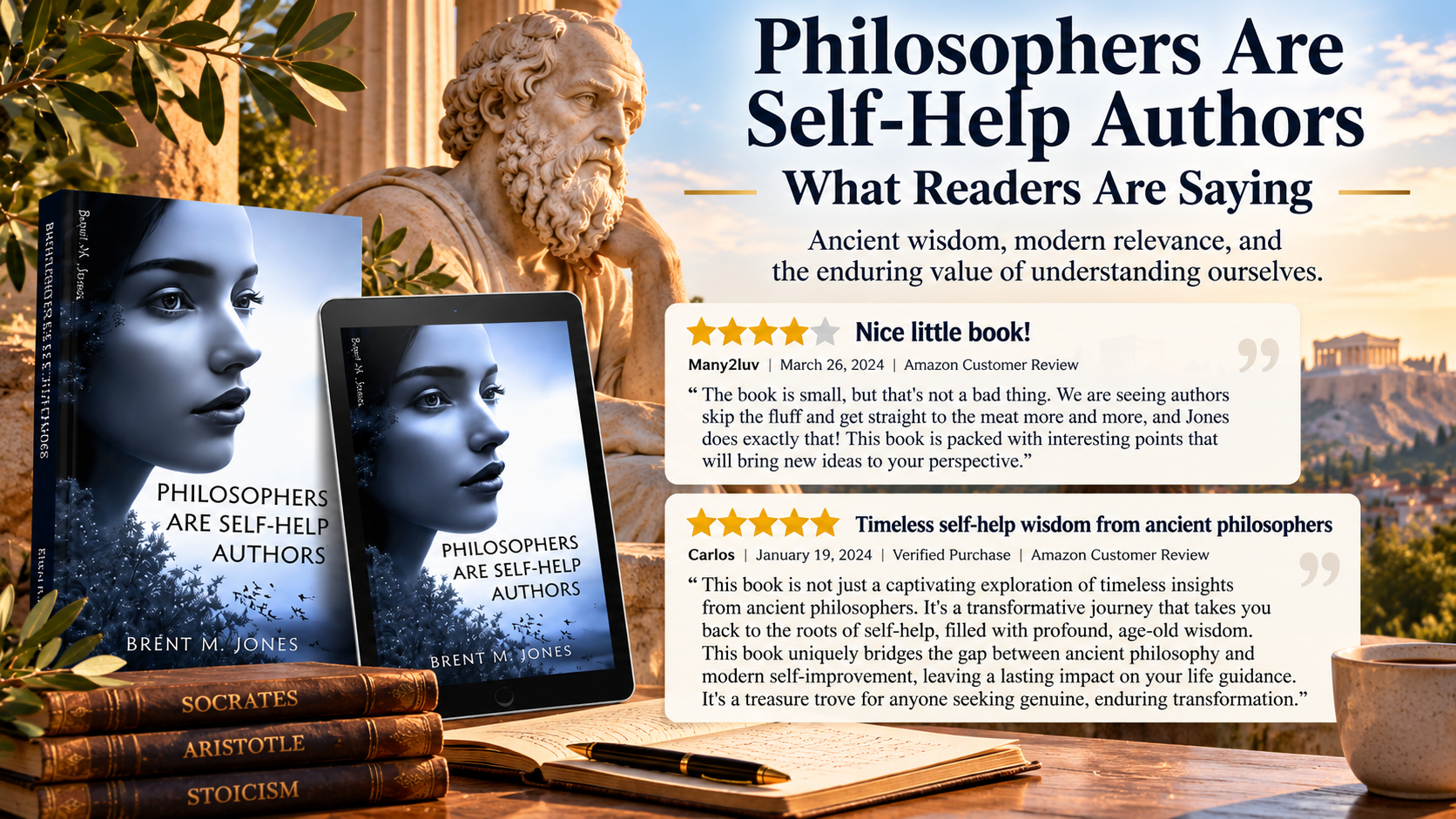
"Nice little book!"
4 out of 5 stars
Many2luv | March 26, 2024 | Amazon Customer Review
The book is small, but that's not a bad thing. More and more, authors skip the fluff and get straight to the meat, and Jones does exactly that! This book is packed with interesting points that will broaden your perspective.
This review highlights what I hoped to accomplish with the book: presenting meaningful ideas without unnecessary complication.
Philosophy can sometimes seem intimidating, particularly when its concepts are presented in academic language. My intention was to make these ideas approachable and relevant to everyday life.
"Timeless self-help wisdom from ancient philosophers"
5 out of 5 stars | Verified Purchase
Carlos | January 19, 2024 | Amazon Customer Review
This book is not just a captivating exploration of timeless insights from ancient philosophers. It's a transformative journey that takes you back to the roots of self-help, filled with profound, age-old wisdom. This book uniquely bridges the gap between ancient philosophy and modern self-improvement, leaving a lasting impact on your life guidance. It's a treasure trove for anyone seeking genuine, enduring transformation.
This reader identifies the central connection I wanted to explore: the relationship between ancient philosophy and modern personal development.
Although our circumstances have changed considerably over the centuries, many of the questions we ask about ourselves remain remarkably similar.
How should we live? What gives life meaning? How do we develop better judgment? What can we learn from our experiences?
These are not new questions, and the philosophers of antiquity devoted considerable attention to them.
Why These Ideas Still Matter
One of the reasons I wrote Philosophers Are Self-Help Authors was to challenge the assumption that personal development is primarily a modern concept.
Long before self-help became a publishing category, philosophers were examining human behavior, character, responsibility, and the pursuit of a meaningful life.
Their approaches differed, but many shared the belief that understanding ourselves could help us make wiser choices.
I believe that remains one of philosophy's most valuable contributions.
The purpose of the book is not to suggest that ancient philosophers had all the answers. Rather, it is to introduce readers to ideas that may encourage them to ask better questions about their own lives.
Explore Philosophers Are Self-Help Authors
If you're interested in self-awareness, personal growth, or the relationship between philosophy and everyday life, Philosophers Are Self-Help Authors offers an accessible introduction to these enduring ideas.
Sometimes the most useful guidance for understanding our lives comes from questions people began asking thousands of years ago.
Explore Philosophers Are Self-Help Authors by Brent M. Jones on Amazon.