G-7NDSD6WRGQ
  • Home |
  • Signature Essays |
    • Reflective Non-Fiction
    • Personal Reflections & Influences
    • Life Meaning & Presence
    • Authenticity Matters
    • About Attitudes & Feelings
    • Alignment & Self Understanding
    • Creativity and Meaning
    • Influence, Persuasion & Manipulation
    • Finding Inspiration
    • Kindness & Doing Good
    • Positivity
    • The Stories We Tell Ourselves
    • Personal Reinvention
    • Well-Being Over Time
    • Literature & Meaning
    • Essays & Reflections
    • Philosophy & Meaning
    • Poetry Why it Matters
    • Poetry by Brent M. Jones
    • Poetry Favorites Reviewed
    • Art, Imagery & Reviews
    • Visual Essays
    • Writers Who Shaped How I Think
    • Writer Symbolism
    • Thoughts & Quotes
    • Explore My Books: Find Your Next Read
    • What Matters: We Are the Sum of Small Moments
    • The Power of Authentic Communication: In a World Full of Noise, Authentic Communication Stands Out
    • The Human Factor: Discover Yourself, Clarify Your Purpose, Create Work That Matters
    • Finding the Best Version of Ourselves: The Interview of Self
    • Terminology Is More Than Words
    • Embrace Life’s Randomness: Path to Personal Reinvention
    • Why Life Stories Change Are We a Result of Choice or Circumstance
    • Why Professionals Use LinkedIn
    • Networking With a Purpose: The Informational Interview, It's Use ...................l
    • Work Matters It takes Technology..
    • Philosophers are Self Help Authors
    • Interviewing Yourself and Asking The Right Questions
    • Earlier Edition - The Human Factor
    • Earlier Edition: Work Matters
    • Praise and Reader Reviews
    • Books Read Reviews
    • Book Review Index A-Z
    • Books Read but Not Reviewed
    • Communication
    • Human Connection & Communication
    • Work, Change & Growth
    • Career -Insights
    • Coaching & Mentoring
    • Soft Skills
    • Work & Careers
    • Employment Trends & Thoughts
    • Interviews & Resumes
    • Platforms & Visibility
    • Networking & Informational Interviews
    • Marketing - Publishing
    • Jobs
  • Guest Posts |
    • Contact Information
    • About Page
    • “Copyright & Content Use”
Menu

Brent M. Jones - Connected Events Matter

11400 W Olympic Blvd Ste 200
Los Angeles, CA 90064-1584
Phone Number
Exploring the unexpected connections that shape our lives


Book Reviews, Comments & Stories,       Quotes, & Poetry & More


"Connections and Why They Matter"


Most of what happens in our life will spark a connection.  Life connects with what has been found in books. Books connect with what happens in life. Use the connections to help you see more clearly. A love of reading and writing is what motivated the creation of this blog. Thank you for coming to the blog. 


3


ff


Th

Brent M. Jones - Connected Events Matter

  • Home |
  • Signature Essays |
  • Reflective |
    • Reflective Non-Fiction
    • Personal Reflections & Influences
    • Life Meaning & Presence
    • Authenticity Matters
    • About Attitudes & Feelings
    • Alignment & Self Understanding
    • Creativity and Meaning
    • Influence, Persuasion & Manipulation
    • Finding Inspiration
    • Kindness & Doing Good
    • Positivity
    • The Stories We Tell Ourselves
    • Personal Reinvention
    • Well-Being Over Time
  • Literary |
    • Literature & Meaning
    • Essays & Reflections
    • Philosophy & Meaning
    • Poetry Why it Matters
    • Poetry by Brent M. Jones
    • Poetry Favorites Reviewed
    • Art, Imagery & Reviews
    • Visual Essays
    • Writers Who Shaped How I Think
    • Writer Symbolism
  • Thoughts |
    • Thoughts & Quotes
  • My Books |
    • Explore My Books: Find Your Next Read
    • What Matters: We Are the Sum of Small Moments
    • The Power of Authentic Communication: In a World Full of Noise, Authentic Communication Stands Out
    • The Human Factor: Discover Yourself, Clarify Your Purpose, Create Work That Matters
    • Finding the Best Version of Ourselves: The Interview of Self
    • Terminology Is More Than Words
    • Embrace Life’s Randomness: Path to Personal Reinvention
    • Why Life Stories Change Are We a Result of Choice or Circumstance
    • Why Professionals Use LinkedIn
    • Networking With a Purpose: The Informational Interview, It's Use ...................l
    • Work Matters It takes Technology..
    • Philosophers are Self Help Authors
    • Interviewing Yourself and Asking The Right Questions
    • Earlier Edition - The Human Factor
    • Earlier Edition: Work Matters
    • Praise and Reader Reviews
  • Book Reviews |
    • Books Read Reviews
    • Book Review Index A-Z
    • Books Read but Not Reviewed
  • Professional |
    • Communication
    • Human Connection & Communication
    • Work, Change & Growth
    • Career -Insights
    • Coaching & Mentoring
    • Soft Skills
    • Work & Careers
    • Employment Trends & Thoughts
    • Interviews & Resumes
    • Platforms & Visibility
    • Networking & Informational Interviews
    • Marketing - Publishing
    • Jobs
  • Guest Posts |
  • Contact |
    • Contact Information
  • About Author |
    • About Page
    • “Copyright & Content Use”
Writers Who Shaped My Thinking.png

.

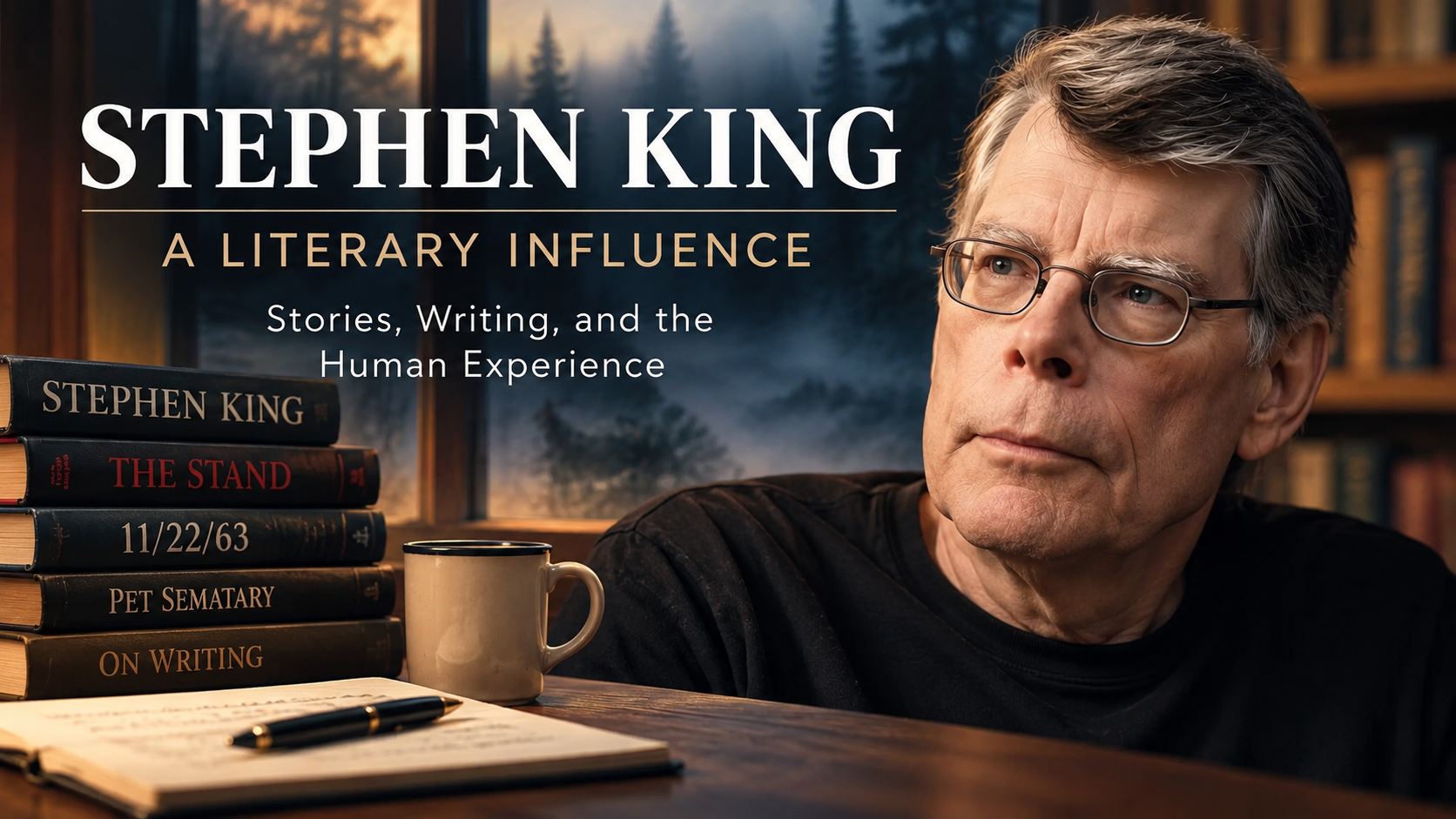
Stephen King: What a Master Storyteller Taught Me About Writing

October 16, 2026 Brent Jones
. RSS

By Brent M. Jones

Some writers’ books we enjoy; others change the way we think about writing itself. For me, Stephen King belongs in the second category.

I've read enough of his books to admit that his storytelling can be addictive. But what keeps me returning isn't simply the suspense, the unexpected twists, or the sometimes disturbing subjects he explores. It's his remarkable ability to make readers care about people in extraordinary circumstances.

King is often identified primarily as a horror writer. That description has always seemed too narrow to me. His stories explore fear, certainly, but they also examine friendship, childhood, memory, grief, morality, and the choices people make when they cannot control their circumstances.

The supernatural may set the scene, but human nature usually sits at the center of the story.

What Stephen King Understands About Storytelling

One of King's greatest strengths is making the unbelievable feel believable.

He accomplishes this not simply through plot, but through the ordinary details of human experience. His characters have recognizable weaknesses, familiar concerns, and complicated relationships. They worry about their families, their work, past mistakes, and what others think.

Then something unexpected happens.

The resulting story becomes more than an account of frightening events. It becomes an exploration of how people respond when the world they thought they understood changes suddenly.

I've always found that particularly interesting because real life often works in much the same way.

We move through familiar routines, making plans and believing we have some understanding of where life is taking us. Then an unexpected event changes our circumstances, sometimes permanently.

King builds extraordinary stories around that familiar human experience.

Reading Stephen King Is an Education in Writing

I have learned a great deal about writing simply by reading King's books.

His plots can be complicated, but his writing often feels conversational and accessible. He knows how to establish a scene, develop a character, and create the curiosity that makes a reader want to continue.

He also understands that readers need reasons to care about what happens next.

Suspense alone is rarely enough. We must become invested in the people experiencing it.

That lesson applies well beyond fiction. Whether someone is writing a novel, a personal reflection, or a book about human relationships, the reader needs a connection to the subject.

Good writing doesn't merely communicate information. It creates an experience that encourages the reader to think and feel.

The Importance of On Writing

Of all King's books, On Writing: A Memoir of the Craft has particular significance for me.

It is part memoir and part examination of what it means to be a writer. Rather than presenting writing as something mysterious, King describes it as a craft that requires attention, discipline, imagination, and considerable reading.

One of his memorable observations is:

"You must not come lightly to the blank page."

I appreciate the seriousness behind that statement.

Writing may begin with an idea, but turning that idea into something meaningful requires work. It also requires a willingness to discover that what we initially intended to say may not be quite what eventually appears on the page.

I have experienced that in my own writing.

Sometimes I begin with a particular observation or question, only to find that the process of writing leads me somewhere I hadn't anticipated.

The act of writing becomes part of the thinking.

That may be one of the most valuable lessons I've taken from King. Writing isn't always the expression of something we already understand. Sometimes it is how we come to understand it.

Does Popular Fiction Have Literary Merit?

King's extraordinary commercial success has sometimes been accompanied by arguments about the literary value of his work.

I've never found the distinction between popular fiction and serious literature particularly convincing.

A book doesn't become less meaningful simply because millions of people enjoy reading it. Nor does a difficult book automatically become more valuable because fewer people understand it.

Literature can challenge us in many ways.

It can introduce unfamiliar ideas, reveal something about human behavior, or cause us to reconsider assumptions we've carried for years.

Sometimes it accomplishes those things through philosophical reflection. Sometimes it does so through a frightening story about an ordinary person facing an impossible situation.

King's work frequently asks readers to consider what fear, loss, loyalty, and moral choices reveal about human character.

That seems to me a worthwhile literary accomplishment.

Memory, Experience, and the Stories We Carry

Another aspect of King's writing that interests me is his use of memory.

His stories frequently return to childhood experiences, old friendships, personal wounds, and events that continue influencing people long after they occurred.

King has written memorably about the relationship between writers and the emotional scars they carry.

That idea connects with something I've explored repeatedly in my own essays and books: our past experiences don't simply disappear. They continue shaping how we understand ourselves and the world around us.

Memory is selective. We remember some experiences vividly while others fade. And as we grow older, even the meaning of what we remember can change.

A writer has the opportunity to examine those memories, reconsider their significance, and sometimes discover connections that weren't apparent when the events originally occurred.

King does this through fiction. Much of my own writing approaches similar questions through personal reflection and nonfiction.

The methods are different, but the underlying interest in human experience is not.

A Writer Who Refuses to Be Confined by Genre

Although King is best known for horror, his writing extends into fantasy, suspense, crime, science fiction, and stories that resist easy classification.

That range is another reason I admire his work.

Consider the differences between The Stand, 11/22/63, The Green Mile, and Pet Sematary. Their settings, subjects, and emotional experiences vary considerably, yet each reflects King's interest in how people respond to extraordinary circumstances.

His short fiction offers another perspective on his versatility.

In The Bazaar of Bad Dreams, he demonstrates how a relatively brief story can introduce a disturbing possibility, develop a compelling situation, and leave the reader thinking long after the final page.

The lesson for writers is that the subject or genre need not define the limits of what we can explore.

What matters is whether the story communicates something meaningful.

Why Stephen King Remains a Literary Influence

I don't write horror novels, and my own books are very different from King's.

Yet I recognize several qualities in his work that I value in writing generally: curiosity about human behavior, attention to seemingly ordinary experiences, and an understanding that the events of our lives often have consequences far beyond the moment in which they occur.

Most of all, King reminds me that writing should engage the reader.

It should invite curiosity, create connections, and occasionally challenge the way we understand something familiar.

I began reading Stephen King because I enjoyed his stories.

I continue to appreciate his work because it has helped me think more carefully about storytelling itself.

And perhaps that is one of the best things we can say about a writer: we come for the story, but we leave with something more to think about.

Related Reading

Find all the Stephen King Books I have reviewed in the book review index


Originally published September 27, 2019. Revised and expanded October 2026.

Source: https://connectedeventsmatter.com/literary...
In Writers Who Shaped Me Tags Stephen King, Literary Influences, Storytelling, Creative Writing, On Writing, Writing and Memory, Human Nature, Writers Who Shaped My Thinking
Comment

My Stephen King Collection: A Look Inside Our Home Library

October 13, 2026 Brent Jones
. RSS

By Brent M. Jones

Books have been an important part of my life for as long as I can remember. Over the years, our home library has grown to approximately 2,000 books, with about 1,500 occupying the shelves of a dedicated room lined with books on three sides.

Among those books is a substantial collection of works by Stephen King, an author whose storytelling I've admired for many years.

There is something satisfying about being surrounded by books that have entertained us, challenged our thinking, and introduced us to ideas we might never have encountered otherwise.

A home library becomes more than a collection of titles. It becomes a record of our interests, our curiosity, and sometimes the different stages of our lives.

A Personal Tour of Our Home Library

In the video below, I take you inside our library, focusing especially on my Stephen King collection.

Watch My Home Library Tour on YouTube

The video also includes observations about the variety of books in our collection, from classic literature to contemporary fiction, and some of my earlier experiences with social media.

Looking back at those comments now is interesting in itself. Our understanding of technology, communication, and even our own interests changes over time.

Why Stephen King Has a Special Place on My Shelves

Stephen King is one of those writers whose books are difficult to put down.

His ability to develop characters, create suspense, and turn ordinary circumstances into extraordinary stories has always impressed me.

But my appreciation of King goes beyond the entertainment his books provide.

Reading his work has taught me something about storytelling. He understands how to make readers care about his characters before placing them in situations that test their courage, judgment, and understanding of themselves.

His books frequently explore fear, friendship, memory, loss, and the unexpected events that change people's lives.

Those subjects interest me because they are also part of the human experience I explore in my own nonfiction writing.

What a Home Library Represents

When I look at our bookshelves, I see more than individual books.

I see subjects that once captured my attention, authors who influenced my thinking, and stories that have stayed with me long after I finished reading them.

Some books were read for enjoyment. Others helped me understand an unfamiliar subject or reconsider something I thought I already knew.

And some have become more meaningful with the passage of time.

That is one of the interesting things about reading. A book doesn't necessarily change, but the person reading it does.

We bring different experiences, questions, and perspectives to the same words at different points in our lives.

A book that meant one thing years ago may reveal something entirely different when we return to it.

The Connection Between Reading and Writing

As I've spent more time writing my own books and essays, I've come to appreciate the relationship between reading and writing even more.

Reading exposes us to different ways of organizing thoughts, developing ideas, and communicating experiences.

Sometimes we learn from the subject itself. Other times, we learn from how the author tells the story.

Stephen King's On Writing is especially valuable in that respect. It reminds us that writing requires both imagination and discipline, and that reading widely is part of developing our own ability to communicate.

My writing is very different from King's, but I appreciate his understanding of the relationship between storytelling and human nature.

More Than a Collection of Books

Our home library reflects years of reading, collecting, learning, and changing interests.

The Stephen King collection is one part of that larger story.

I originally made this video simply to share some books and thoughts with others who enjoy reading. Looking back, I realize it also captures something personal: the way books become part of the history of our lives.

We may remember when we first encountered an author, why a particular book mattered, or how a story changed our perspective.

And sometimes, standing in front of a bookshelf, we discover that we're looking at more than books.

We're looking at reminders of who we were, what interested us, and how our thinking has evolved.

Related Reading

A companion essay exploring King's influence on my understanding of storytelling, memory, writing, and human nature.

Originally published January 2, 2020. Revised and expanded October 2026.

Stephen King: What a Master Storyteller Taught Me About Writing
In Writers Who Shaped Me Tags Stephen King, Home Library, Book Collection, Literary Influences, Reading and Writing, On Writing, Personal Reflections, Books and Memory
Comment
. RSS

About

Brent M. Jones

Brent writes with quiet confidence and curiosity, exploring communication, reinvention, and what truly matters. His reflections invite readers to slow down, reconsider their stories, and reconnect with the values that guide them. Through books, essays, and his What Matters Substack Articles and Notes, he offers thoughtful writing shaped by observation, experience, and reflection.

Subscribe to Subtack-Newsletter-What Matters
Author's Page Amazon
Book Review Section
Book Review index
Click to Read the poem -People come into your life ..........

CONNECTED EVENTS MATTER

Because they Explain Who We are and Where We Are Going

 © Copyright 2026 Connected Events Matter

© 2026 Brent M. Jones / Connected Events Publishing. All essays, reflections, poetry, and original content on this site are protected by copyright and may not be reproduced without permission.

See more information about Copyright & Content Use