• Home |
  • Signature Essays |
    • Reflective Non-Fiction
    • Personal Reflections & Influences
    • Life Meaning & Presence
    • Authenticity Matters
    • About Attitudes & Feelings
    • Alignment & Self Understanding
    • Creativity and Meaning
    • Influence, Persuasion & Manipulation
    • Finding Inspiration
    • Kindness & Doing Good
    • About Positivity
    • The Stories We Tell Ourselves
    • Personal Reinvention
    • Well-Being Over Time
    • Literature & Meaning
    • Essays & Reflections
    • Philosophy & Meaning
    • Poetry Why it Matters
    • Poetry by Brent M. Jones
    • Poetry Favorites Reviewed
    • Art, Imagery & Reviews
    • Visual Essays
    • Writers Who Shaped How I Think
    • Writer Symbolism
    • Thoughts & Quotes
    • What Matters: We Are the Sum of Small Moments
    • The Power of Authentic Communication: In a World Full of Noise, Authentic Communication Stands Out
    • The Human Factor: Discover Yourself, Clarify Your Purpose, Create Work That Matters
    • Finding the Best Version of Ourselves: The Interview of Self
    • Terminology Is More Than Words
    • Embrace Life’s Randomness: Path to Personal Reinvention
    • Why Life Stories Change Are We a Result of Choice or Circumstance
    • Why Professionals Use LinkedIn
    • Networking With a Purpose: The Informational Interview, It's Use ...................l
    • Work Matters It takes Technology..
    • Philosophers are Self Help Authors
    • Interviewing Yourself and Asking The Right Questions
    • Earlier Edition - The Human Factor
    • Earlier Edition: Work Matters
    • Praise and Reader Reviews
    • Book Reviews
    • Book Review Index A-Z
    • Contact Information
    • Communication
    • Human Connection & Communication
    • Change & Trends
    • Career -Insights
    • Coaching & Mentoring
    • Soft Skills
    • Work & Careers
    • Employment Trends & Thoughts
    • Interviews & Resumes
    • Platforms & Visibility
    • Informational Interviews
    • Marketing - Publishing
    • Jobs
  • Guest Posts
    • About Page
    • “Copyright & Content Use”
Menu

Brent M. Jones - Connected Events Matter

11400 W Olympic Blvd Ste 200
Los Angeles, CA 90064-1584
Phone Number
Exploring the unexpected connections that shape our lives


Book Reviews, Comments & Stories,       Quotes, & Poetry & More


"Connections and Why They Matter"


Most of what happens in our life will spark a connection.  Life connects with what has been found in books. Books connect with what happens in life. Use the connections to help you see more clearly. A love of reading and writing is what motivated the creation of this blog. Thank you for coming to the blog. 


3


ff


Th

Brent M. Jones - Connected Events Matter

  • Home |
  • Signature Essays |
  • Reflective |
    • Reflective Non-Fiction
    • Personal Reflections & Influences
    • Life Meaning & Presence
    • Authenticity Matters
    • About Attitudes & Feelings
    • Alignment & Self Understanding
    • Creativity and Meaning
    • Influence, Persuasion & Manipulation
    • Finding Inspiration
    • Kindness & Doing Good
    • About Positivity
    • The Stories We Tell Ourselves
    • Personal Reinvention
    • Well-Being Over Time
  • Literary |
    • Literature & Meaning
    • Essays & Reflections
    • Philosophy & Meaning
    • Poetry Why it Matters
    • Poetry by Brent M. Jones
    • Poetry Favorites Reviewed
    • Art, Imagery & Reviews
    • Visual Essays
    • Writers Who Shaped How I Think
    • Writer Symbolism
  • Thoughts |
    • Thoughts & Quotes
  • My-Books |
    • What Matters: We Are the Sum of Small Moments
    • The Power of Authentic Communication: In a World Full of Noise, Authentic Communication Stands Out
    • The Human Factor: Discover Yourself, Clarify Your Purpose, Create Work That Matters
    • Finding the Best Version of Ourselves: The Interview of Self
    • Terminology Is More Than Words
    • Embrace Life’s Randomness: Path to Personal Reinvention
    • Why Life Stories Change Are We a Result of Choice or Circumstance
    • Why Professionals Use LinkedIn
    • Networking With a Purpose: The Informational Interview, It's Use ...................l
    • Work Matters It takes Technology..
    • Philosophers are Self Help Authors
    • Interviewing Yourself and Asking The Right Questions
    • Earlier Edition - The Human Factor
    • Earlier Edition: Work Matters
    • Praise and Reader Reviews
  • Book-Reviews |
    • Book Reviews
    • Book Review Index A-Z
  • Substack |
    • Contact Information
  • Professional Insights |
    • Communication
    • Human Connection & Communication
    • Change & Trends
    • Career -Insights
    • Coaching & Mentoring
    • Soft Skills
    • Work & Careers
    • Employment Trends & Thoughts
    • Interviews & Resumes
    • Platforms & Visibility
    • Informational Interviews
    • Marketing - Publishing
    • Jobs
  • Guest Posts
  • About Brent M. Jones |
    • About Page
    • “Copyright & Content Use”
Literature & Meaning (1).png

.

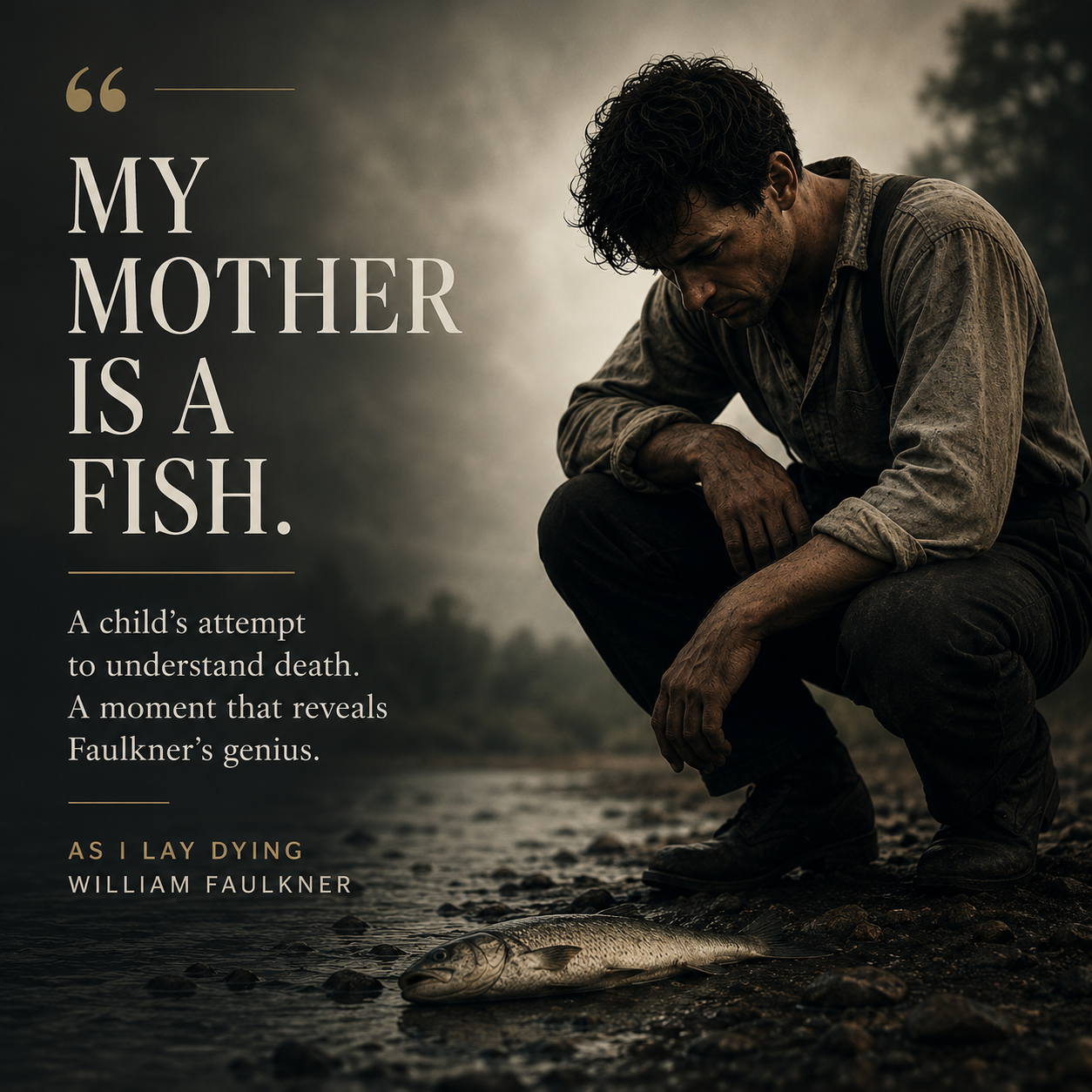
What Does "My Mother Is a Fish" Mean? Understanding Faulkner's Most Famous Line

May 10, 2026 Brent Jones
. RSS

In As I Lay Dying, William Faulkner gives readers one of the most haunting and puzzling lines in American literature:

“My mother is a fish.”

The sentence comes from Vardaman, Addie Bundren’s young son, shortly after his mother dies. At first glance, the statement feels absurd, almost detached from reality. Yet the line has endured for generations precisely because it captures something difficult to explain: the confusion of grief when language itself begins to fail.

"My mother is a fish" symbolizes Vardaman Bundren's struggle to understand his mother's death in William Faulkner's As I Lay Dying. After catching and cutting up a fish shortly before Addie Bundren dies, Vardaman associates the transformation of the fish with the transformation he sees in his mother. The sentence captures the confusion of grief through the mind of a child.

Earlier in the novel, Vardaman catches and cuts apart a fish. What was once alive and recognizable becomes something altered — fragmented, transformed into something no longer fully identifiable as what it had been before. In the mind of a child, that experience becomes linked to death.

His mother was once alive.

Now she is still physically present, yet somehow no longer the same.

Vardaman struggles to reconcile those two realities. The sentence is not logical in an adult sense, but grief rarely is. Children often search for understanding through association rather than abstraction. The fish becomes a way for Vardaman to express a transformation he cannot yet articulate.

Faulkner’s genius lies in how little he explains.

The line is brief, almost primitive, but emotionally enormous. It reflects how death can fracture identity, memory, and understanding all at once. The person remains before us physically, yet feels unreachable. Language collapses under the weight of what has changed.

This is why the line continues to resonate. It is not merely strange. It is human.

And perhaps that is what Faulkner understood so well: sometimes the deepest truths arrive in sentences that seem impossible at first glance.

see the book review of "As i lay dying"
Source: https://connectedeventsmatter.com/litera/v...
In Literature & Meaning Tags William Faulkner, As I Lay Dying, My Mother Is a Fish, Literary Symbolism, American Literature, Writer Symbolism, Literary Analysis
Comment

“My Mother Is a Fish”: Why Faulkner’s Most Peculiar Line Still Resonates →

November 22, 2025 Brent Jones
. RSS

There are lines in literature that stay with us not because they are elegant, but because they are unsettling. William Faulkner’s As I Lay Dying gives us one of the strangest and most unforgettable: Vardaman’s declaration, “My mother is a fish.”

It’s an odd sentence—five simple words, childlike in structure, and yet heavy with meaning. For decades, it has puzzled readers, inspired essays, and filled search bars. But what keeps this line alive isn’t just its peculiarity. It’s the way it exposes something deeply human: the struggle to make sense of loss when our language hasn’t caught up to our experience.

A Child’s Logic Inside a World That Has Broken Open

Vardaman’s reasoning is literal. A fish becomes something else once it is cut apart; his mother, once alive, is now transformed into something not-mother. His world has shifted, and he reaches for the only framework he understands.

Faulkner wasn’t simply being clever here. He was showing us how children meet grief with raw logic. When the world becomes unrecognizable, they reach for metaphors they don’t yet know are metaphors.

Adults do this too—we just hide it better.

Identity, Change, and the Names We Give to Loss

There’s a deeper truth at the center of Vardaman’s confusion:

When someone changes in a way we cannot comprehend, we scramble for new language to match the new reality.

We feel this when:

  • a relationship fractures

  • a loved one becomes someone we hardly recognize

  • illness changes a person’s mind, personality, or presence

  • death reshapes our understanding of who they were

We often respond with the emotional equivalent of Vardaman’s line.
We rename the experience to survive it.

“My mother is gone.”
“The person I knew isn’t here anymore.”
“He’s not himself.”
“It doesn’t feel real.”

Language becomes a coping mechanism—imperfect, blunt, necessary.

Where Logic Fails, Metaphor Steps In

Faulkner understood something essential about human nature:

We use symbols when reality feels unmanageable.

When Vardaman says his mother is a fish, he isn’t offering a literal explanation.
He’s reaching for the only metaphor he has.

Adults do the same when we say things like:

  • “My life is in pieces.”

  • “Everything is up in the air.”

  • “I’m trying to keep my head above water.”

We tell stories to understand ourselves, even when the stories are strange.

Why This Line Still Matters Today

What makes “My mother is a fish” timeless is not the shock value.
It’s the honesty.

It captures:

  • the collapse of certainty

  • the reshaping of identity

  • the struggle to name what can’t be named

  • the way grief pulls language apart and forces it back together

It reminds us that confusion is not a failure of understanding—it is part of the process of making sense of what has changed.

Sometimes truth arrives through the simplest, strangest sentence.

Closing Reflection

Faulkner wasn’t writing about a fish.
He was writing about the fragile bridge between what we know and what we can no longer explain.

When life changes suddenly—when someone we love becomes someone we lose—we reach for words that are too small for the moment. And yet, sometimes those words are all we have.

Vardaman’s line stays with us because it exposes a reality we don’t often admit:

Grief makes children of us all.

Related Reading

If you're interested in the original context and symbolism behind Vardaman’s line, you can read my earlier 2018 analysis of As I Lay Dying here:
Related Reading

If you're interested in the original context and symbolism behind Vardaman’s line, you can read my earlier 2018 analysis of As I Lay Dying here:

“My Mother Is a Fish — Original Reflection and Commentary”
See the Book Review for as I lay dying
In Literature & Meaning Tags My Mother Is a Fish, Vardaman, As I Lay Dying, William Faulkner, Literary Analysis, Grief in Literature, Classic Literature, Stream of Consciousness
Comment
. RSS

About

Brent M. Jones

Brent writes with quiet confidence and curiosity, exploring communication, reinvention, and what truly matters. His reflections invite readers to slow down, reconsider their stories, and reconnect with the values that guide them. Through books, essays, and his What Matters Substack Articles and Notes, he offers thoughtful writing shaped by observation, experience, and reflection.

Writing that doesn’t shout—but still speaks clearly.

Subscribe to Subtack-Newsletter-What Matters
Author's Page Amazon
Book Review Section
Book Review index
Click to Read the poem -People come into your life ..........

CONNECTED EVENTS MATTER

Because they Explain Who We are and Where We Are Going

 © Copyright 2026 Connected Events Matter

© 2026 Brent M. Jones / Connected Events Publishing. All essays, reflections, poetry, and original content on this site are protected by copyright and may not be reproduced without permission.