
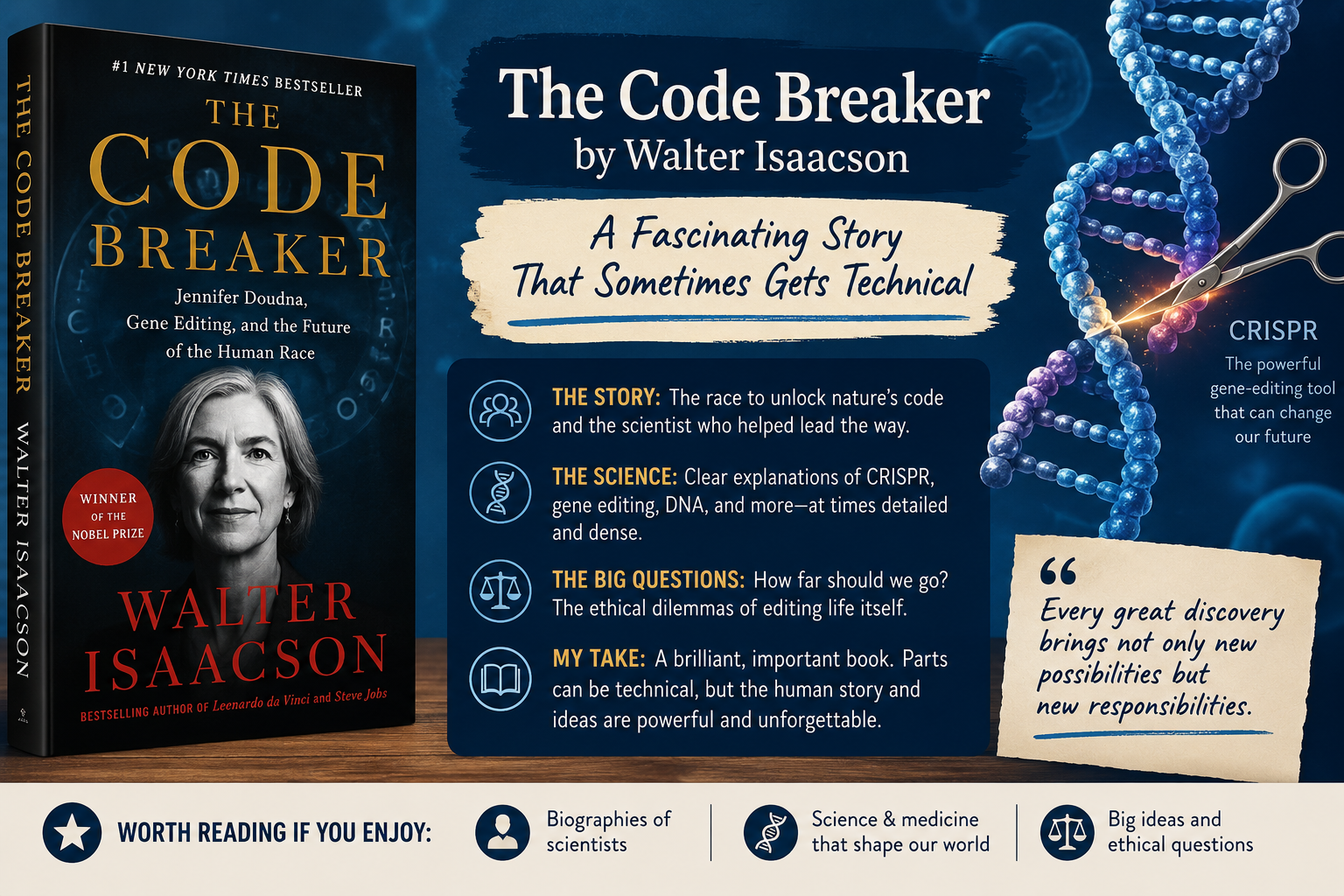
The Code Breaker: Jennifer Doudna, Gene Editing, and the Future of the Human Race is one of Walter Isaacson's most ambitious biographies. Rather than simply telling the story of Jennifer Doudna, he also explains the development of CRISPR gene-editing technology and explores the ethical questions it raises for humanity.
Overall, I would rate it 4.5 out of 5 stars.
I don't have a scientific background, so I occasionally found myself slowing down or skipping some of the more technical explanations. Even so, I never felt I had lost the central story. Walter Isaacson succeeds in showing why this discovery matters and why Jennifer Doudna's work will likely shape the future of medicine.
What the book does well
Isaacson has a gift for making complicated scientific discoveries feel like compelling human stories. Much of the book reads like a detective story, with scientists around the world racing to understand how bacteria defend themselves against viruses. Those discoveries eventually led to CRISPR, a tool that allows scientists to edit DNA with remarkable precision.
The strongest parts of the book include:
The biography of Jennifer Doudna. She comes across as brilliant, collaborative, curious, and surprisingly humble.
The competition between researchers. Isaacson captures both the excitement of discovery and the rivalries over patents, credit, and Nobel recognition.
The ethical discussion. The final chapters ask difficult questions about where gene editing should stop, especially after the birth of the first gene-edited babies in China.
Why some readers struggle
Your experience is actually very common.
Isaacson wants readers to understand enough biology to appreciate why CRISPR is revolutionary. That means he spends considerable time explaining:
DNA
RNA
genes
proteins
bacteria
viruses
enzymes
molecular biology
