Exploring the unexpected connections that shape our lives
Book Reviews, Comments & Stories, Quotes, & Poetry & More
"Connections and Why They Matter"
Most of what happens in our life will spark a connection. Life connects with what has been found in books. Books connect with what happens in life. Use the connections to help you see more clearly. A love of reading and writing is what motivated the creation of this blog. Thank you for coming to the blog.
Research has shown that social skills and personality traits are key factors in emotional intelligence, and practicing emotional competencies can increase this valuable skill set.
Self-awareness is a critical skill when it comes to EQ (emotional intelligence).Practice recognizing your own emotions to become more self-aware.
Our feelings make up our emotions, can create immediate responses, and instantaneously affect our behavior. On the other hand, attitudes are more stable over time as they involve a cognitive process that considers emotions, feelings, beliefs, and behavioral intentions.
Research has shown that social skills and personality traits are key factors in emotional intelligence, and practicing emotional competencies can increase this valuable skill set. Self-awareness is a critical skill when it comes to EQ.
Practice recognizing your emotions to become more self-aware, as they involve a cognitive process that considers emotions, feelings, beliefs, and behavioral intentions.
Feelings and attitudes improve the ability to connect with self and others, leading to healthier and happier relationships. They also improve decision-making and the ability to solve problems. Increases resilience. Reduces stress.
Expressing feelings and emotions can help you to feel better about yourself and the situation. They determine our outlook on life based on the events occurring around us. They allow us to empathize with other humans and share joy or pain. Whichever emotion you feel on a morning generally shapes how you feel throughout your day.
Emotions – even those that feel unpleasant or seem negative – have a few essential uses: Emotions drive our actions – for example, a fight, flight or freeze response. Emotions tell others that we're dealing with stressors and may need support.
When emotions are expressed appropriately, senders can formulate a message that reflects their internal status and intentions while considering audience needs and perceptions. The audience also benefits by receiving a more transparent and easily understood message. Emotions affect communication in many ways.
Emotions can play an essential role in how you think and behave. For example, the emotions you feel each day can compel you to take action and influence the decisions you make about your life, both large and small.
The idea that emotional intelligence is an important soft skill is a focus in several of Author Brent M. Jones’s books.
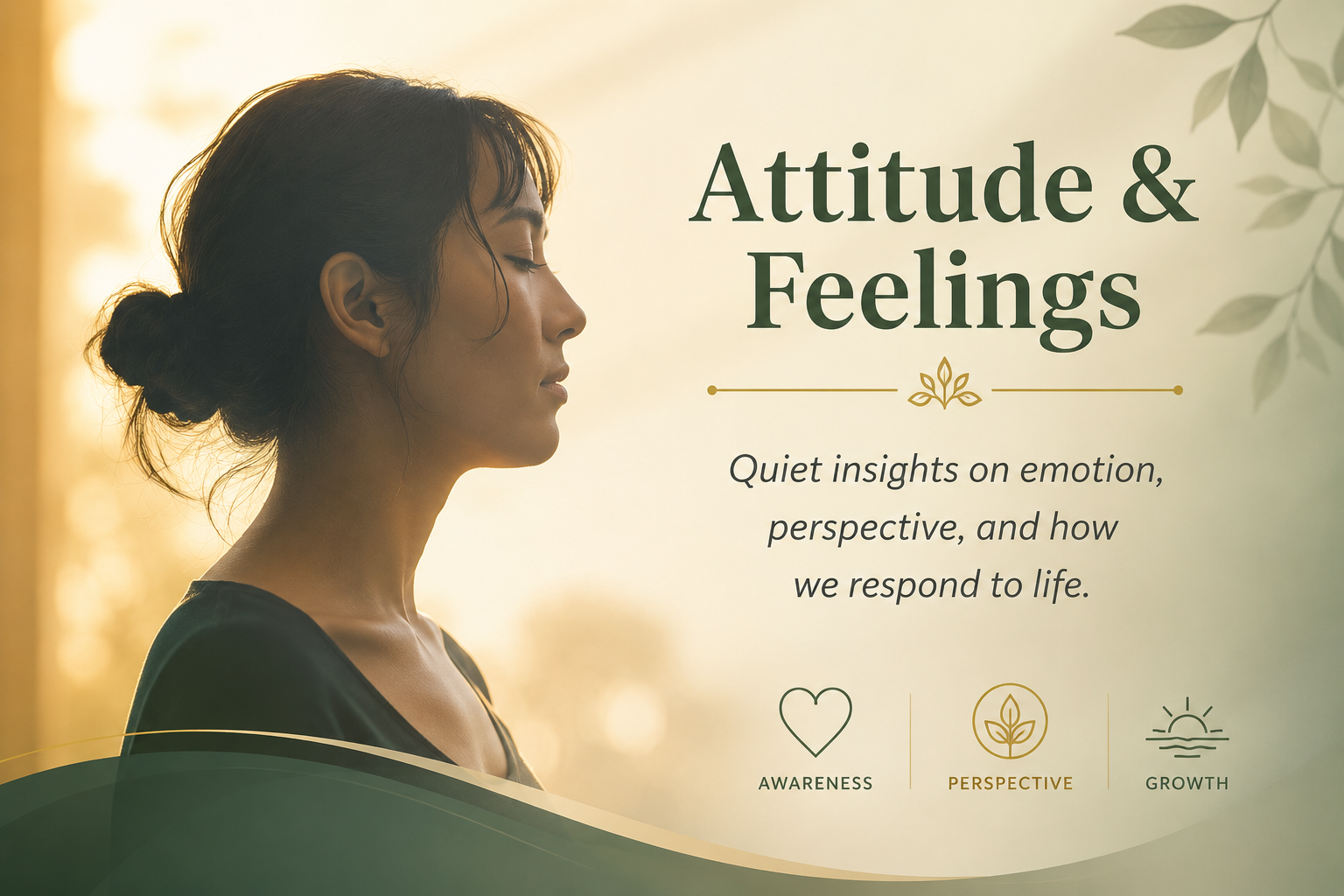
Our attitude is not a single choice we make once. It’s something that forms quietly, shaped by how we interpret events, respond to emotion, and carry experiences forward. Thoughts, feelings, and actions are closely connected, but not always in the tidy, controllable way we like to imagine.
We often try to manage our emotions by suppressing them, especially those that feel uncomfortable or inconvenient. Anger, grief, frustration, sadness. But when emotions are ignored or pushed aside, they don’t disappear. They surface elsewhere, often as tension, stress, or a sense of being stuck. What we refuse to acknowledge has a way of staying with us.
Awareness changes this. Not by fixing emotions, but by making space for them. When we allow ourselves to notice what we’re feeling—without immediately judging or correcting it—we gain clarity. Emotions begin to feel less like obstacles and more like information. They tell us something about what matters, what feels threatened, or what needs attention.
This awareness also shapes how we relate to others. When we recognize our own emotional patterns, we’re less likely to project them outward. Conversations soften. Perspective widens. Responses become more intentional rather than reactive.
None of this means living in a constant state of positivity. Human experience includes discomfort, uncertainty, and emotional fluctuation. Every feeling has value, even those we’d prefer to avoid. The goal isn’t to eliminate difficult emotions, but to let them move through us without letting them define us.
Over time, attitude becomes less about control and more about orientation. Where we place our attention. How we interpret what happens. What we choose to carry forward. When we allow ourselves to feel fully and respond thoughtfully, our actions begin to reflect not just what we think—but who we are becoming.
There’s growing research, and discussion, around the effects of suppressing emotion. For those who want to explore that further, I’ve linked a short video below.