Exploring the unexpected connections that shape our lives
Book Reviews, Comments & Stories, Quotes, & Poetry & More
"Connections and Why They Matter"
Most of what happens in our life will spark a connection. Life connects with what has been found in books. Books connect with what happens in life. Use the connections to help you see more clearly. A love of reading and writing is what motivated the creation of this blog. Thank you for coming to the blog.
And yet, sometimes we respond to it as though it is.
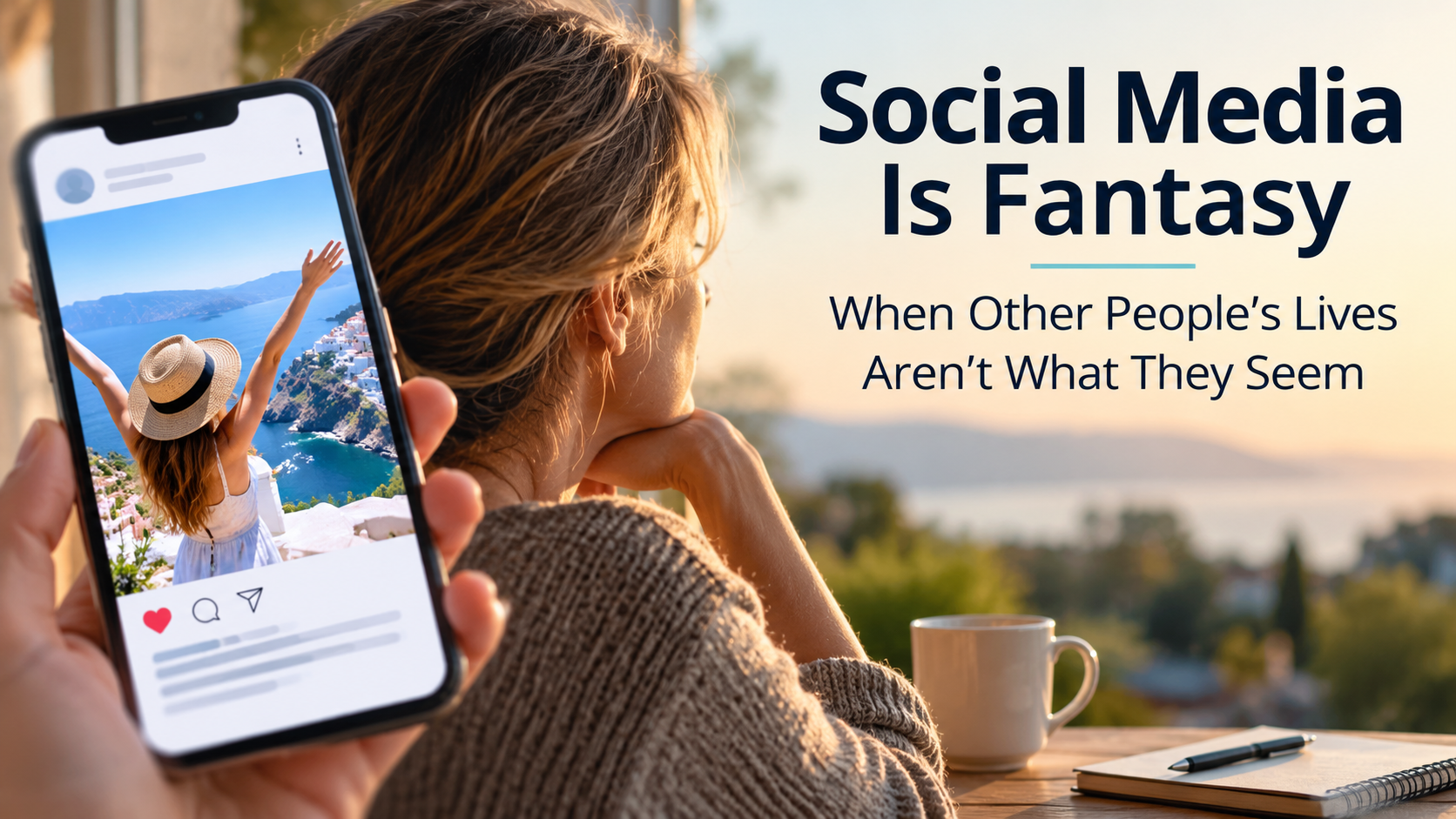
We see the vacation, not the argument that happened on the way there. We see the smiling family photograph, not everything the family may be struggling with. We see the announcement of a new job, a promotion, an accomplishment, or a celebration.
We see moments.
But we can easily mistake those moments for lives.
That was what I was thinking about when I first wrote about social media several years ago. I was concerned that these platforms could give us a false sense of connection while also encouraging us to compare our ordinary lives with carefully selected versions of other people's lives.
Since then, social media has changed considerably.
But I am not sure the underlying human problem has.
We Know Our Own Lives From the Inside
There is a basic imbalance in how we compare ourselves with other people.
We experience our own lives from the inside, but we usually see other people's lives from the outside.
We know our own disappointments.
We know the conversations that didn't go well. The opportunities we missed. The relationships that became complicated. The plans that didn't work. The mornings when we weren't particularly enthusiastic about getting out of bed.
We know the doubts we don't talk about.
But we don't necessarily know those things about someone else.
Instead, we see what they choose to show us.
Social media magnifies that difference.
Someone else posts the photograph from the beautiful restaurant. We don't know what happened before dinner or after it.
Someone announces an accomplishment. We don't see the failures that preceded it.
Someone posts photographs of a wonderful trip. We don't know whether the trip was actually wonderful.
Perhaps it was.
Perhaps it wasn't.
Usually, we simply don't know.
The Problem Isn't That Everything Is False
Calling social media "fantasy" doesn't mean that everything we see there is dishonest.
The photograph may be real. The accomplishment may be real. The happiness may be real.
The problem is selection.
All of us select what we tell other people about ourselves.
We have always done that.
Long before Facebook, Instagram, TikTok, or whatever platform comes next, people presented different versions of themselves in different situations. We behaved one way at work, another way with family, and perhaps another way with close friends.
Social media didn't invent this.
It simply gave us a remarkably powerful way to do it.
Now we can construct a public version of our lives one photograph, comment, accomplishment, and story at a time.
And then something curious happens.
Other people compare their complete lives with our selected one.
We do the same with theirs.
Comparison Becomes Unequal
There is nothing particularly new about comparing ourselves with others.
What is different is the scale.
At one time, most of our comparisons were with people we actually knew. We had some context for their lives. We knew something about their struggles as well as their successes.
Social media can remove that context.
We may now compare ourselves with hundreds or thousands of people we barely know.
And the comparison is almost always unfair.
We compare our ordinary Tuesday afternoon with someone else's vacation.
Our uncertainty with someone else's announcement.
Our aging body with someone's carefully selected photograph.
Our unfinished work with someone else's finished accomplishment.
Our private doubts with someone else's public confidence.
The comparison begins with incomplete information, yet we can still allow it to influence how we feel about ourselves.
And Now, Even Seeing Isn't Necessarily Believing
There is another dimension to this today that wasn't nearly as obvious when I first wrote about the subject.
Technology has made it increasingly difficult to know exactly what we're looking at.
Photographs can be altered. Videos can be manipulated. Artificial intelligence can create people, voices, scenes, and events that never existed.
But perhaps the deeper issue isn't technological at all.
Even when everything in a photograph is genuine, the impression it creates can still be incomplete.
A real photograph can tell an incomplete story.
A true statement can leave out important context.
A genuine happy moment doesn't necessarily mean someone has a happy life.
That distinction matters.
Connection Is Still Real
None of this means social media is inherently bad.
I've used it for years.
I use it to share my writing, communicate ideas, discover other people's work, and connect with people I otherwise might never encounter.
Those connections can be meaningful.
But there is a difference between using social media as a tool for connection and allowing it to become our measure of reality.
Real connection asks more of us.
It requires listening.
It requires curiosity.
Sometimes it requires sitting with another person long enough to discover that the life we imagined they were living isn't quite the life they are actually experiencing.
That is difficult to capture in a post.
Perhaps We Should Ask a Different Question
Instead of asking whether social media is real or fake, perhaps a better question is:
How much of another person's life can we really understand from what they choose to show us?
Probably not very much.
And that should affect the way we compare ourselves with them.
The person who appears to have everything figured out probably doesn't.
The person whose life looks exciting still experiences ordinary days.
The person celebrating success has experienced disappointment.
The person who seems confident has doubts.
Just as we do.
Perhaps the healthiest way to use social media is to remember that what appears on our screens is not necessarily false.
It is simply partial.
A moment isn't a life.
A photograph isn't a relationship.
An announcement isn't a complete story.
And someone else's carefully selected outside should never become the standard by which we judge our own complicated inside.
Social media may show us something real.
We just shouldn't mistake it for the whole truth.
Originally published in an earlier form and substantially revised and expanded in October 2026.
Originally inspired by reflections written in 2022. Revised to reflect how my thinking has continued to evolve.
We often imagine life moving in a straight line.
Education leads to work. Work leads to success. Success leads to fulfillment.
But very few lives unfold that way.
Instead, our lives become a series of relationships, unexpected events, difficult seasons, quiet victories, disappointments, and moments that seemed insignificant when they happened. Only later do we begin connecting those experiences into something that resembles a story.
That story becomes one of the most powerful influences on who we believe we are.
Many successful people describe their lives this way. Looking back, they can identify setbacks that eventually became turning points, failures that redirected them, and disappointments that taught lessons success never could.
The meaning wasn't obvious at the time.
It emerged years later.
Years ago I wrote about an article by Julie Beck in The Atlantic that included a thought I have never forgotten:
"How you arrange the plot points of your life into a narrative shapes who you are and is a fundamental part of being human."
That idea continues to resonate with me.
We don't simply remember our lives.
We interpret them.
Developmental psychologist Monisha Pasupathi has observed that relationships are built by telling pieces of our story. Every introduction, every conversation about where we've been or what we've learned, becomes another opportunity to shape how we understand ourselves.
As we change, those stories change too.
The events themselves remain the same.
What changes is the person looking back at them.
Author Bill George has suggested creating a timeline of your life, marking both the high points and the difficult seasons. I have always liked that exercise because it reveals something many of us overlook.
Rarely does one event stand alone.
Instead, one experience quietly influences another. A difficult job leads to an unexpected opportunity. A painful loss deepens compassion. A conversation changes a career. A disappointment becomes the beginning of a different life than the one we originally imagined.
What once looked like isolated moments begin revealing connections.
Your path forward often becomes clearer because you finally understand where you've already been.
That is one reason I believe reflection matters so much.
A journal can help preserve what happened, but revisiting those pages years later often reveals something entirely different. New experiences reshape old memories. What once seemed like failure may now look like preparation. What once felt random may now appear meaningful.
Our stories are not rewritten because the past changes.
They are rewritten because we do.
Perhaps that is one of the quiet gifts of growing older.
We become less interested in proving ourselves and more interested in understanding ourselves.
Looking back is not about living in the past.
It is about discovering patterns we could never have seen while we were busy living them.
The future remains uncertain for all of us.
But when we pause long enough to reflect, we often realize that our lives have been teaching us far longer than we recognized.
Sometimes the clearest view of the road ahead begins by looking behind.
If these ideas resonate with you, you may also enjoy What Matters: We Are the Sum of Small Moments and Why Life Stories Change, where I explore more deeply how ordinary experiences shape our identity and the stories we tell about our lives.
One day we will feel confident. One day we will feel clear. One day we will finally become who we are meant to be.
This expectation is subtle but powerful. It assumes that identity culminates. It assumes there is a finished version of ourselves waiting at the end of enough effort, experience, and self-discovery.
But identity rarely operates that way.
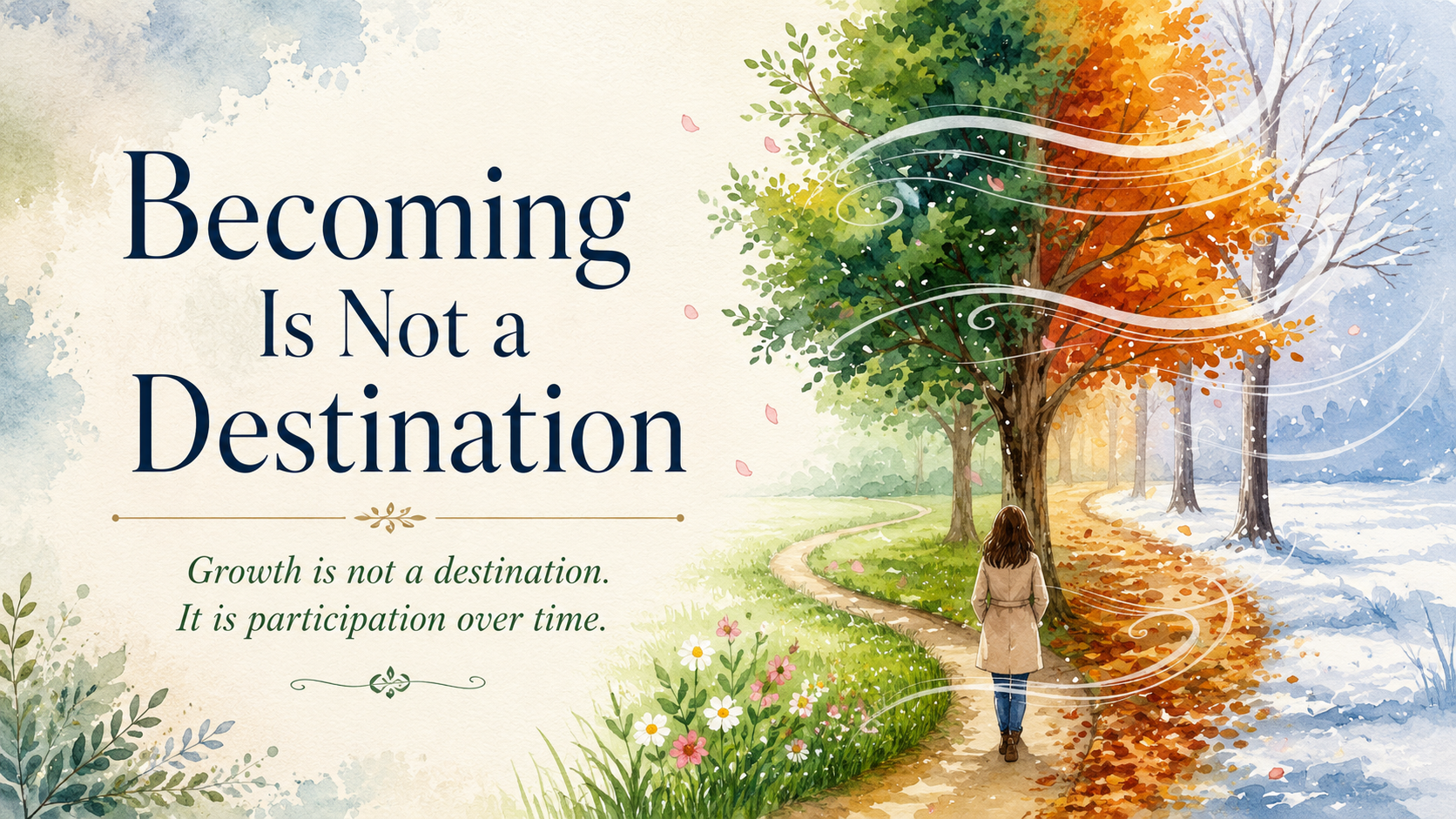
Growth is not a single shift. It is a series of revisions that occur over time. We learn, adapt, recover, reconsider, and adjust. Becoming is not a destination. It is participation in an ongoing process.
The idea of arrival can quietly distort the way we see ourselves. If we believe there is a finished version of who we should already be, then every setback feels like failure. Every uncertainty feels like evidence that we are falling behind.
Yet formation never fully ends.
There is no final edition of you. There are seasons of life, periods of refinement, and moments that reshape the way you understand yourself and the world around you. Growth continues even when it is difficult to see.
Much of modern culture celebrates dramatic reinvention. We hear stories about the new city, the new career, the new identity, or the new narrative. These changes certainly happen, but lasting growth is often much less dramatic than we imagine.
More often, growth appears in small shifts that accumulate over time. You respond differently than you once did. You recover more quickly from disappointment. You become more patient with uncertainty. You listen more carefully. You react less impulsively.
No announcement marks these changes. There is no ceremony recognizing them. Yet they matter.
In many ways, the most significant changes in our lives happen quietly. They occur beneath the surface through repetition, reflection, and experience. Because they happen gradually, we often overlook them until we look back and realize we are not quite the same person we used to be.
Growth that depends on spectacle rarely lasts. Growth that depends on repetition becomes part of who we are.
Perhaps that is why patience matters so much. We do not become through a single breakthrough moment. We become through countless ordinary moments that slowly shape our thinking, our habits, and our responses.
You do not wait to become.
You practice becoming.
Daily.
Through interpretation.
Through repetition.
Through revision.
You are not meant to become someone else entirely. You are meant to refine. And refinement requires patience.
Perhaps one of the great surprises of life is that growth often becomes visible only in hindsight. We spend years wondering whether we are changing, only to discover that the person looking back is already different from the person who began the journey.