

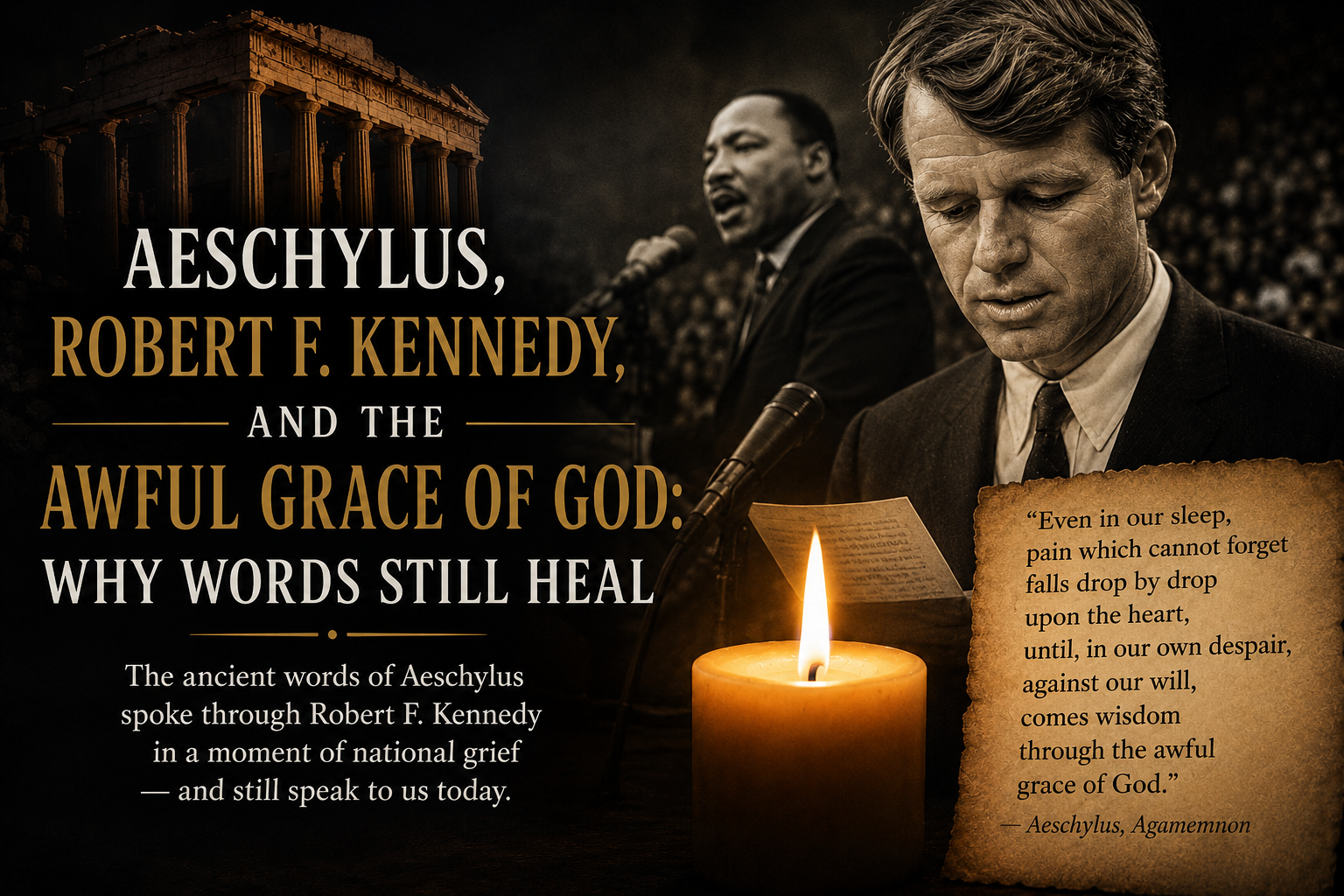
Aeschylus, Robert F. Kennedy, and the Awful Grace of God: Why Words Still Heal
Originally published February 2022 · Updated October 2025
“Even in our sleep, pain which cannot forget falls drop by drop upon the heart,
until, in our own despair, against our will,
comes wisdom through the awful grace of God.”
— Aeschylus, Agamemnon
Updated 2025 Reflection
More than fifty years after Robert F. Kennedy spoke these lines on the night of Dr. Martin Luther King Jr.’s death, the words of Aeschylus still echo with quiet urgency.
“Even in our sleep, pain which cannot forget…” reminds us that wisdom often arrives through suffering and that compassion can grow from shared grief.
In moments of division or uncertainty, poetry still offers what politics or argument rarely can — a language for our common humanity.
Each generation discovers, in its own heartbreak, that empathy is not weakness but a form of courage.
Robert F. Kennedy and the Power of Words
On April 4, 1968, Kennedy stood before a largely Black crowd in Indianapolis and announced the assassination of Dr. King. He had no prepared text.
Instead, he reached for poetry, for the language of an ancient playwright who understood that wisdom often comes “against our will.”
“What we need in the United States is not division;
what we need… is love, and wisdom, and compassion toward one another.”
In that dark moment, Kennedy reminded the nation that language can be an act of leadership.
He chose not to inflame, but to console. He quoted a voice from 2,000 years earlier to remind listeners that grief, though personal, can also be shared.
The same lines would later appear on his tombstone at Arlington National Cemetery — a final gesture toward words that helped him carry a nation’s sorrow.
About Aeschylus
Aeschylus was born around 525 BCE in Eleusis, northwest of Athens. He reportedly began writing after dreaming that the god Dionysus commanded him to bring tragedy to the stage.
Often called the father of tragedy, he wrote with a depth that continues to reach across millennia.
His surviving play Agamemnon explores how suffering shapes the moral conscience — that through pain and reflection, we may become wiser and more humane.
Why These Lines Still Matter
In moments of loss, words often fail, but sometimes they also hold us. That a 2,000-year-old verse could speak to the grief of 1968 and still resonate today shows poetry’s enduring role: not to erase pain, but to give it form.
When Kennedy turned to Aeschylus, he reminded us that our shared vocabulary of sorrow and hope is what allows societies to heal.
Even now, when headlines move too quickly for reflection, this passage invites us to pause:
to let the drops fall, to let the heart remember, and to find, within our own despair, a measure of grace.
The Wisdom We Never Ask For
None of us chooses suffering. We do, however, choose what happens after it.
Looking back over our lives, many of the moments that shaped us most were not victories but disappointments, losses, failures, illnesses, or unexpected turns. We would never have asked for them. Yet those experiences often changed how we understood ourselves and how we treated other people.
That may be why Aeschylus still speaks across twenty-five centuries. He wasn't celebrating pain. He was reminding us that suffering can become wisdom if we allow it to deepen our compassion rather than harden our hearts.
What does "the awful grace of God" mean?
Aeschylus suggests that wisdom often grows from suffering we never wanted. The phrase doesn't glorify pain. Instead, it reflects the idea that hardship can deepen compassion, humility, and understanding.
Perhaps the "awful grace of God" is not that suffering exists, but that even suffering can become part of what teaches us how to live
If this reflection resonated with you, you may also enjoy:
When You Feel Too Small to Matter
Why Life Stories Change
The Night Has a Thousand Eyes