Originally published February 6, 2020. Revised and expanded August 2026.
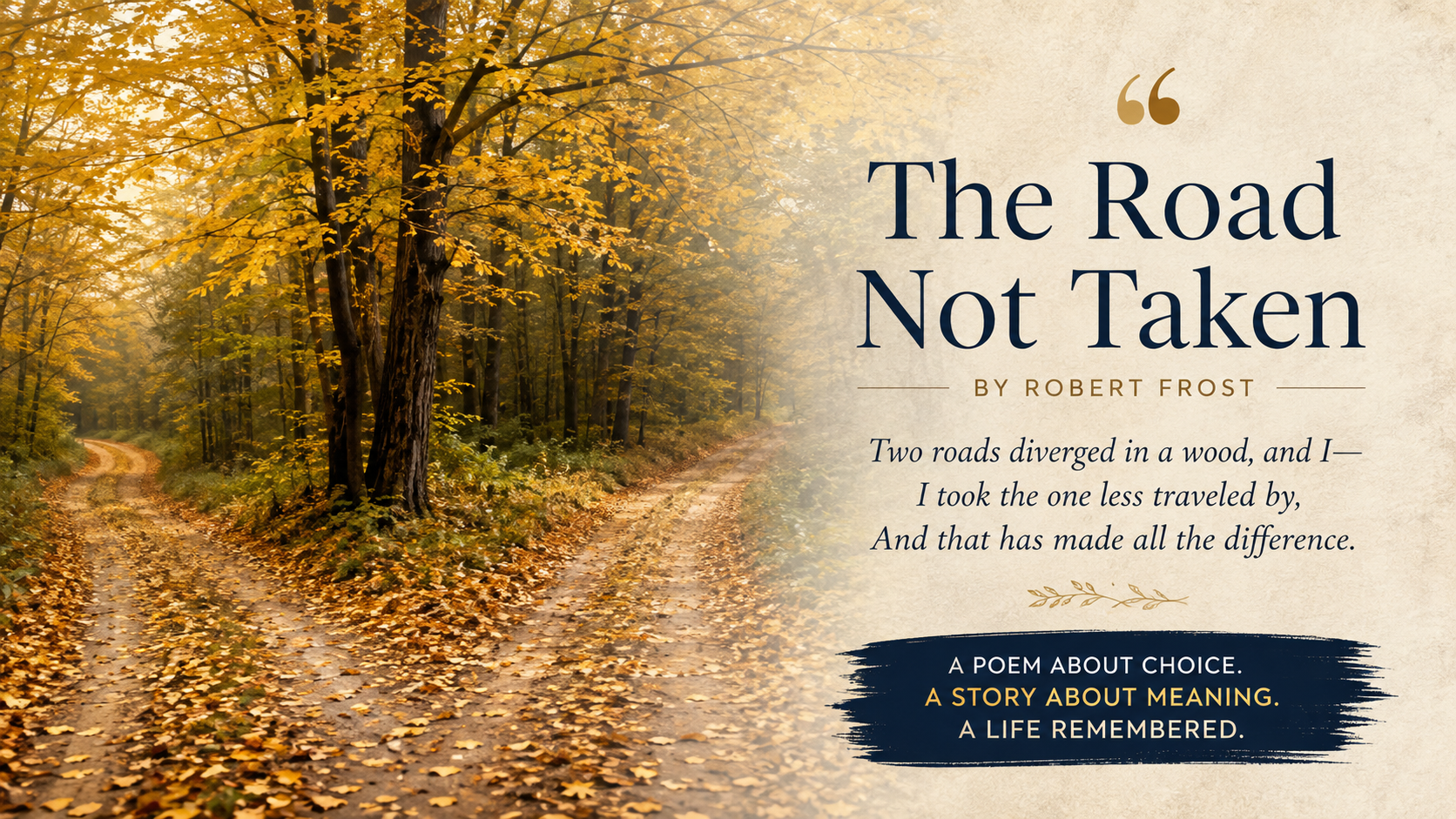
Two roads diverged in a yellow wood,
And sorry I could not travel both
And be one traveler, long I stood
And looked down one as far as I could
To where it bent in the undergrowth;
Then took the other, as just as fair,
And having perhaps the better claim,
Because it was grassy and wanted wear;
Though as for that the passing there
Had worn them really about the same,
And both that morning equally lay
In leaves no step had trodden black.
Oh, I kept the first for another day!
Yet knowing how way leads on to way,
I doubted if I should ever come back.
I shall be telling this with a sigh
Somewhere ages and ages hence:
Two roads diverged in a wood, and I—
I took the one less traveled by,
And that has made all the difference.
What Does The Road Not Taken Really Mean?
Robert Frost's The Road Not Taken is often treated as a poem about having the courage to take a different path. "I took the one less traveled by" has become almost a slogan for independence and choosing your own way.
But that interpretation overlooks something Frost makes remarkably clear.
The two roads were almost the same.
The traveler initially thinks one might have "the better claim" because it appears grassy and less worn. Then he immediately corrects himself:
Though as for that the passing there
Had worn them really about the same.
And the next stanza goes even further:
And both that morning equally lay
In leaves no step had trodden black.
There was no obviously conventional road and unconventional road. There were simply two roads, and the traveler could choose only one.
That changes the poem’s meaning.
The Road May Matter Less Than the Story We Tell About It
Where did the two roads lead? Were their destinations really different, or was the important difference simply the experience of having to choose?
Years later, the traveler imagines himself looking back and saying that he took "the one less traveled by" and that this choice "made all the difference."
But that isn't quite what happened.
At the moment of decision, the roads were essentially equal.
This is one reason the poem remains so fascinating. It isn't simply about choosing the braver path. It is also about how human beings make sense of their lives after their choices have been made.
Looking backward, we naturally organize events into a story. We connect moments that once seemed unrelated. We assign significance to decisions that, at the time, felt uncertain, necessary, or even ordinary.
The past becomes more coherent because the person we are today is trying to understand how we became that person.
That doesn't make the story false. It means that meaning often arrives long after the moment itself.
Why "The Road Less Traveled" Is Often Misunderstood
People frequently remember Frost's message as "take the road less traveled."
But Frost never actually tells us to do that.
The famous phrase appears when the traveler imagines how he will describe his decision "ages and ages hence." By then, memory has transformed two similar roads into a story about taking the less traveled one.
That distinction matters.
Frost reminds us that life rarely announces which choice is the right one. We make decisions with incomplete information. Only later can we see what followed from them.
What once appeared to be two nearly identical roads can eventually become the turning point around which an entire life story seems to revolve.
Perhaps the greatest insight in the poem is not that one road was better than the other. It is that we are meaning-making creatures.
We don't simply remember our past.
We interpret it.
Looking Back at My Own Roads
As I look back over my own life, it is easy to see the forks in the road.
It is also tempting to assume that everything depended on taking the particular road I chose.
But the clarity of hindsight can be deceptive.
Many decisions that now look like major turning points didn't necessarily feel that way when I made them. At the time, one choice may simply have seemed like the natural or necessary thing to do.
And that raises another question.
How much of a choice is a choice?
Every decision we make is influenced by everything that came before it: our experiences, relationships, successes, failures, fears, responsibilities, opportunities, and the person we had become by that particular moment.
Looking backward, I can say, "That decision changed my life."
But the person I was then may have been very likely to make exactly that decision.
Perhaps this is another reason Frost's poem becomes more interesting as we grow older.
We can see the roads we took. We can even imagine the roads we didn't take. What we cannot know is where those other roads would actually have led.
We know only the life that followed the choice we made.
And then, like Frost's traveler, we tell the story.
What made the difference may not have been the road itself. It may have been the life that unfolded after the choice, and the meaning we eventually found in it.
In that sense, The Road Not Taken isn't simply a poem about decisions.
It is a poem about choice, memory, identity, and the stories we create to understand the lives we have lived.
If this poem resonated with you, you may also enjoy these reflections on memory, identity, chance, and the way we create meaning from the events of our lives.