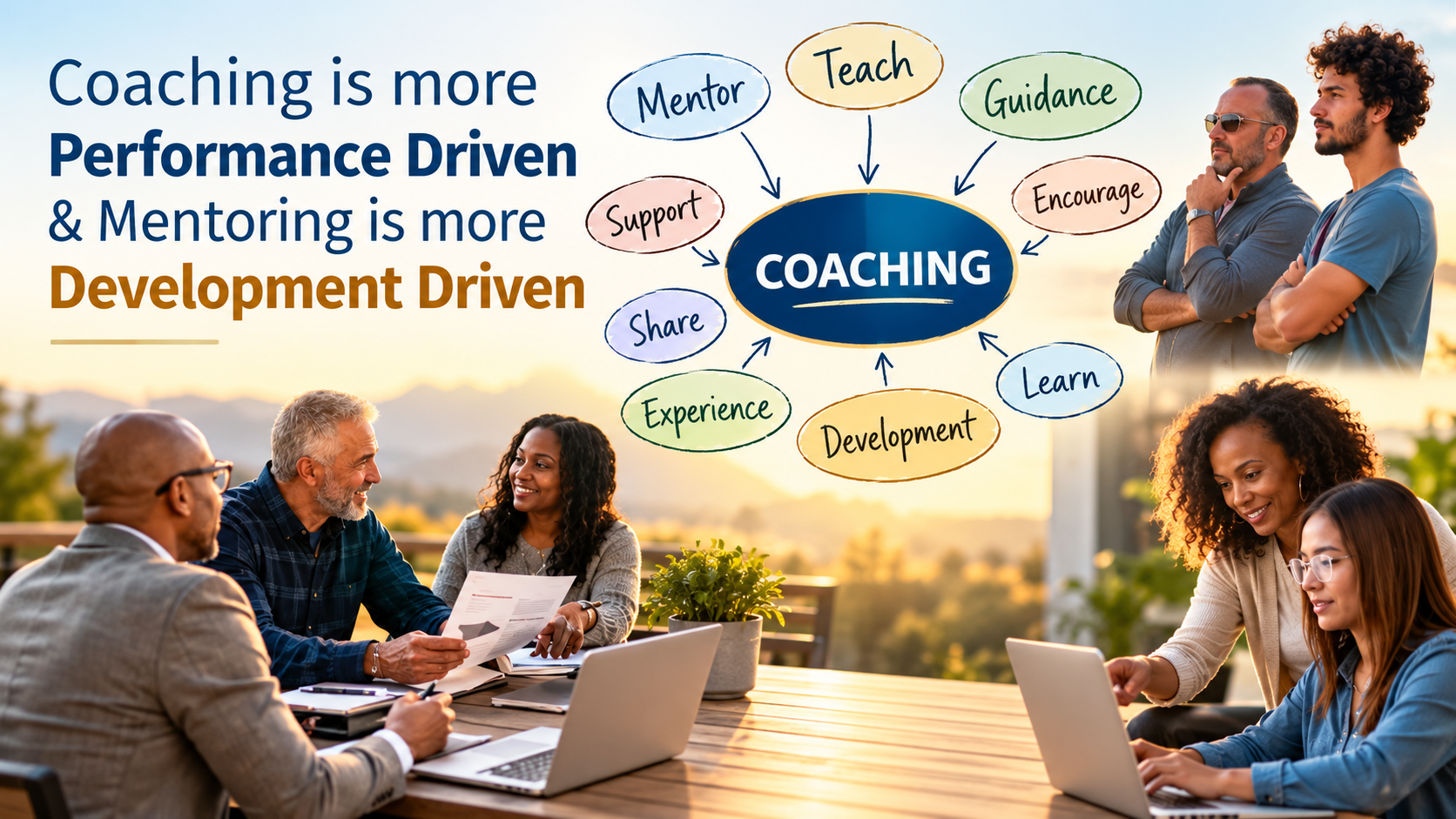
Why the people who help us grow may not always remain in the same roles in our lives.
Throughout our lives, we encounter people who help us see things differently, develop new skills, and recognize possibilities we might otherwise have overlooked.
Sometimes those people are coaches. Sometimes they are mentors. And sometimes they become something we never anticipated when the relationship began.
We often think of coaching and mentoring as established relationships with clearly defined purposes. One person provides guidance, and the other receives it. But human relationships are rarely that simple.
They evolve. Their purpose changes. Sometimes the people involved exchange roles. And sometimes a relationship that was once valuable simply reaches its natural conclusion.
Understanding coaching and mentoring requires understanding something about the changing nature of relationships themselves.
Coaching and Mentoring: What's the Difference?
Coaching and mentoring share an important objective: helping another person grow.
Their approaches, however, often differ.
Coaching is generally more performance-driven. It focuses on improving specific abilities, overcoming obstacles, achieving goals, and developing more effective behaviors.
A good coach helps someone recognize what they are doing, understand what might be holding them back, and identify ways to improve.
Coaches often provide structure, feedback, accountability, and opportunities to evaluate progress.
Mentoring is generally more development-driven. It draws heavily on experience, perspective, trust, and the willingness to share what has been learned.
A mentor may help someone understand an unfamiliar situation, recognize opportunities, or think through decisions that have consequences beyond the immediate moment.
Mentoring is often less about providing answers and more about helping someone develop the judgment needed to find their own.
Of course, these distinctions are not absolute.
A good mentor often becomes a coach when specific performance issues arise. A good coach may provide mentoring when personal experience and perspective become especially valuable.
The most meaningful relationships rarely fit perfectly into one category.
Why Great Coaches Matter
One of the most valuable things a coach can provide is a perspective we cannot easily develop on our own.
We all have blind spots.
We become accustomed to our habits, assumptions, and ways of responding to situations. Over time, these patterns can become so familiar that we no longer recognize their influence.
An effective coach helps us see what we may be missing.
That might involve improving communication, developing leadership skills, managing difficult situations, or understanding why a particular approach is not producing the desired results.
Great coaches do more than identify weaknesses. They help people recognize their strengths and understand how those strengths can be used more effectively.
In leadership, a coaching mindset is particularly valuable.
A leader who coaches employees is not simply telling them what to do. The leader is helping them develop the ability to think, decide, and act more effectively for themselves.
That kind of development benefits both the individual and the organization.
The Special Value of Mentoring
Mentoring offers something that formal instruction and performance coaching cannot always provide.
It offers perspective shaped by experience.
A mentor may have encountered similar challenges, made difficult decisions, experienced failures, and learned lessons that are difficult to communicate through training alone.
But the value of mentoring is not simply having someone tell us what worked for them.
Circumstances change. People are different. What succeeded in one situation may not work in another.
The real value often comes from discussing possibilities, questioning assumptions, and learning how someone else thinks about a problem.
A good mentor does not create a copy of themselves.
They help another person become more capable of making their own decisions.
And that brings us to an aspect of mentoring that I believe deserves more attention.
Mentoring Relationships Are Not Always Permanent
We sometimes assume that a successful mentoring relationship should continue indefinitely.
My experience has suggested otherwise.
Relationships develop around circumstances, needs, interests, and opportunities. When those conditions change, the relationship may change with them.
Someone who was particularly helpful during the early stages of a career may become less relevant as experience and responsibilities grow.
A mentor who once provided valuable guidance may eventually have little new advice to offer. The person being mentored may have developed the judgment, confidence, and experience needed to move forward independently.
That does not diminish the relationship.
It may actually demonstrate its success.
One of the most meaningful outcomes of mentoring is reaching a point where the original guidance is no longer needed.
Not every relationship is intended to last a lifetime.
Some people enter our lives for a particular reason, during a particular period, and contribute something that remains valuable long after the relationship itself has ended.
Sometimes the Roles Reverse
Another interesting aspect of mentoring is that the relationship does not always remain one-directional.
Someone who once needed guidance may eventually become the person offering it.
A younger employee might initially rely on an experienced executive for advice about leadership, organizational relationships, or career decisions.
Years later, that same employee may have developed expertise or encountered circumstances that the former mentor knows little about.
The roles can reverse.
The original mentor becomes the learner.
This is not necessarily an indication that one person has surpassed the other. It reflects the reality that knowledge, experience, and understanding develop differently in different people.
Age and experience do not give anyone a permanent advantage in every situation.
A person with decades of professional experience may have valuable lessons to share about judgment and leadership, while someone much younger may offer insight into changing technologies, workplace expectations, or entirely different ways of approaching problems.
The strongest relationships allow for this exchange.
Mentoring becomes especially meaningful when both people recognize that they have something to learn from each other.
When Relationships Change or End
Not every coaching or mentoring relationship ends because its purpose has been fulfilled.
Sometimes circumstances simply change.
People move into different careers, organizations, or stages of life. Their priorities shift. The connection that once brought them together may no longer exist.
Other times, the relationship changes because the individuals themselves have changed.
A person who once needed reassurance may now need someone willing to challenge their thinking. Someone who once valued detailed direction may have developed a preference for independence.
The relationship may continue, but its purpose becomes different.
And sometimes it ends.
We tend to measure relationships by how long they last, as though duration were evidence of their value.
I am not convinced that is always the right measure.
A conversation that changes someone's thinking may have a lasting influence even if the two people never speak again.
A mentor who helps someone through a difficult transition may contribute more during a few months than another relationship contributes over many years.
The significance of a relationship is not necessarily determined by its length.
It may be better understood by what changed because the relationship existed.
Knowing When You Need a Coach or a Mentor
The decision often depends on what you are trying to accomplish.
If you need to improve a specific skill, address a performance problem, develop better habits, or work toward a measurable goal, coaching may be the better choice.
If you are facing unfamiliar decisions, considering a career change, trying to understand an organization, or seeking perspective from someone with relevant experience, mentoring may be more useful.
But the distinction becomes less important when you find someone who genuinely understands your needs and can contribute to your growth.
The title we give the relationship matters less than what happens within it.
And the relationship itself should be allowed to change as those needs change.
Growth Is Not Always a One-Way Relationship
Looking back over a lifetime of professional and personal relationships, I find it interesting how differently we understand them with the passage of time.
Someone we once considered a teacher may later become a colleague or friend.
Someone we helped early in their career may eventually teach us something important.
And someone whose influence seemed temporary may turn out to have shaped our thinking for years.
We may not recognize the full significance of these relationships while we are experiencing them.
Only later do we begin to understand what they contributed.
Perhaps that is one reason coaching and mentoring should not be viewed simply as methods of improving performance or developing skills.
They are also expressions of how people influence one another.
Sometimes that influence is intentional. Sometimes it happens without either person recognizing it.
And sometimes the relationship ends long before its influence does.
The purpose of a good mentoring relationship is not necessarily to remain the same forever. It is to help someone grow, even when that growth eventually changes the relationship itself.
The people who help us become who we are do not always remain beside us.
But what they contributed can remain part of us long after their role in our lives has changed.