Exploring the unexpected connections that shape our lives
Book Reviews, Comments & Stories, Quotes, & Poetry & More
"Connections and Why They Matter"
Most of what happens in our life will spark a connection. Life connects with what has been found in books. Books connect with what happens in life. Use the connections to help you see more clearly. A love of reading and writing is what motivated the creation of this blog. Thank you for coming to the blog.
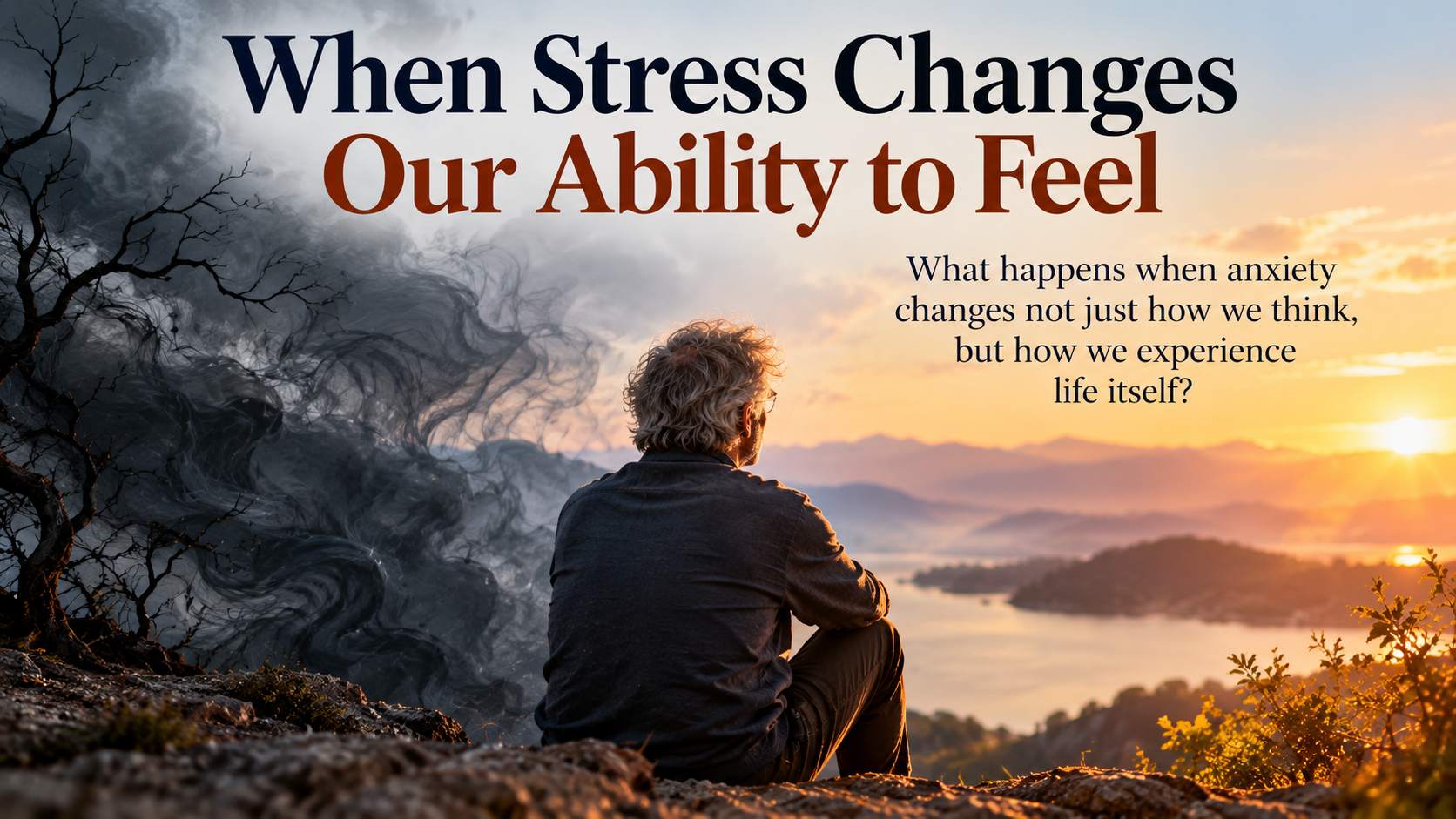
What happens when anxiety changes not just how we think, but how we experience life itself?
Does reducing anxiety restore our natural feelings, or does reconnecting with those feelings reduce anxiety?
We often think of stress and anxiety as feelings we would rather not have.
They bring tension, worry, uncertainty, and sometimes fear. We recognize their presence because they make us uncomfortable.
But I've been wondering whether stress and anxiety do something more than create unpleasant feelings.
What if they actually change the way we experience other feelings?
Not simply how we think about our circumstances, but how those circumstances feel to us.
Our surroundings. Our relationships. The activities we enjoy. Our sense of ourselves. Even the ordinary experience of being alive.
Sometimes feelings that would normally be present seem to disappear. At other times, those feelings remain but take on an entirely different character.
Something that once felt comfortable may become unsettling. Something enjoyable may lose its appeal. An ordinary activity may begin to feel like an obligation rather than a pleasure.
The circumstances themselves may not have changed.
But our experience of them has.
When Anxiety Changes More Than Our Mood
We often describe anxiety as though it occupies one part of our emotional lives.
We feel anxious about a problem, a decision, an appointment, or an uncertain future.
Yet anxiety doesn't always remain confined to the thing that caused it.
It can influence how we experience almost everything else.
A familiar room may feel less comfortable. A conversation may become more difficult. Activities that once came naturally may require greater effort.
Even pleasant experiences can feel different when our minds are occupied by tension.
This raises an interesting possibility.
Perhaps stress doesn't merely compete with our other feelings. It sometimes changes the conditions under which those feelings are experienced.
We may still recognize something as beautiful, enjoyable, or meaningful without experiencing the same emotional response we once did.
We know how we think we should feel.
But the feeling itself seems missing.
The Feelings That Seem to Disappear
There is a difference between feeling unhappy and not feeling the happiness we might normally expect.
The first is an unpleasant emotion.
The second is an absence.
Stress and anxiety can sometimes contribute to both.
We may find ourselves unable to enjoy something that ordinarily gives us pleasure. We may recognize that our surroundings are peaceful without experiencing that peace internally.
Or we may feel disconnected from activities and relationships that remain important to us.
That absence can be difficult to explain because nothing obvious may be wrong with the experience itself.
It is as though our emotional response has been turned down.
Perhaps this is one reason prolonged stress can be so exhausting. We are not only dealing with the tension itself. We may also be missing some of the positive experiences that would ordinarily help us manage it.
When Familiar Things Feel Different
There is another possibility that interests me.
Sometimes the feelings don't disappear. They change.
A familiar environment may suddenly seem unfamiliar or uncomfortable. An ordinary responsibility may feel threatening. A conversation that would normally be enjoyable may produce tension.
The experience is still there, but its emotional character has changed.
This makes me wonder how much of what we call reality is actually our interpretation of reality through our current emotional condition.
We assume that we respond to things because of what those things are.
But perhaps we respond partly because of the emotional condition we bring to them.
The same experience can feel entirely different depending on what is happening within us.
What Happens When the Stress Is Gone?
Suppose, for a moment, that stress and anxiety could be turned off completely.
Would our ordinary feelings return?
Would familiar places feel comfortable again? Would activities become enjoyable? Would our relationships and surroundings recover the emotional qualities we remember?
Or might something else happen?
Perhaps the absence of anxiety would allow us to experience things in ways we had never fully recognized before.
We often assume that removing something negative simply restores what existed previously.
But that may not always be true.
When tension subsides, we may become aware of sensations, emotions, and details that were previously overshadowed by worry.
The world has not necessarily changed.
Our capacity to experience it may have changed.
Of course, not all stress is harmful. Some stress helps us respond to challenges, recognize danger, and accomplish difficult things. Nor is a completely stress-free life necessarily possible or desirable.
The more useful question may be what happens when unnecessary or persistent tension no longer dominates our experience.
Which Comes First: Peace or the Feeling of Peace?
This brings me to the question that interests me most.
Does reducing stress and anxiety allow our more natural feelings to return, or does reconnecting with those feelings help reduce the stress and anxiety?
Perhaps the relationship works in both directions.
When anxiety diminishes, we may find it easier to enjoy our surroundings, appreciate relationships, and experience the ordinary pleasures of living.
But when we become more engaged with something meaningful, that experience may also reduce our attention to whatever has been troubling us.
A walk, a conversation, music, poetry, time outdoors, or a moment of genuine connection may change how we feel.
Not necessarily because the problem has disappeared.
But because our experience of the present moment has changed.
It may be that emotional well-being is not simply the absence of negative feelings.
It also involves the presence of feelings that make life meaningful.
How Do We Turn Down the Tension?
If stress can change so much about how life feels, how do we reduce its influence?
Perhaps the first step is recognizing that tension is not always a reliable reflection of our circumstances.
Something may feel threatening without actually being dangerous. An ordinary task may feel overwhelming because we are already carrying too much tension.
Recognizing that difference may help us respond more thoughtfully.
There are also practical ways to reduce tension.
Slowing our breathing, taking a walk, spending time in a comfortable environment, getting adequate rest, or talking with someone we trust can sometimes help calm the body's stress response.
But I wonder whether another approach deserves more attention.
Instead of concentrating entirely on getting rid of anxiety, perhaps we can also pay attention to the feelings and experiences that anxiety has pushed into the background.
What still brings us a sense of connection?
What activities allow us to become absorbed in something other than our worries?
What surroundings help us feel comfortable rather than guarded?
And what ordinary experiences remind us that there is more to life than the concerns occupying our minds?
These questions may not eliminate anxiety, especially when it has become persistent or overwhelming.
But they may help us recognize what has been missing from our emotional experience.
Are Our True Feelings Waiting to Return?
I keep coming back to the idea of true feelings.
Perhaps that phrase is not entirely accurate.
Our anxious feelings are real, too. They are part of our experience, even when they distort how we interpret the world around us.
But there may be a difference between feelings that arise naturally from an experience and feelings strongly influenced by tension we are carrying from somewhere else.
When we recognize that distinction, we may begin to understand ourselves differently.
Perhaps the goal is not to eliminate every uncomfortable emotion.
It is to prevent one emotional condition from controlling how we experience everything else.
A Final Thought
Stress and anxiety may do more than make life uncomfortable.
They may change how life feels.
They can diminish pleasure, alter our perception of familiar surroundings, and interfere with the emotional connections that ordinarily give our experiences meaning.
Yet the relationship may work in both directions.
Reducing tension may allow positive feelings to become more accessible. And reconnecting with meaningful experiences may help reduce tension.
Perhaps we should not think of emotional well-being simply as learning how to stop feeling anxious.
Perhaps it is also about learning how to feel the rest of life again.
And that leaves me with a question: Are we trying to find peace so we can experience life more fully, or does experiencing life more fully help us find peace?
Perhaps the greatest loss caused by prolonged stress and anxiety is not simply the discomfort they create. It is their ability to interfere with the feelings that make life meaningful.
We may still have the people, places, relationships, and experiences that once brought us happiness, but our ability to feel that happiness has changed.
Maybe finding peace isn't simply about changing our circumstances or eliminating anxiety.
Maybe it is about recovering our ability to feel life as it happens.
Because what life means to us depends, in the end, on our ability to feel it.
What life means to us depends, in the end, on our ability to feel it.