Exploring the unexpected connections that shape our lives
Book Reviews, Comments & Stories, Quotes, & Poetry & More
"Connections and Why They Matter"
Most of what happens in our life will spark a connection. Life connects with what has been found in books. Books connect with what happens in life. Use the connections to help you see more clearly. A love of reading and writing is what motivated the creation of this blog. Thank you for coming to the blog.
We’re used to thinking about work in terms of roles.
Job titles. Responsibilities. Functions.
But those categories are starting to shift.
Artificial intelligence is often discussed in terms of replacement.
Will it take jobs? Will it outperform people? Will it eventually do more than we can?
Those questions are easy to ask.
But they may not be the most important ones.
In many cases, AI isn’t replacing work.
It’s redistributing it.
Tasks that were once time-consuming are becoming automated. Processes that required manual effort are becoming streamlined. And in that shift, something subtle happens.
The nature of contribution begins to change.
Take something like human resources.
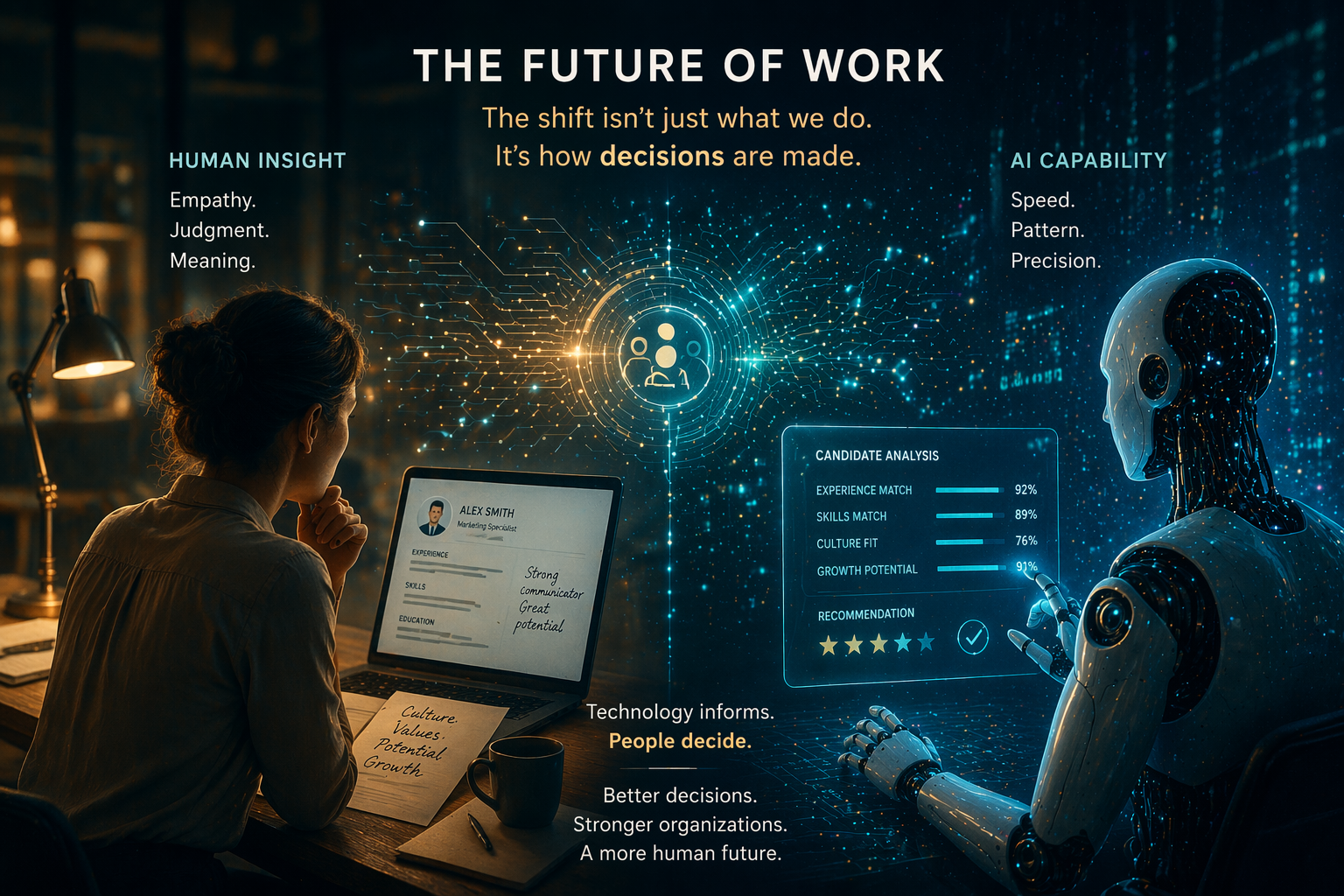
AI can now screen resumes, identify patterns, and surface candidates more efficiently than a person reviewing applications one by one.
That improves speed.
But it also raises a quieter question:
Who decides what “fit” means?
Because when decisions are guided by systems, those systems carry assumptions.
What is valued. What is prioritized. What is filtered out before anyone notices.
The same pattern shows up across industries.
Technology doesn’t just change what we do.
It changes how decisions are made.
And over time, that influences what kinds of work matter.
We often hear that AI will allow people to focus on more “strategic” or “creative” work.
That may be true.
But it also means that the definition of value is shifting.
From execution → to interpretation. From process → to judgment. From doing → to deciding
That transition isn’t just economic.
It’s human.
Because as systems take on more of the visible work, the invisible parts become more important:
how we think
how we interpret
how we define what matters
The future of work is often described in terms of skills.
But it may be better understood in terms of awareness.
Not:
What can AI do?
But:
How does its presence change what we pay attention to?