
A few lines from What Matters that stay closest to the questions at the center of the book.
How are we shaped?
What do we repeat?
What changes when we begin to notice?
These are not instructions or answers. They are observations about identity, change, attention, and the small moments that quietly accumulate into a life.
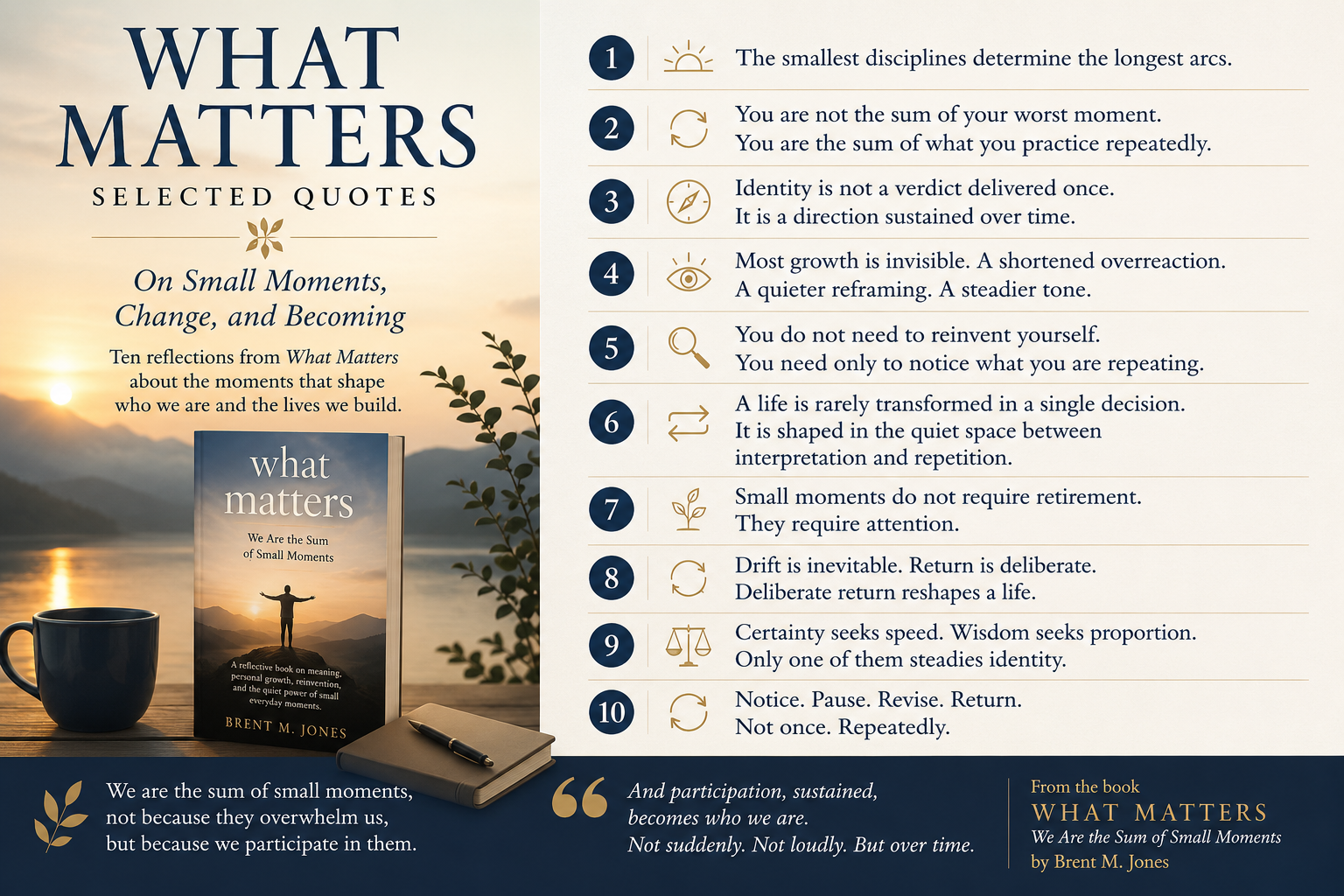
The smallest disciplines determine the longest arcs.
We often look for change in large decisions and dramatic turning points. But the direction of a life is more often shaped by what we practice when no one is watching and what we repeat long after the moment itself has passed.
You are not the sum of your worst moment. You are the sum of what you practice repeatedly.
A single failure can feel defining. So can a bad decision, a painful reaction, or a season when we were not at our best.
But identity is larger than a single moment. What matters is what we continue, what we revise, and what we return to.
Identity is not a verdict delivered once. It is a direction sustained over time.
We sometimes speak of identity as though it were fixed. As though we discover who we are and then simply live out that conclusion.
But identity continues to form. Direction matters because direction, sustained long enough, becomes part of who we are.
Most growth is invisible. A shortened overreaction. A quieter reframing. A steadier tone.
Growth does not always announce itself.
Sometimes it is simply the moment when we recover a little faster, listen a little longer, or stop carrying something quite as far as we once did.
The change may be almost invisible. The accumulation is not.
You do not need to reinvent yourself. You need only to notice what you are repeating.
Reinvention sounds dramatic.
Most change is not.
What we repeat becomes familiar. What becomes familiar begins to feel true. What feels true influences direction.
Sometimes the most important question is not, “Who should I become?”
It is, “What am I practicing now?”
A life is rarely transformed in a single decision. It is shaped in the quiet space between interpretation and repetition.
Events happen.
Then we decide what they mean.
When an interpretation is repeated often enough, it can become a belief. Beliefs influence direction. Direction, sustained over time, shapes identity.
The space between what happens and what we continue to tell ourselves about it may be one of the most important spaces we have.
Small moments do not require retirement. They require attention.
It can be easier to notice life when the pace slows.
But small moments are not reserved for quiet seasons. They are present during ambition, responsibility, uncertainty, change, and ordinary routine.
The question is not whether they are there.
The question is whether we notice them.
Drift is inevitable. Return is deliberate. Deliberate return reshapes a life.
No one maintains clarity continuously.
We overreact. We exaggerate. We return to old stories. We lose sight of what we thought we understood.
Growth is not the absence of drift.
Sometimes growth is simply learning to return sooner.
Certainty seeks speed. Wisdom seeks proportion. Only one of them steadies identity.
Certainty is attractive because it resolves tension quickly.
Wisdom is slower.
It asks whether something is representative, proportional, or permanent before allowing one moment to become a conclusion.
In a world that rewards immediate reactions, proportion may be one of the quietest forms of wisdom.
Notice. Pause. Revise. Return. Not once. Repeatedly.
Perhaps this is the simplest expression of what What Matters is about.
Not perfection.
Not control.
Not one dramatic transformation.
Participation.
The willingness to notice what is happening, pause before interpretation hardens, revise what no longer fits, and return when we drift.
Again and again.
We are the sum of small moments, not because they overwhelm us, but because we participate in them.
And participation, sustained, becomes who we are.
Not suddenly.
Not loudly.
But over time.
Selected from What Matters A few lines from What Matters that stay closest to the questions at the center of the book.
How are we shaped?
What do we repeat?
What changes when we begin to notice?
These are not instructions or answers. They are observations about identity, change, attention, and the small moments that quietly accumulate into a life.
The smallest disciplines determine the longest arcs.
We often look for change in large decisions and dramatic turning points. But the direction of a life is more often shaped by what we practice when no one is watching and what we repeat long after the moment itself has passed.
You are not the sum of your worst moment. You are the sum of what you practice repeatedly.
A single failure can feel defining. So can a bad decision, a painful reaction, or a season when we were not at our best.
But identity is larger than a single moment. What matters is what we continue, what we revise, and what we return to.
Identity is not a verdict delivered once. It is a direction sustained over time.
We sometimes speak of identity as though it were fixed. As though we discover who we are and then simply live out that conclusion.
But identity continues to form. Direction matters because direction, sustained long enough, becomes part of who we are.
Most growth is invisible. A shortened overreaction. A quieter reframing. A steadier tone.
Growth does not always announce itself.
Sometimes it is simply the moment when we recover a little faster, listen a little longer, or stop carrying something quite as far as we once did.
The change may be almost invisible. The accumulation is not.
You do not need to reinvent yourself. You need only to notice what you are repeating.
Reinvention sounds dramatic.
Most change is not.
What we repeat becomes familiar. What becomes familiar begins to feel true. What feels true influences direction.
Sometimes the most important question is not, “Who should I become?”
It is, “What am I practicing now?”
A life is rarely transformed in a single decision. It is shaped in the quiet space between interpretation and repetition.
Events happen.
Then we decide what they mean.
When an interpretation is repeated often enough, it can become a belief. Beliefs influence direction. Direction, sustained over time, shapes identity.
The space between what happens and what we continue to tell ourselves about it may be one of the most important spaces we have.
Small moments do not require retirement. They require attention.
It can be easier to notice life when the pace slows.
But small moments are not reserved for quiet seasons. They are present during ambition, responsibility, uncertainty, change, and ordinary routine.
The question is not whether they are there.
The question is whether we notice them.
Drift is inevitable. Return is deliberate. Deliberate return reshapes a life.
No one maintains clarity continuously.
We overreact. We exaggerate. We return to old stories. We lose sight of what we thought we understood.
Growth is not the absence of drift.
Sometimes growth is simply learning to return sooner.
Certainty seeks speed. Wisdom seeks proportion. Only one of them steadies identity.
Certainty is attractive because it resolves tension quickly.
Wisdom is slower.
It asks whether something is representative, proportional, or permanent before allowing one moment to become a conclusion.
In a world that rewards immediate reactions, proportion may be one of the quietest forms of wisdom.
Notice. Pause. Revise. Return. Not once. Repeatedly.
Perhaps this is the simplest expression of what What Matters is about.
Not perfection.
Not control.
Not one dramatic transformation.
Participation.
The willingness to notice what is happening, pause before interpretation hardens, revise what no longer fits, and return when we drift.
Again and again.
We are the sum of small moments, not because they overwhelm us, but because we participate in them.
And participation, sustained, becomes who we are.
Not suddenly.
Not loudly.
But over time.
Selected from What Matters: We Are the Sum of Small Moments by Brent M. Jones. by Brent M. Jones.