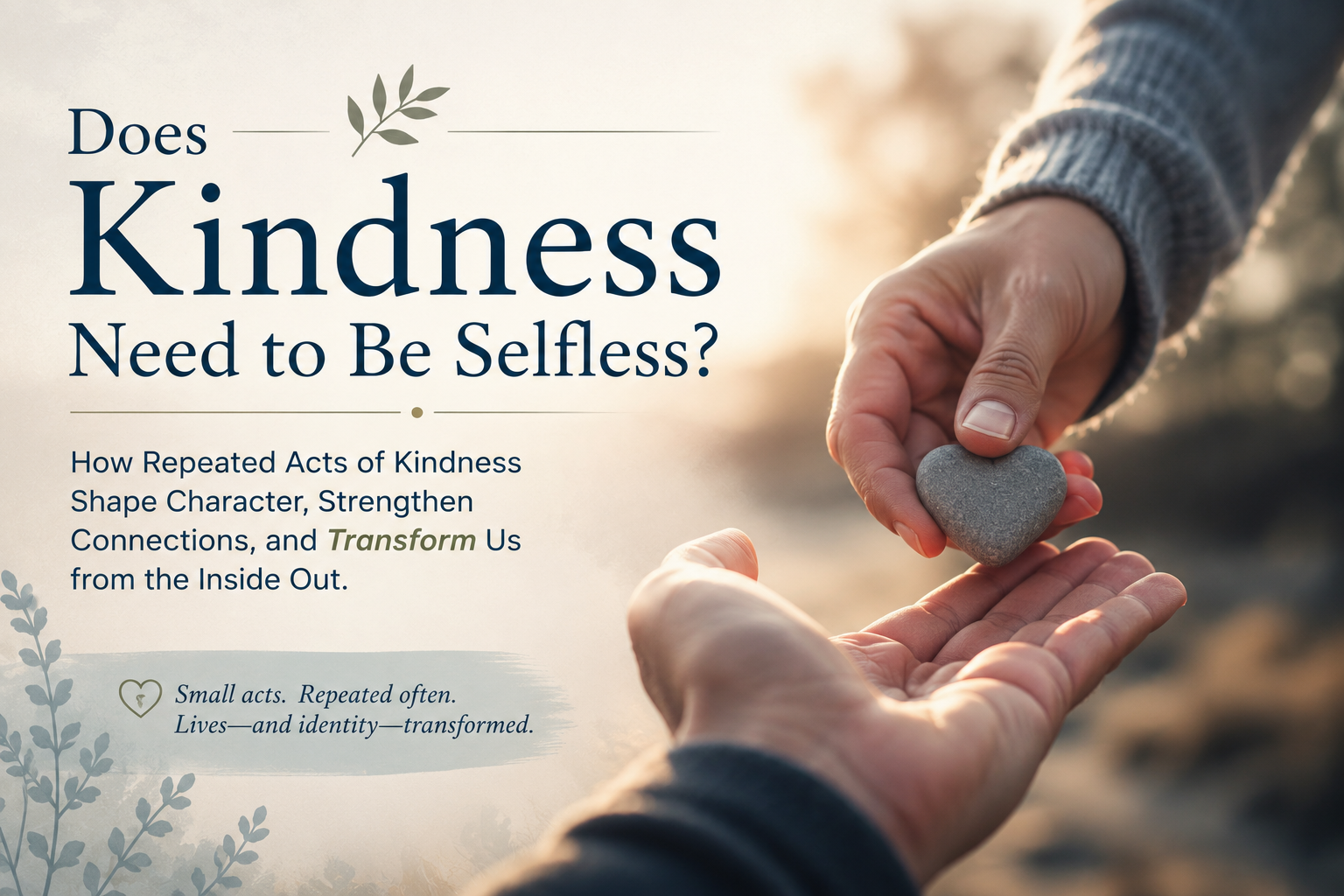
What kind of motive does kindness have?
There is an important difference between helping someone because you value their well-being and helping someone because you want something from them.
Outwardly, the two actions may look identical.
One person offers encouragement because they genuinely care.
Another offers encouragement because they hope to gain influence, admiration, or a future favor.
The behavior may be the same.
The posture is not.
Authentic kindness is not defined by the absence of benefit to ourselves.
It is defined by the presence of genuine concern for someone else.
If another person's well-being matters while we act, then the fact that we also experience joy or fulfillment does not diminish the kindness.
It simply means our brains may be reinforcing behaviors that help human relationships flourish.
Perhaps that is exactly how we were designed.
This also raises another question.
If kindness shapes the lives of others, what does it shape within us?
In What Matters, I argue that identity is formed through repeated participation.
We become the sum of what we repeatedly practice.
The same may be true of kindness.
A single generous act can happen almost by accident.
But repeatedly choosing to notice another person's needs gradually reshapes the person doing the noticing.
Kindness becomes less like a task and more like a posture.
We begin to pay attention differently.
We become slower to judge.
Quicker to encourage.
More willing to assume good intentions.
Over time, these repeated choices become part of who we are.
Ancient philosophers understood this long before neuroscience could observe it.
Aristotle suggested that we become virtuous by repeatedly practicing virtuous actions.
Today, neuroscience tells us that repeated behaviors strengthen neural pathways, making those behaviors increasingly natural.
Different languages.
Remarkably similar conclusion.
Character is not simply discovered.
It is formed.
Perhaps that is why genuine kindness does not require perfect selflessness.
It requires participation.
Not because we hope to become happier, although we often do.
Not because others will notice, although they sometimes will.
But because another person's well-being genuinely matters to us.
Ironically, when kindness is practiced that way, something unexpected happens.
The person we intended to help is not the only one who changes.
We do too.
One small act rarely transforms a life.
But repeated participation often does.
And perhaps that is one more reminder that we really are the sum of small moments.
This essay explores one expression of a broader question: How are we shaped over time?
If that question interests you, you'll find it explored throughout What Matters: We Are the Sum of Small Moments, where I examine how attention, interpretation, and repeated participation quietly shape identity.
Learn more about What Matters.