Exploring the unexpected connections that shape our lives
Book Reviews, Comments & Stories, Quotes, & Poetry & More
"Connections and Why They Matter"
Most of what happens in our life will spark a connection. Life connects with what has been found in books. Books connect with what happens in life. Use the connections to help you see more clearly. A love of reading and writing is what motivated the creation of this blog. Thank you for coming to the blog.
We like to believe we are writing our own life stories. But how much of what happens to us is actually within our control?
Looking back over a lifetime, it's difficult not to wonder how differently things might have turned out if a few circumstances had changed.
What if we had never met a particular person? What if we had accepted a different job, moved to another city, or made a decision that seemed insignificant at the time?
And what about the things we never chose at all? The family we were born into, the opportunities that appeared unexpectedly, the losses we experienced, or the events that changed our direction without asking our permission?
We often explain our lives through the decisions we made. Yet much of what shaped those decisions was already happening around us.
That raises a question I've returned to many times in my writing:
Are we directing our lives, or are our lives being shaped by circumstances we cannot control?
Free Will, Determinism, and the Lives We Live
Philosophers have debated the relationship between free will and determinism for centuries.
One view holds that our actions and experiences arise from preceding causes. Our choices may feel independent, but they are influenced by circumstances, experiences, inherited characteristics, and events that came before them.
Another view places greater emphasis on human agency, the belief that we can make meaningful choices and influence the direction of our lives.
Both perspectives offer something worth considering.
We know that our decisions matter. Choosing a career, building a relationship, pursuing an opportunity, or responding to adversity can change what happens next.
But we also know that our choices are never made in isolation.
The opportunities available to one person may never appear for another. Our understanding of what is possible depends partly on what we have experienced, what we have learned, and what we believe about ourselves.
Even the decision to take a chance depends on having encountered the opportunity in the first place.
Perhaps the question isn't simply whether we have free will.
Perhaps it's how much freedom we actually have within the circumstances life presents.
When the Unexpected Changes Everything
Some events are so unexpected and consequential that they change the direction of entire lives, communities, or societies.
These are sometimes described as black swan events, a concept associated with philosopher and writer Nassim Nicholas Taleb.
A black swan event is generally understood as an event that is difficult to anticipate, has a major impact, and is often explained afterward as though its occurrence should have been obvious.
We can recognize similar patterns in our personal lives, although not every unexpected experience qualifies as a true black swan event.
A sudden illness, an economic downturn, an unexpected loss, or an opportunity that appears without warning can change everything we thought we knew about our future.
Sometimes the consequences are immediate.
Other times, we don't recognize their significance until years later.
An ordinary conversation might introduce us to someone who becomes important in our lives. A disappointment might redirect us toward an opportunity we would never otherwise have considered.
We may eventually describe these experiences as turning points, even though we had no idea at the time that anything important was happening.
What appears random in the moment may become central to the story we tell about our lives.
Does Everything Happen for a Reason?
There is comfort in believing that events happen for a reason.
It suggests that even our difficulties belong to some larger pattern and that the events we cannot explain may eventually make sense.
But I think there's an important distinction between believing that everything happens for a reason and recognizing that we can sometimes find meaning in what happens.
Not every tragedy produces something positive. Not every disappointment leads to a better opportunity. Some losses remain losses, regardless of how much time passes.
Yet our understanding of those experiences can change.
We may discover something about ourselves through adversity. We may become more compassionate because of what we have witnessed. We may reconsider our priorities after an experience that interrupted our expectations.
That doesn't mean the experience was necessary or desirable.
It means we are capable of responding to circumstances in ways that influence what happens afterward.
Perhaps meaning isn't always something hidden inside an event, waiting to be discovered.
Sometimes meaning is something we create through the way we remember, interpret, and respond to what has happened.
Why the Past Looks Different as We Grow Older
One of the more interesting things about looking back over a lifetime is realizing that our past doesn't always seem to remain the same.
The events themselves may not have changed, but our understanding of them often does.
A decision we once regretted may eventually seem reasonable when viewed through the experiences that followed.
A relationship we thought we understood may look very different after many years.
Even our memories are influenced by who we have become.
We don't simply remember events. We interpret them through the knowledge, emotions, and perspectives we have today.
In that sense, our life stories continue to evolve long after the events themselves have ended.
This is one reason I find the relationship between chance and choice so fascinating.
We make decisions based on what we understand at a particular moment. Later, we evaluate those decisions with knowledge we didn't possess when we made them.
Sometimes we judge ourselves too harshly because we forget how little we knew at the time.
Other times, we give ourselves too much credit for outcomes that depended heavily on circumstances beyond our control.
Recognizing that distinction can change how we view both our successes and our disappointments
The Difference Between Responsibility and Blame
If our lives are shaped by both choice and circumstance, how should we think about responsibility?
I don't believe recognizing the influence of chance means abandoning personal responsibility.
Our decisions still have consequences. Our attitudes still influence our relationships. The way we respond to opportunities and difficulties still matters.
But responsibility and blame are not necessarily the same thing.
We can accept responsibility for our choices without assuming that everything that happens to us is our own doing.
Likewise, we can acknowledge the influence of circumstances without believing we have no ability to change our direction.
There is a practical value in understanding this balance.
It allows us to look at the past with greater honesty and perhaps greater compassion, both for ourselves and for others.
We begin to recognize that people are often responding to circumstances we may not fully understand.
And we may become less certain that our own successes resulted entirely from our wisdom or that someone else's difficulties resulted entirely from poor decisions.
The Life We Planned and the Life That Happened
Most of us begin adulthood with some idea of how our lives might unfold.
We imagine careers, relationships, families, accomplishments, and the kind of people we hope to become.
Then life happens.
Some plans succeed. Others disappear. New opportunities emerge. Unexpected circumstances change what seems possible.
Over time, the distance between the life we imagined and the life we actually lived can become considerable.
But that doesn't necessarily mean we failed to follow the right path.
It may simply mean that life was never going to be as predictable as we assumed.
Looking back, I can see how many experiences gained their significance only because of what happened afterward.
A moment that seemed unimportant became part of a much larger story.
A choice that appeared straightforward eventually produced consequences I could never have anticipated.
And some of the most influential circumstances in life were never choices at all.
Perhaps the Most Important Choice Is What We Do Next
I don't know that the debate between free will and determinism will ever produce an answer that satisfies everyone.
The more I think about it, the less convinced I am that we need a definitive answer to find value in the question.
We live within circumstances we did not entirely create.
We make choices with incomplete information.
We encounter people and experiences we could never have anticipated.
And we continually reinterpret our past as our understanding of life changes.
Perhaps embracing life's randomness isn't about surrendering to chance or pretending we control everything.
It's about recognizing the relationship between the two.
We may not choose every event that becomes part of our story.
We may not even understand its significance while we're living through it.
But we can continue learning from what happens, reconsidering what we believe, and making choices about what comes next.
We cannot rewrite everything that has happened in our lives. But we can change how we understand the story, and sometimes that changes the direction of the chapters still ahead.
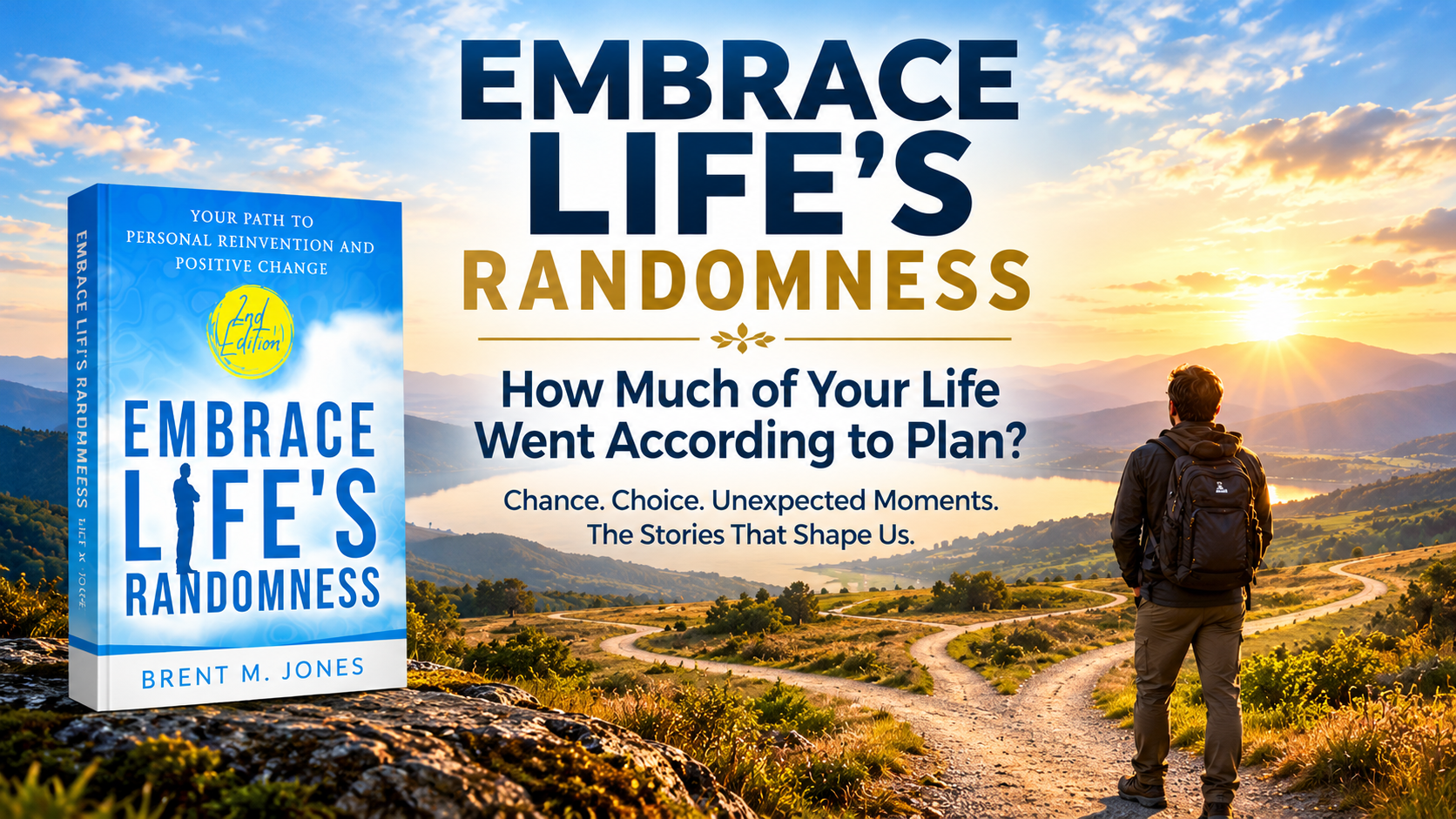
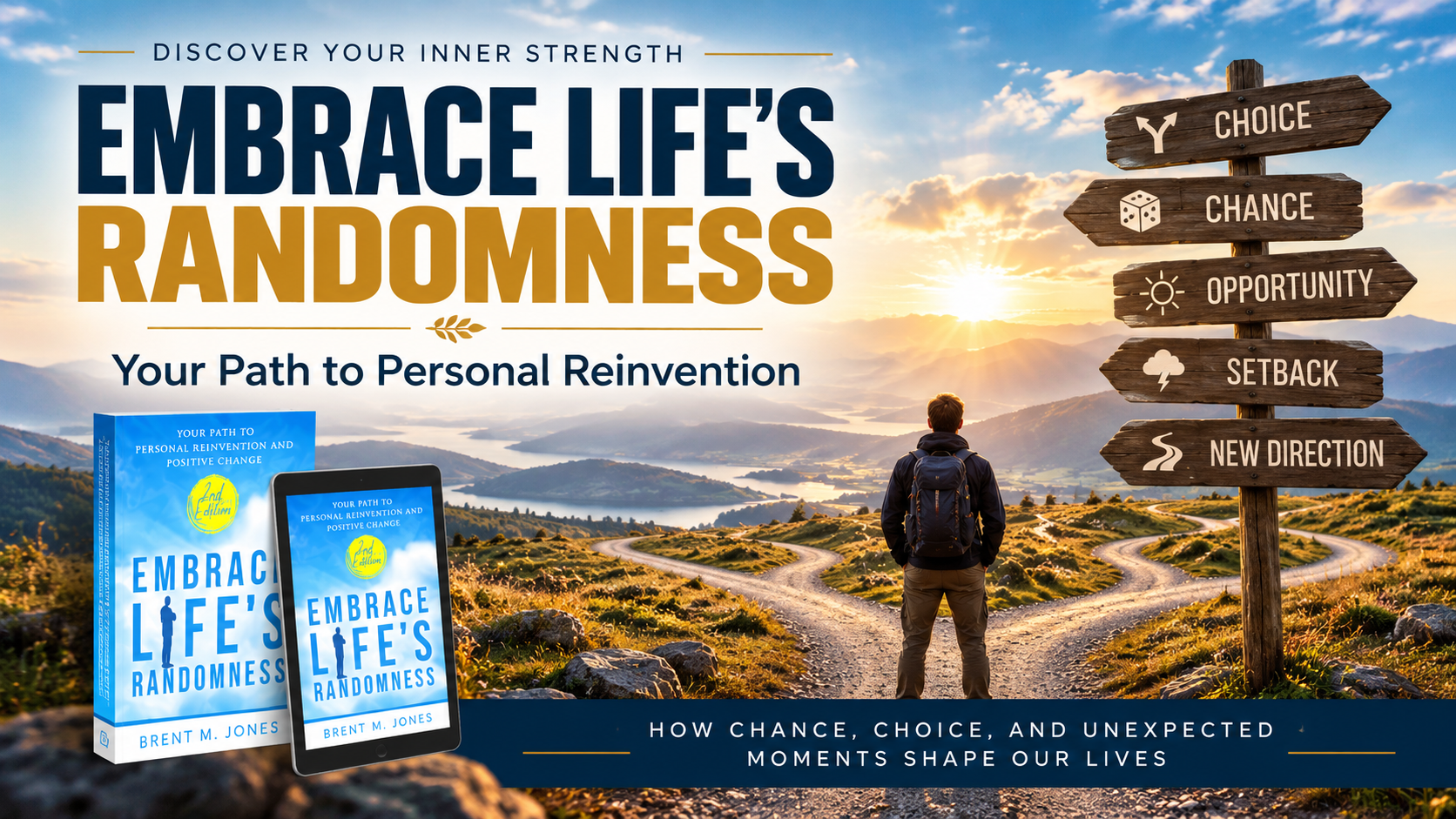
These reflections explore themes developed in my book, Embrace Life's Randomness: Your Path to Personal Reinvention and Positive Change, including free will, determinism, unexpected events, and the changing meaning of our personal histories.
Brent M. Jones
This essay develops ideas originally explored in reflections published in 2022 and 2024.