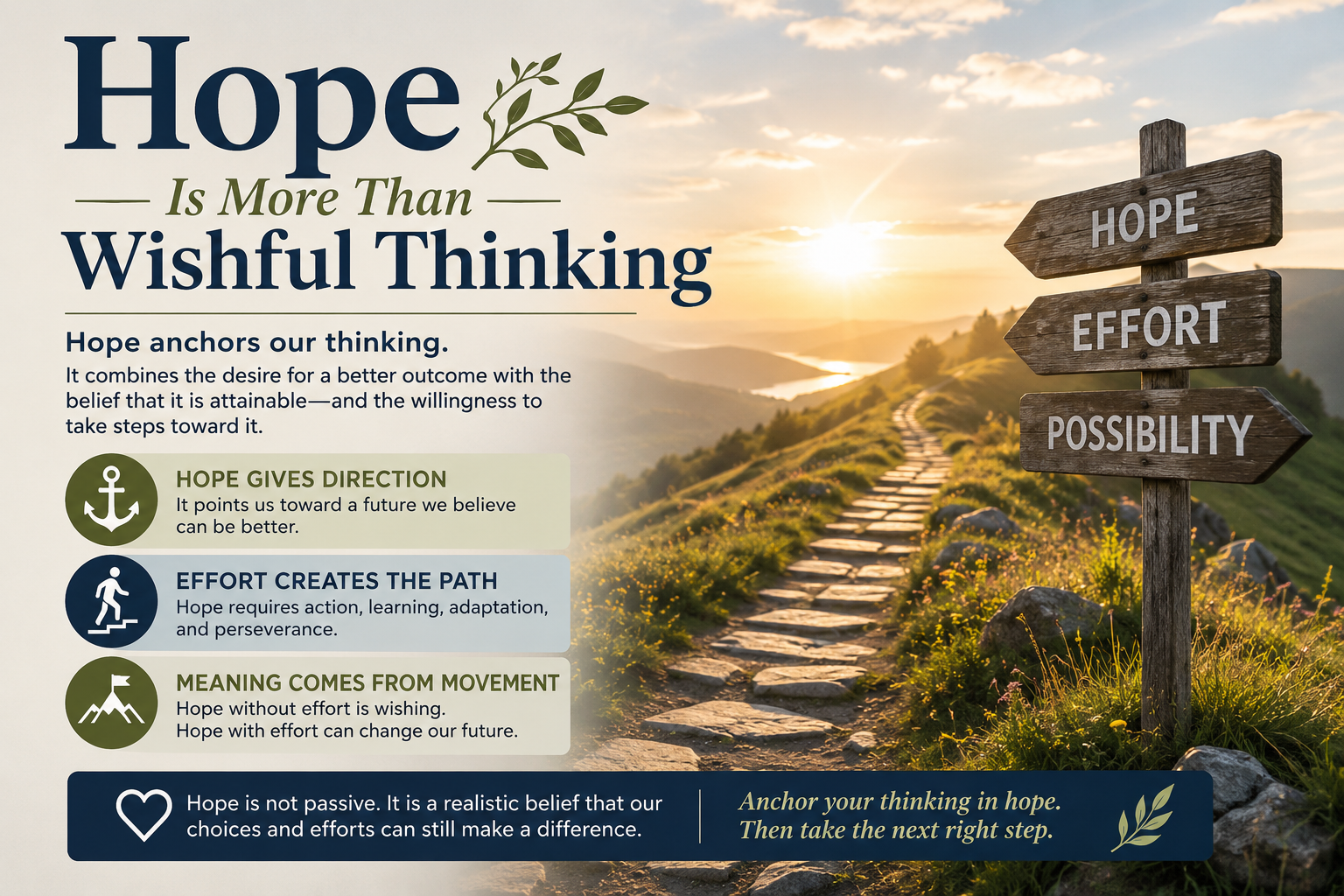
Hope is often described as an optimistic state of mind. Yet hope is more than wishing that something good will happen. Hope implies movement. It suggests that the future is not entirely fixed and that our choices, actions, and persistence still matter.
A person may hope for better relationships, improved health, meaningful work, or greater peace of mind. But hope without effort eventually becomes little more than wishful thinking. For hope to retain its value, it must be accompanied by some willingness to act, learn, adapt, or persevere.
Perhaps this is why hope can serve as an anchor for positive thinking. Positive thinking is not simply forcing ourselves to see the bright side of life. Rather, it is the ability to believe that possibilities still exist and that our participation in those possibilities matters.
Hope says, "The outcome I desire may be difficult, uncertain, or even unlikely, but there is still a path worth exploring."
Positive thinking anchored in hope is therefore neither naïve nor passive. It is a form of realism that acknowledges obstacles while refusing to surrender to them. It allows us to remain open to possibilities while accepting that meaningful outcomes usually require both patience and effort.
In that sense, hope may not merely support positive thinking. It may be one of the conditions that makes positive thinking possible in the first place.
What hopes continue to anchor your thinking, and what efforts are you willing to make in order to give those hopes a chance to become reality?