Exploring the unexpected connections that shape our lives
Book Reviews, Comments & Stories, Quotes, & Poetry & More
"Connections and Why They Matter"
Most of what happens in our life will spark a connection. Life connects with what has been found in books. Books connect with what happens in life. Use the connections to help you see more clearly. A love of reading and writing is what motivated the creation of this blog. Thank you for coming to the blog.
What we say matters, but how we say it can change how people understand our message.
Tone of voice, facial expressions, and body language influence how others interpret our feelings, attitudes, and intentions. This matters especially in emotionally sensitive conversations, disagreements, and situations involving trust.
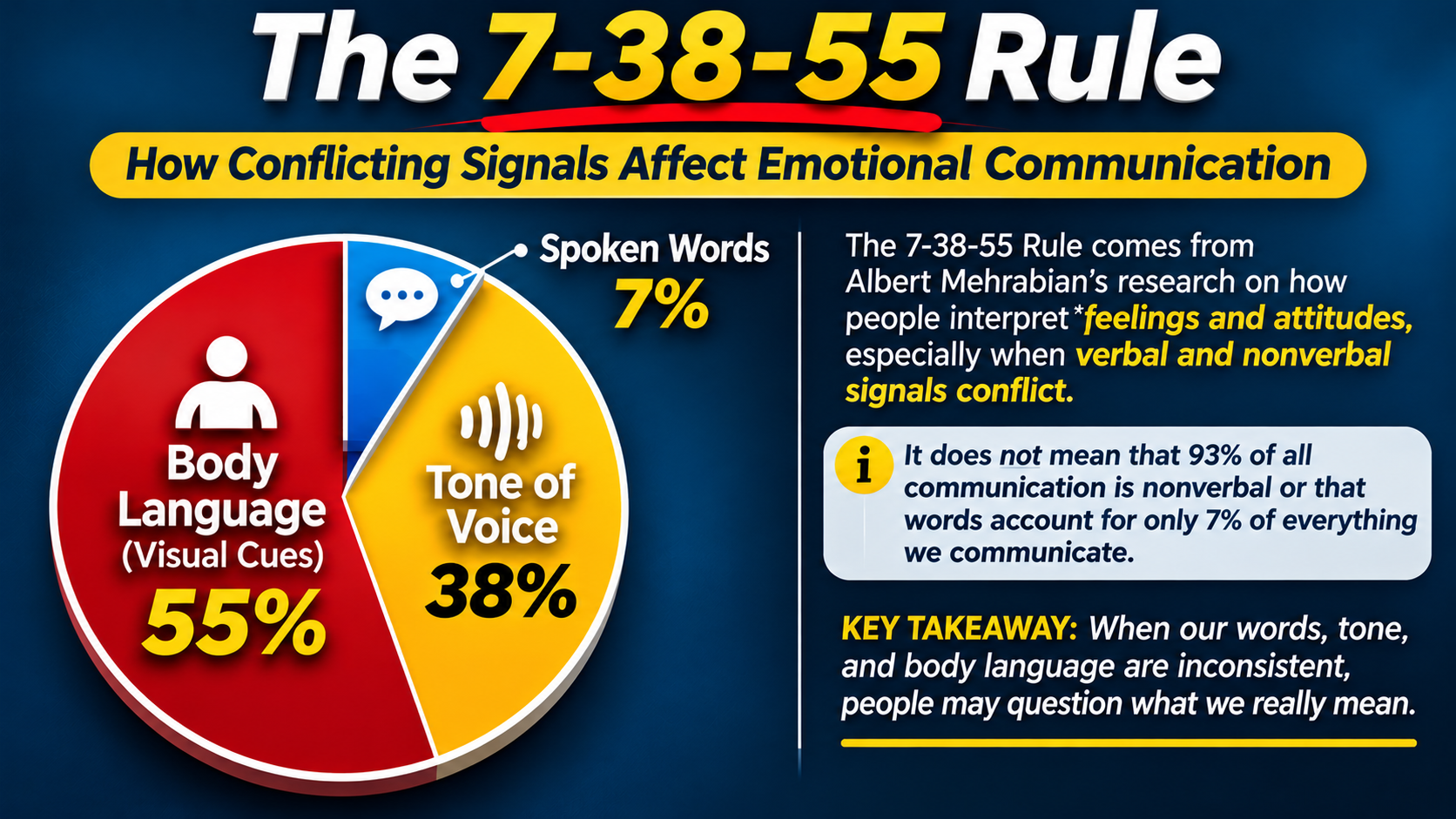
Psychologist Albert Mehrabian's research is often cited to illustrate this relationship. His findings became widely known as the 7-38-55 Rule, which identifies three elements involved in communicating feelings and attitudes:
7%: The words being spoken
38%: Tone of voice
55%: Facial expressions and other visual cues
What the 7-38-55 Rule Really Means
These percentages are frequently misunderstood.
Mehrabian's research examined specific situations involving the communication of feelings and attitudes, particularly when words, vocal tone, and facial expressions conveyed conflicting messages.
The research does not establish that 93% of all communication is nonverbal or that words account for only 7% of everything we communicate.
For example, when explaining technical information, giving directions, or sharing facts, the actual words are essential to understanding the message.
The 7-38-55 Rule is most relevant when someone is trying to interpret another person's feelings or attitudes and the signals they receive do not agree.
It also should not be interpreted as a universal formula for every emotional conversation.
The broader lesson remains valuable: When our words and nonverbal signals contradict one another, people may question what we really mean.
When Words and Tone Send Different Messages
Consider someone saying, "I'm happy to help."
Spoken warmly, with a welcoming expression, those words can communicate genuine interest and willingness.
But imagine hearing the same words delivered impatiently, with a frustrated expression or dismissive tone.
The words haven't changed, but the message we perceive may be entirely different.
That doesn't necessarily mean the person is being dishonest. They may be distracted, tired, uncomfortable, or dealing with unrelated concerns.
This is why understanding communication requires more than interpreting isolated gestures or expressions. We need to consider the circumstances and, when necessary, ask questions rather than assume we know what someone is thinking.
Why This Matters
Effective communication depends on alignment between our words, tone, and behavior.
When these elements reinforce one another, our messages are more likely to feel sincere, clear, and trustworthy. When they conflict, even well-intended communication can create confusion or resistance.
This matters especially in professional relationships, leadership, feedback conversations, negotiations, and conflict resolution.
A manager offering constructive feedback with patience and respect may encourage openness. The same feedback delivered with irritation or contempt can create defensiveness, even when the advice itself is useful.
The principle applies equally to personal relationships. A thoughtful tone, attentive expression, and a willingness to listen can communicate respect before we finish speaking.
Perhaps the most useful lesson is not simply learning to recognize someone else's nonverbal signals, but becoming more aware of our own.
Are our words expressing what we intend? Does our tone support that message? Are our expressions and behavior reinforcing the respect and understanding we hope to communicate?
Because effective communication isn't only about what we intend to say.
It's also about how others experience what we say.