
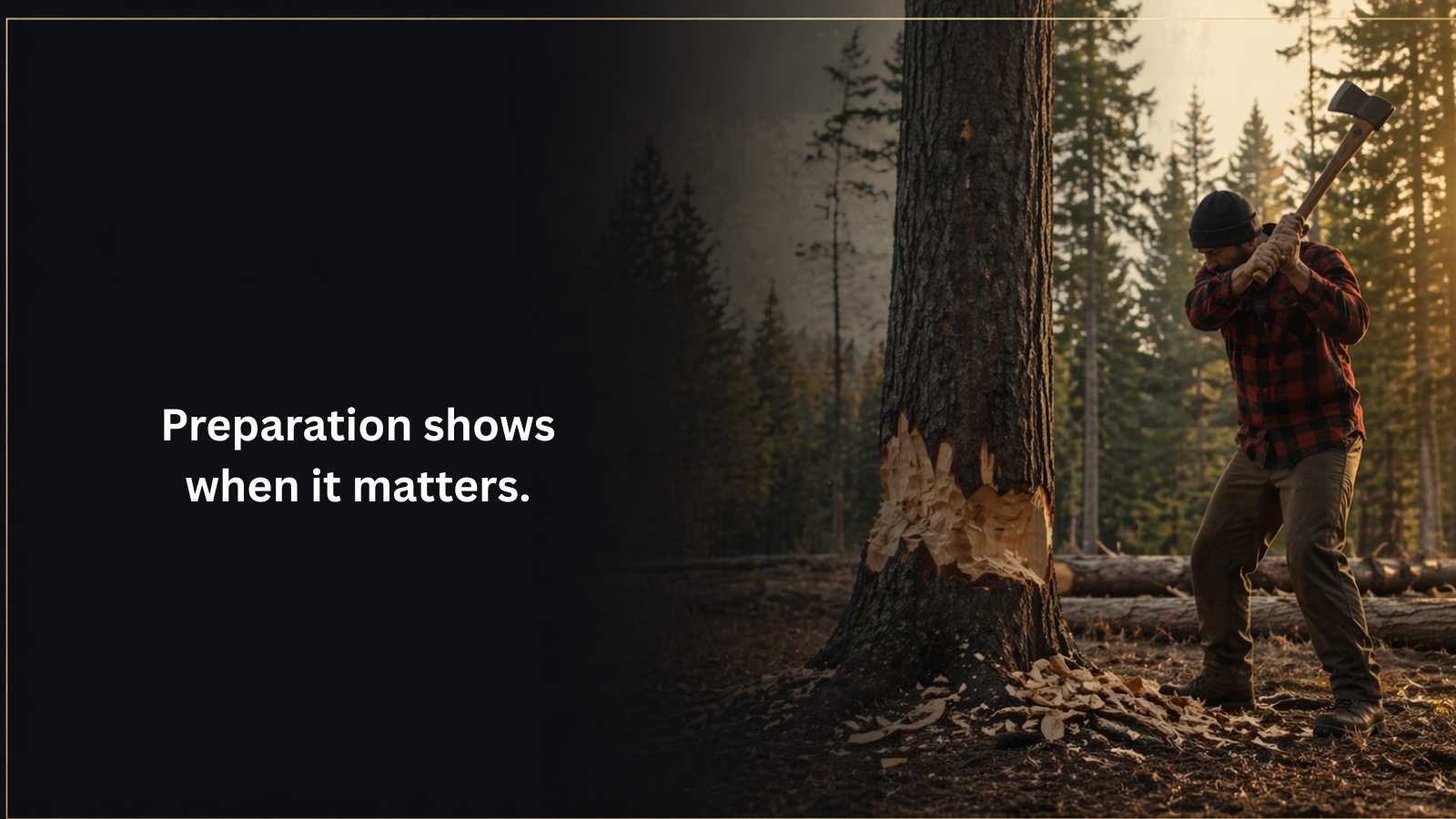
Abraham Lincoln once said, “If I had six hours to chop down a tree, I’d spend the first four sharpening the axe.”
The point wasn’t efficiency. It was preparation.
Tools dull. Skills do the same. And most of the time, we don’t notice until we need them.
Stephen Covey described this idea as “sharpening the saw.” Not something done once, but something practiced continuously. The challenge is that decline is gradual. There isn’t always a clear moment when a skill stops being effective. It simply becomes less sharp over time.
Many people wait until an opportunity appears—or until something changes—to start preparing. A job search begins. A role shifts. Expectations increase.
That’s when preparation feels urgent.
But by then, you’re catching up.
Preparation works differently when it happens in advance. When your skills are already developing, opportunities don’t feel like pressure. They feel like alignment.
Your work doesn’t automatically speak for itself. It reflects the level of attention you’ve given to developing it.
If you want a different result, something has to change before the moment arrives.
Sharpening your skills does not require a single method. It requires consistency.
You might take a course.
Read more deeply in your field.
Ask for feedback you don’t usually seek.
Learn something adjacent to your role.
Strengthen your network in a more deliberate way.
None of these actions are dramatic. But repeated, they change how you show up.
Preparation is rarely visible. But its absence is.
If someone is hired to do a job, we expect them to arrive ready—not to begin preparing once the work has started.
The same expectation applies to us.
Being prepared is not about perfection. It is about participation before it becomes necessary.
That is what allows your work—and your direction—to stand out.