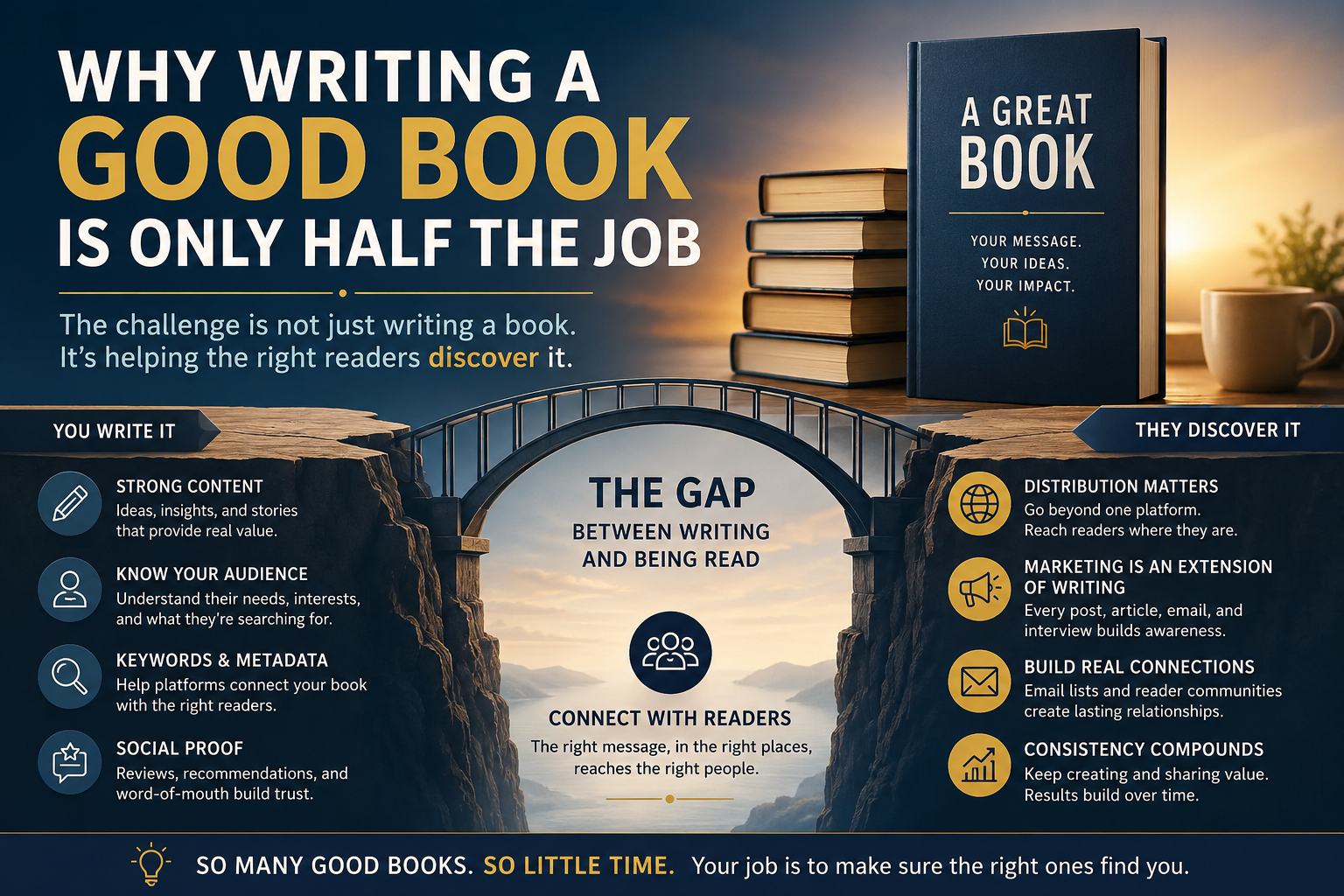
There has never been an easier time to publish a book. There has also never been more competition for a reader's attention.
Every day, thousands of books are published across multiple platforms. Many are well-written, thoughtfully produced, and genuinely useful. Yet most will never find a significant audience.
This creates a frustrating gap between writing a book and selling one.
As authors, we naturally focus on the quality of our work. We spend months or years developing ideas, revising manuscripts, and creating something we believe has value. Then the book is published, and a new challenge begins.
How do readers find it?
The answer lies in discoverability.
Book marketing often feels mysterious, but much of it comes down to helping the right readers find the right book. In many ways, publishing platforms and search algorithms work similarly to matchmaking systems. They use keywords, categories, metadata, reviews, and reader behavior to determine which books to show to which audiences.
That is why keywords are not simply technical details. They are part of the writing job. A title, subtitle, book description, categories, and metadata all communicate what a book is about and who it is intended to serve.
The question is not simply, "How do I market this book?"
The better question is, "Who is this book for?"
Understanding an audience is the foundation of effective marketing. What are readers trying to understand? What problems are they trying to solve? What subjects keep their attention? What kind of writing stays with them after they finish reading?
When those answers become clearer, marketing becomes more focused.
This is where many authors struggle. We often assume that if a book is good enough, readers will somehow find it. Sometimes they do. Most of the time, they don't.
Social media can help. Websites and blogs can help. Book reviews, interviews, newsletters, and reader communities can help. Distribution through Amazon and other retailers can increase exposure.
But none of these channels create demand on their own.
They simply carry the message.
Marketing is difficult because there is no guaranteed formula. Authors can receive positive reviews, encouraging feedback, and occasional sales while still feeling that the effort invested far exceeds the results achieved. I have certainly experienced that gap myself.
Pricing can matter. Cover design matters. Presentation matters. Distribution matters. Sometimes luck matters.
Yet over time, I have come to believe that the most sustainable approach is to continue creating valuable content and consistently placing it where interested readers can discover it.
Writing and marketing are not separate activities.
Marketing is an extension of writing.
Every article, newsletter, interview, social media post, and book description becomes another opportunity to communicate who you are, what you write about, and why it matters.
There are many good books and far too little time.
The challenge is not simply writing one.
The challenge is helping the people who would appreciate it know that it exists.