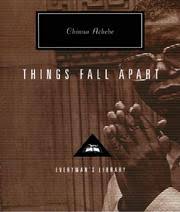
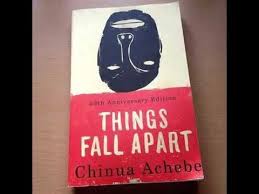
Things Fall Apart, by Chinua Achebe

images.jpg

It has been at least 20 years since I first read “Things Fall Apart” and discovered it's author, Chinua Archebe. The book must have resonated with others because today it is the most translated African work of all time. It has been translated into 50 languages and has sold over 8 million copies.

In “Things Fall Apart” the main character was Okonkwo from a village in Nigeria. He was a warrior, father, and husband. A single minded hard man. 

In the beginning of the book the Africans appeared uncivilized. As the book proceeded we understand that they were indeed a African tribe with strong traditions and values.

The dignity and humanity of their lives just falls away with the influence of the white missionaries and intruders, whose teachings are foreign to the tribe and of which resistance is impossible. The Christian salvation just doesn't resonate. 

Okonkwo can't change himself, and seems to be alone in his understanding of what is happening, and he commits suicide. The culture is lost and a civilization is lost

Quotes

“The white man is very clever. He came quietly and peaceably with his religion. We were amused at his foolishness and allowed him to stay. Now he has won our brothers, and our clan can no longer act like one. He has put a knife on the things that held us together and we have fallen apart.”

 “There is no story that is not true, [...] The world has no end, and what is good among one people is an abomination with others.”

"The Heart A Novel"

images.jpg

The French author, Maylis De Kerangal, wrote this novel about three 20 year old French men who go surfing in the middle of the night and on the way back they have a terrible accident and one man dies.

The book starts with the sentence: "The thing about Simon Limbres's heart, this human heart, is that from the moment of his birth, when its rhythm accelerated, as did the other hearts around it, in celebration of the event......................" . The sentence continues for more than a page.  

Many of sentences are long and often are as poetic as this first one. You find yourself seeing this human, and his connection to his heart, differently. The story really is about his heart, his death, and the care and grief that follow. The heart and the event itself has a poetic feel to it because of the writers approach. 

Bill Gates review this book and called it "A poetic novel about grief".  

Kirkus review said "Doctors and other medical experts hasten to prepare a young man’s organs for transplant and reckon with the need to be both compassionate and precise in a hurry." The story of the heart and the young man are seen from the parents, friends, hospital staff, doctors, and even the body itself's experience with this tragic event. We share in the grief and the book is one you will not want to put down


Falstaff Give Me Life, by Harold Bloom / Falstaff is a happy fellow it seem!

I have made some comments below about Professor Bloom and his favorite Shakespearean character, Falstaff.

Harold Bloom is a Shakespeare Scholar and Sterling Professor of Humanities at Yale. He was a former Harvard Professor.  He knows the Shakespeare plays like no one alive today.

He has said of Shakespeare that these particular plays are his favorites: Henry IV and parts 1 and 2 of Henry V. Bloom makes this choice because of his appreciation and love of the character Falstaff who has interesting roles in these plays. Bloom thinks of himself as a Falstaff character.

Falstaff is a happy guy (Tragic and Comic). He mocks faith, can be lewd, funny and reckless. When thinking of him Bloom offers these comments for traits: 'age, care, wisdom, & reflection!"

He imagines Falstaff and Socrates meeting in a pub and trading wit. This would be the ideal play script and it has been a wish of his for many years. The idea of one character from one play and then another from another and then someone way back in history meeting and talking would take a deep understanding of what the characteristics and personalities of those involved would be. For Bloom this is no problem and he seems to know the characters extremely well 

I hope at 86 I can care enough about some of my reading to imagine my own plots. What focus to have carried the image of character you read about for years. It testifies of both the strength of the author and of the student. 

Quotes about Falstaff


“Hal, if I tell thee a lie, spit in my face, call me horse.” 
― William Shakespeare, King Henry IV, Part 1

 “I’ll be no longer guilty of this sin; this sanguine coward, this bed-presser, this horseback-breaker, this huge hill of flesh,—” 
― William Shakespeare, King Henry IV, Part 1

“How now, my sweet creature of bombast! How long is't ago, Jack, since thou saw'st thien own knee?” 
― William ShakespeareKing Henry IV, Part 1