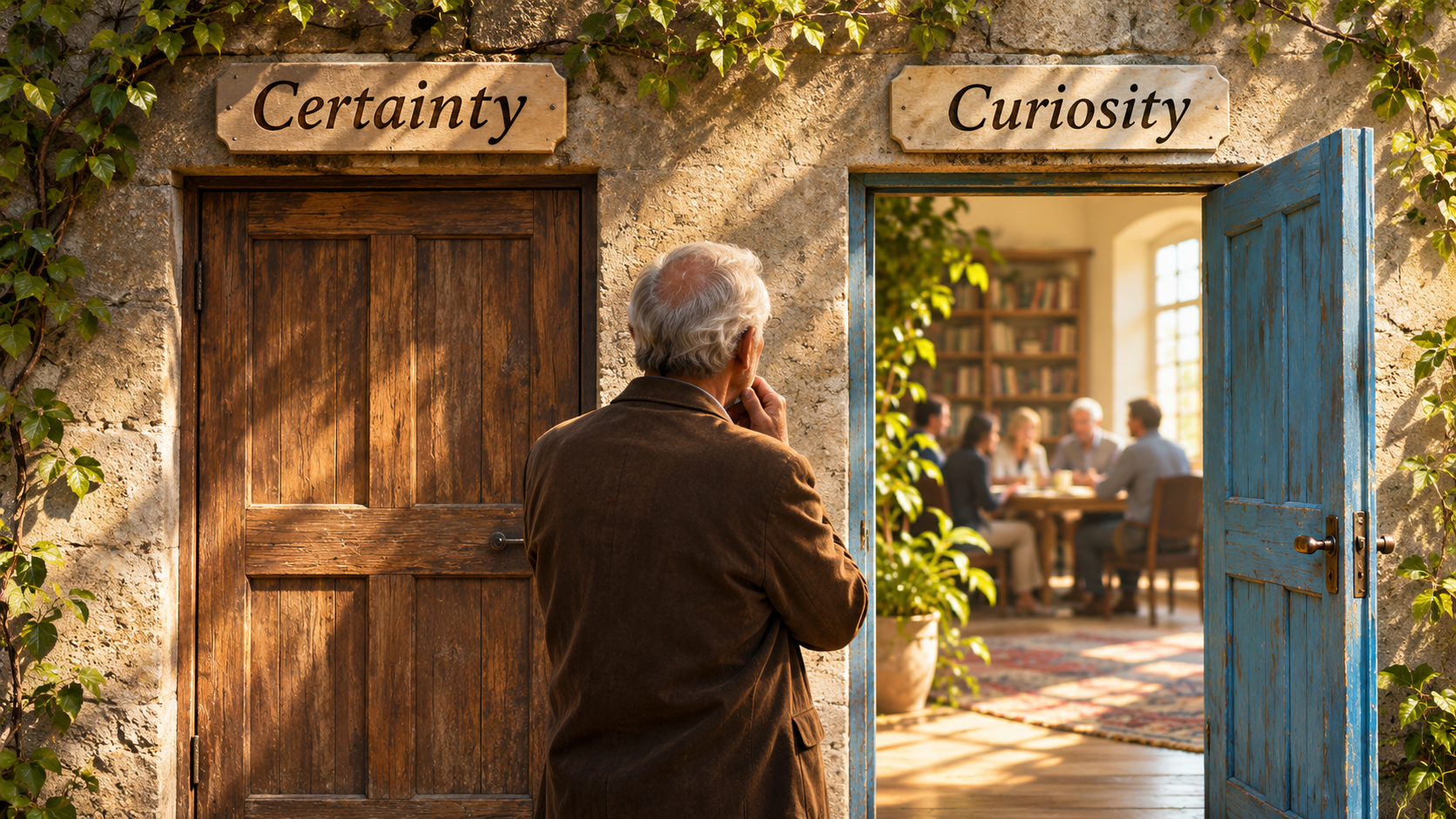
Throughout most of our lives, we are constantly learning. We meet new people, encounter different points of view, and discover things that challenge what we thought we understood.
Learning is part of living. Our experiences shape our beliefs, and those beliefs influence how we see ourselves and the world around us.
Yet something interesting seems to happen as people grow older.
Some become increasingly open-minded. They recognize that life is complicated, that people experience the world differently, and that even long-held beliefs may be incomplete.
Others seem to move in the opposite direction. They become more certain of their conclusions, less interested in alternative viewpoints, and sometimes unwilling to consider that what they believe might be wrong.
Both groups have accumulated years of experience. Both have had opportunities to learn.
Why does experience seem to produce wisdom in some people and greater certainty in others?
When Experience Becomes Certainty
We generally assume that experience makes us wiser.
That seems reasonable. The longer we live, the more situations we encounter, the more people we meet, and the more opportunities we have to learn from our successes and mistakes.
But experience doesn’t necessarily produce wisdom.
Sometimes it simply reinforces what we already believe.
Over the years, we develop explanations for how the world works. We form opinions about people, relationships, success, morality, and what makes life meaningful.
Eventually, those opinions may become so familiar that we stop questioning them.
We no longer think of them as conclusions we have reached. We begin treating them as established truths.
When someone offers a different perspective, we may not seriously consider it. Instead, we measure it against what we already believe and dismiss it if it doesn’t fit.
At that point, our accumulated knowledge may actually interfere with further learning.
Experience can make us more knowledgeable without necessarily making us more open-minded.
The Fear of Entering a New Room
I’ve been thinking about why some people resist new ideas, particularly after spending decades developing their beliefs.
Perhaps part of the answer is fear.
Imagine entering a room filled with people who understand something you know very little about.
You may have spent your life being respected for your knowledge, judgment, and experience. You are accustomed to having answers. Others may even look to you for guidance.
But in this new room, you are no longer the knowledgeable person.
You are the beginner.
You may discover that people with far less experience in life know considerably more than you do about a particular subject. Worse, you may discover that something you have confidently believed for years is mistaken.
That can be uncomfortable.
Admitting uncertainty may feel like admitting weakness. Acknowledging that someone else knows more may threaten the image we have developed of ourselves.
And we may worry about how others will see us if we admit we were wrong.
The fear may not be of learning something new. It may be of discovering that we don’t know what we thought we knew.
So we avoid entering the room.
We remain where our knowledge feels secure and our conclusions are familiar.
But by avoiding the possibility of being wrong, we also avoid opportunities to become wiser.
When Our Beliefs Become Part of Our Identity
There may be another stage in this process.
Initially, someone may resist a new idea because it makes them uncomfortable. They don’t want to question their judgment or acknowledge that their understanding might be incomplete.
But over time, that resistance can become something more permanent.
They have defended their conclusions for so long that those conclusions become part of how they define themselves.
They take pride in what they believe.
Eventually, they may find it difficult even to imagine another possibility.
What began as uncertainty about entering a new room has become a conviction that there is no reason to enter it.
This is where confidence can turn into something less productive.
Confidence allows us to say, “This is what I believe, and these are the reasons I believe it.”
Pride may lead us to say, “I know I’m right, and I have no reason to reconsider.”
The distinction matters.
When our beliefs become inseparable from our identity, questioning those beliefs can feel like questioning who we are.
We stop defending an idea and begin defending ourselves.
And once that happens, even good evidence or thoughtful disagreement may have little influence.
Does Wisdom Mean Knowing That We Don’t Know?
This brings me to something that initially seems contradictory.
We generally think of wisdom as having knowledge, understanding, and good judgment.
We seek advice from people we consider wise because we expect them to know something we don’t.
Yet some of the wisest people seem particularly comfortable acknowledging the limits of their knowledge.
They recognize that they don’t have all the answers.
They understand that their experiences, however extensive, represent only a small part of everything there is to understand.
And they remain interested in what other people have learned.
Does that mean wisdom is simply knowing that we don’t know?
I don’t think it’s quite that simple.
Recognizing our limitations is important, but wisdom also involves knowing how to use what we have learned.
Perhaps wisdom is the ability to distinguish between what we know, what we believe, and what we have yet to understand.
Those are not always the same things.
We can have strong convictions while recognizing that our understanding may be incomplete.
We can make decisions based on experience without assuming that our experiences apply to everyone.
And we can acknowledge that another person’s perspective may reveal something we have overlooked.
Wisdom may not require us to abandon certainty. It may require us to understand when certainty is justified and when it isn’t.
Does Aging Make Us More Like Ourselves?
Another possibility occurs to me.
Perhaps aging doesn’t necessarily make people wiser or more narrow-minded.
Perhaps it gives us more time to develop and reinforce our existing habits of thinking.
Someone who has spent decades defending opinions may become increasingly skilled at finding reasons to support them.
Someone who has spent decades asking questions may become increasingly comfortable discovering that their answers are incomplete.
Both have accumulated experience.
But they have used that experience differently.
One has primarily searched for confirmation of what they already believed.
The other has remained willing to discover what they may have missed.
Of course, none of us fits perfectly into either category. We may be open-minded about some subjects and remarkably stubborn about others.
We may welcome new ideas when they don’t threaten our identity, yet resist them when they challenge something we consider fundamental.
That is worth recognizing because it prevents this discussion from becoming simply a judgment about other people.
The tendency to defend our conclusions is something most of us can recognize in ourselves.
Perhaps Wisdom Requires a Different Kind of Confidence
There is an interesting paradox in all this.
We often associate confidence with certainty.
We admire people who seem to know what they believe and can explain their convictions without hesitation.
But perhaps there is another kind of confidence.
The confidence to admit that we were wrong.
The confidence to listen to someone who knows more than we do.
The confidence to reconsider a belief without feeling that everything we previously learned has lost its value.
And the confidence to enter a new room, knowing we may be the least knowledgeable person there.
That kind of confidence doesn’t depend on always having the answers.
It comes from being comfortable enough with ourselves to continue asking questions.
Maybe that is one of the differences between growing older and growing wiser.
As we age, we naturally accumulate memories, knowledge, experiences, and conclusions.
But wisdom may depend less on how much we have accumulated than on how willing we remain to reconsider what it all means.
The Difference Between Growing Older and Growing Wiser
I’ve reached an age where I have had many opportunities to observe people, learn from them, and reconsider my own understanding of life.
I have also had enough experience to recognize that some of the things I once believed with considerable confidence were incomplete.
That doesn’t mean those earlier beliefs were necessarily foolish. They reflected what I understood at the time.
But time has a way of introducing us to experiences and perspectives we could not have anticipated.
If we allow them to, those experiences can change how we understand ourselves and others.
Perhaps that is what wisdom really requires.
Not simply accumulating answers, but remaining willing to discover better questions.
Not abandoning everything we believe, but recognizing that our understanding may continue to develop.
And not measuring our worth by how much we know, but by our willingness to keep learning.
Some people spend their lives gathering evidence that they were right. Others spend their lives discovering what they may have missed.
Both grow older.
But perhaps the second approach offers a better opportunity to grow wiser.
And that leaves me with a question worth asking ourselves, regardless of our age:
As we grow older, are we becoming more certain of what we know, or more aware of what we have yet to understand?