Exploring the unexpected connections that shape our lives
Book Reviews, Comments & Stories, Quotes, & Poetry & More
"Connections and Why They Matter"
Most of what happens in our life will spark a connection. Life connects with what has been found in books. Books connect with what happens in life. Use the connections to help you see more clearly. A love of reading and writing is what motivated the creation of this blog. Thank you for coming to the blog.
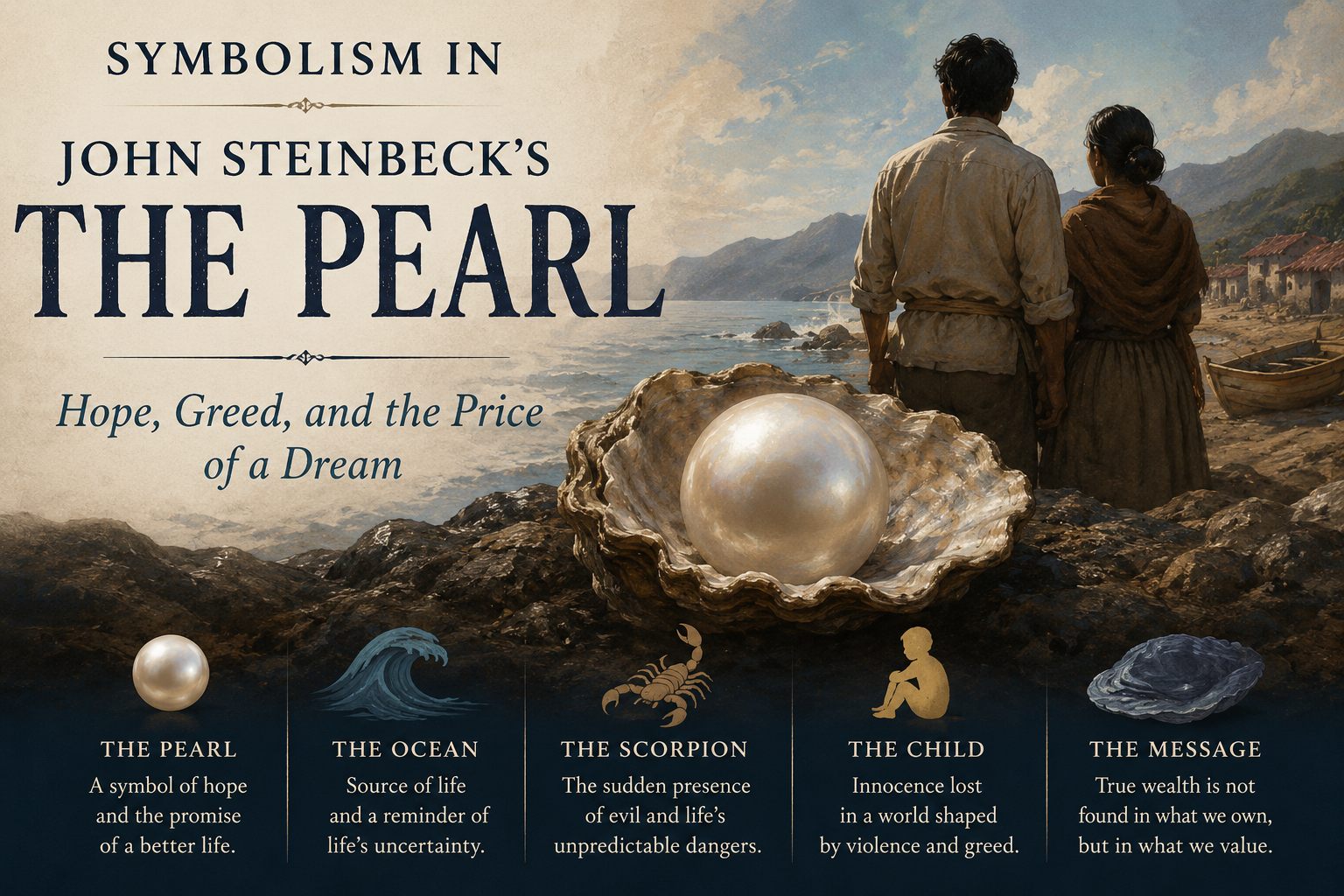
John Steinbeck’s The Pearl is a short novel, but its simplicity is deceptive. Beneath the story of Kino, Juana, and the discovery of a valuable pearl is a much larger story about hope, poverty, greed, power, and the price people sometimes pay for believing that wealth will change their lives.
Several elements carry symbolic weight throughout the novel, including the pearl, the ocean, the scorpion, and the child. Together, they turn Kino's seemingly good fortune into something far more complicated.
The Pearl as a Symbol of Hope and Corruption
At first, the pearl represents possibility.
Kino is a third-generation pearl diver. His life has largely been determined by circumstances established long before he was born. When he discovers an extraordinarily valuable pearl, it appears to offer something he has never really possessed before: the ability to change his family's future.
He imagines an education for his son, better clothes, a proper marriage, and a life less constrained by poverty. The pearl becomes a symbol not simply of money, but of hope.
Yet the meaning of the pearl changes.
As others recognize its value, greed, deception, violence, and fear begin to surround Kino and his family. What initially represents freedom gradually becomes a source of danger. Steinbeck turns the pearl into a powerful contradiction: something of enormous monetary value that ultimately costs Kino far more than it can ever give him.
The Ocean and the Uncertainty of Life
The ocean is both Kino's livelihood and something he can never control.
As a pearl diver, he depends upon it, but every dive contains uncertainty. He may find nothing, something ordinary, or the pearl that appears capable of transforming his life.
In that sense, the ocean reflects the larger uncertainty of human experience. Kino works within a world in which effort does not necessarily determine outcome. Chance can suddenly change a life, but change is not always improvement.
The pearl comes from the ocean as an apparent gift. In the end, Kino returns it to the same place.
That circular journey matters.
The Scorpion and the Arrival of Evil
Early in the story, a scorpion threatens Kino and Juana's innocent child, Coyotito. Its appearance introduces danger before the pearl is ever found.
The scorpion can be read as a symbol of evil, but also of life's unpredictability. One small event suddenly places the family in crisis. Their inability to obtain medical treatment without money exposes the powerlessness created by their poverty.
Kino searches for the pearl partly because he needs a way to protect his family.
Yet the pearl that seems capable of providing that protection eventually attracts another form of danger.
The irony is devastating. The family's pursuit of a better life begins with an attempt to save their child, yet Coyotito ultimately becomes the innocent victim of the violence surrounding the pearl.
What Does the Pearl Finally Mean?
By the end of the novel, the pearl no longer represents the future Kino imagined.
Its financial value has not changed. Its meaning has.
When Kino and Juana finally throw it back into the ocean, they are rejecting more than a valuable object. They are rejecting everything the pearl has come to represent: greed, obsession, violence, false hope, and the belief that wealth alone could give them a better life.
That may be Steinbeck's most powerful use of symbolism in the novel.
The pearl itself never changes. What changes is what Kino sees when he looks at it.