Work Matters, and Volunteers Matter, but the Benefits and Motivations will often Vary.

All work matters, but it isn't just the work itself that matters; all who contribute to it matter. All sides gain.

Volunteers do some work, but for most work, those doing the work are paid. Participants learn new skills, meet new contacts, and help get things done in both cases. Sometimes volunteers get things done that paid workers might not have done. With these benefits, you would expect a long line of volunteers from those out of work.

It is usually unknown who will be showing up to volunteer on a project, and those doing the work also often meet new people from various life backgrounds. Your connections with coworkers, suppliers, recipients, and organizations can make a difference to you long after the work is done.

Those receiving the benefit of the work done are lifted, improving their lives. Volunteering, working side by side with others, connect you to other human beings. When you volunteer, you are making connections. Paid for your time or not, always do your best in your work. It matters.

When you know, you have made a difference; you feel better about yourself. Therefore, taking pride in your volunteer work and doing your best work is essential.

Life is 10% what happens to you and 90% how you react to it

This quote is by bestselling author Charles Swindoll. Another similar thought is from a Japanese proverb:

“Fall seven times, stand up eight.”

We must react positively to falling by returning up, even if it means falling again.

Effective Communication brings people closer together or ensures that they don’t get closer.

Effective communication requires you to become an engaged listener. That means changing the usual focus of trying to listen to decide what to say next. Listening well will help you understand the words being communicated, but a person needs to learn how to understand the emotions conveyed.

When you listen, you’ll hear more than just words; you will hear the feelings in someone’s voice and understand that more than terms are being communicated and how a person feels about those words are more important.

Listening this way lets the other person know they were heard and understood. Resulting in a better connection.

What is being communicated often has nothing to do with the words, and the real intention (motive) can be a concern if known.

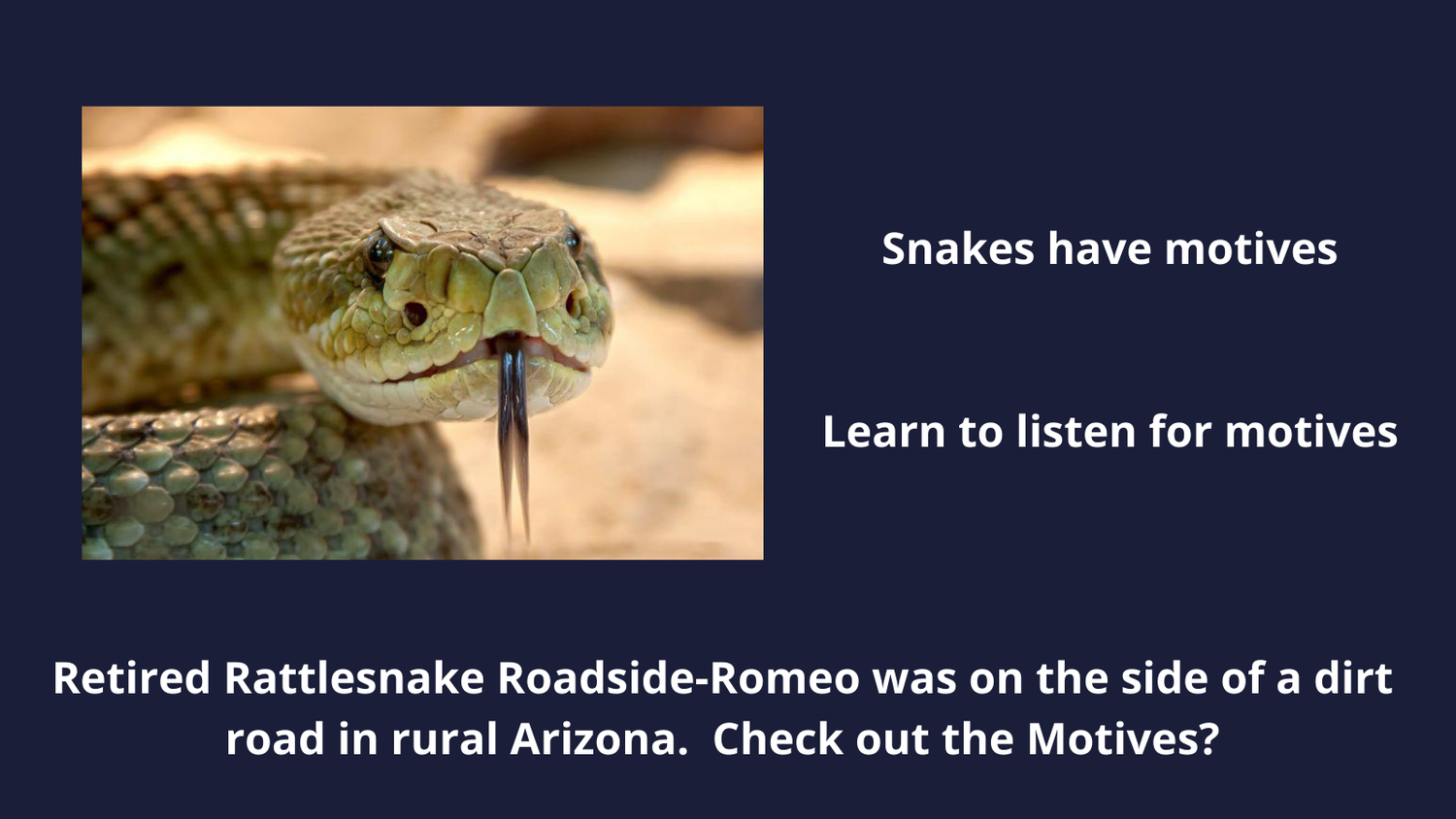
Snakes have motives

Retired Rattlesnake Roadside-Romeo was on a dirt road in rural Arizona. On the other side of the road was a chicken.

So, he hollers, "Hey there! Babe! I don't usually talk with random chicks, but you should know I am a hundred years old. Do you want to know the secret to long life?"

The chicken is intrigued and asks, "Well, what is it? Tell me"

Roadside-Romeo replies, "What'd you say? Can't hear you."

The chicken says, "What is the secret to long life?"

Roadside-Romeo says, "What, babe? Whatcha sayin'?"

So, the curious chicken crossed the road.

And went near Roadside-Romeo's ear and yelled, "What is the secret to long life?"

Roadside-Romeo hissed and rattled and replied, "Oh!!! The secret is - Don't talk to strangers!"

And in one quick swoop, the snake pounced and swallowed the bird.

And smugly, he thought, "Amazing, I can still pick up chicks with that joke!"

“Effective Communication is not just for good guys.”

#effectivecommunication #earlycareers #motivation #communication #community #listening #intentions

Should your job define you as a human being, and how can LinkedIn help?

This article below can also be found on my LinkedIn Newsletter site, where many subscribe to this and receive notifications when posts are made.

Link to my LinkedIn newsletter site

The best answer to that question is no, and the support for that point of view is that a person is a being that has specific capacities or attributes such as reason, morality, consciousness or self-consciousness, values, and part of a culturally established form of social relations such as families. All these areas overlap the work time, often subjugate work responsibilities, and make it far easier to function when employment values align with an employer’s goals.

Apart from work, a human being’s life has some critical areas of focus, but even so, the reality is that time can be an obstacle to this definition. One week has 168 hours. Suppose a person sleeps an average of 8 hours a day; that takes 56 hours out of this total, leaving 112 hours. If a person works 50 hours a week working and commuting, then this leaves 62 hours or 8 hours a day to devote to your family, eating, hobbies, church, reading, study, and social relations.

The financial support from working 50 hours a week often is needed to support everything about the 168-hour week. Usually, it takes two adults to support a family, but full-time work leaves little time for reinvesting in oneself.

According to the Bureau of Labor Statistics, the average worker currently holds ten different jobs before age forty, and this number is projected to grow. Forrester Research predicts that today's youngest workers will have twelve to fifteen jobs in their lifetime.

If you probably have job changes ahead within your projected career, what can be done to create an upward trajectory in a career? One answer comes in understanding the skills critical to holding your current job in place and the logical following skills that should be added. Working until you are burnt out and want nothing to do with your past career focus can be a very costly career mistake.

The LinkedIn profile is a template for all the experiences and qualifications that came together to get you your current job. With that template in place, you can ask yourself where you go next when a job change happens. An easy answer can be to use LinkedIn to find out what skills your supervisor or that person’s manager has and identify what skills you lack for that job. You can look at competitors' profiles and find their employees’ skills and what is something that would help you. Another approach is looking at similar industries and finding job profiles based on the same or similar skill set.

You may have asked yourself if you could fit into the business and culture of competitors, suppliers, and customers from your own business experiences. Linkedin can show you the people who run those businesses and departments, and that can open the door to call and ask for 30 minutes in an informational interview to ask some questions.

The LinkedIn profile can point to the future as well as be a road map of where you have been, and that tool can prove invaluable for you. As we have seen, a working person's week isn’t much time open.

Living your life is about reinventing yourself everyday

Our lives change constantly, and those changes are additions to our life stories that enable us to see past events differently and contribute to seeing our past lives differently.

“How you arrange the plot points of your life into narrative shapes who you are and is a fundamental part of being human.” This is the subtitle in an interesting article titled Life’s Stories, published in The Atlantic in 2015. In that article, Monisha Pasupathi, a professor of developmental psychology at the University of Utah, offered much insight on this subject. She stated: “To have relationships, we’ve all had to tell little pieces of our story.”

When we create a narrative about the events in our life, it triggers the conclusions new experiences and knowledge has brought to us. We could conclude that all we did was add clarity to what happened, but in looking back, we have unique insights offering more transparency, and the events themselves take on new meaning. Through this experience, we reinvent who we are.

Quotes about Reinvention

1. "It's never too late to be what you might have been." -- George Elliot

2. "When I let go of what I am, I become what I might be." -- Lao Tzu

3. "The reinvention of daily life means marching off the edge of our maps." -- Bob Black

4. "Change your life today. Don't gamble on the future; act now, without delay." -- Simone de Beauvoir

"The Human Factor How Finding Your Dream Job Starts By Getting To Know Yourself":

“Introduction Page” to “The Human Factor”

July 25, 2022

Despite our many differences, all humans share at least one thing in common. We all want to be the best version of ourselves.

Some of us define that goal as connecting to a community, having a big family, or excelling at a job we love. Others can’t necessarily represent it but seek the abstract idea of “happiness.”  Surely, once we find our “purpose and fulfill it, we will find that elusive “happiness,” right?

Alexander Pope said, “Act well your part; there all the honor lies” But what if you find yourself unsure of your place in this world? What if you know your part but find your goals too insurmountable to reach?

You need a change, and to get that, you need to change.

Only then will you have the confidence and focus on making that big career change or learning that new skill to help you jump into another profession. These significant life changes can be scary. It can sometimes seem impossible, especially after feeling you’ve lived a whole life without changing.

Other Newsletter Items

Several weeks ago, there was a lot of bad news. It seemed like the whole world was falling apart. Later that day, I posted thoughts and graphics titled "What a Wonderful World."

That day I also came across a Louis Armstong recording where he sang this song. The words inspired me, as did Mr. Armstong's voice and instrument.

The post below was inspired at that time when that week's news was anything but good. It was inspired by Louis Armstrong's recording of the song, "What a Wonderful World" I wondered what kind of feedback I would get. I was pleasantly surprised.

The website posts about "Bad Poetry" and "Writers' Symbolism" have also been well received. I am amazed at the number of website visits from google visitors worldwide about my website post on "Bad Poetry. 

Other Interesting Website Recent Posts