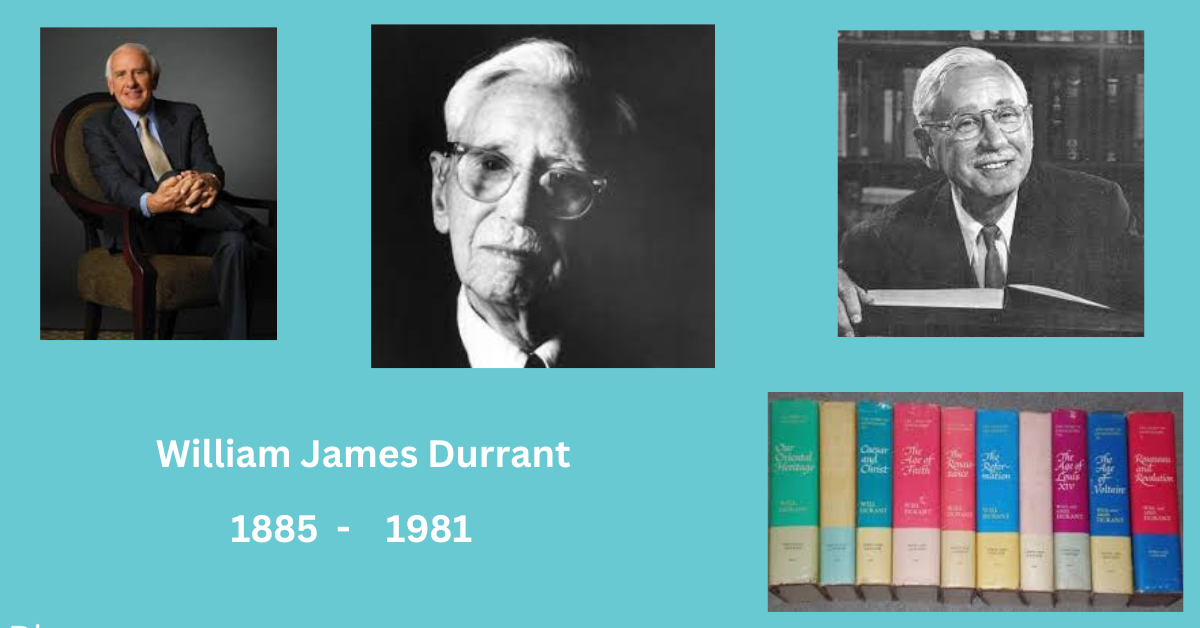
Will Durrant is a favorite and influencial author

Will Durant has long interested me not simply as a historian or philosopher, but as a writer deeply concerned with the human soul—its fears, contradictions, longings, and quiet search for meaning. Across decades of writing, Durant returned again and again to the same enduring questions: how we live with mortality, how we educate ourselves beyond information, and how wisdom differs from knowledge. His work does not aim to impress with systems or abstractions, but to understand what it means to be human across time.

Quotes

“The fear of death is strangely mingled with the longing for repose.” 

"I found it impossible to continue my pretenses to orthodoxy."

Knowledge is power, but only wisdom is liberty.”

“Education is the transmission of civilization.”

“To speak ill of others is a dishonest way of praising ourselves. Nothing is often a good thing to say, and always a clever thing to say.”

 “Truth will make us free.” 

(This could be considered his most important work)

Fallen Leaves could be considered one of Durant’s most important works. He wrote its preface at the age of ninety-five, addressing readers who might expect a final, definitive philosophy. Instead, he offered a modest clarification:

“Please do not expect any new system of philosophy, nor any world-shaking cogitations; these will be human confessions, not divine revelations; they are micro- or mini-essays whose only dignity lies in their subjects rather than in their profundity or their size.”

Even as Durant downplays the depth of what follows, the book leaves the reader waiting—not for grand conclusions, but for recognition. The twenty-two short chapters distill more than sixty years of engagement with philosophy, religion, art, science, and history, returning repeatedly to the human condition rather than abstract theory.

His writings included thoughts about the soul.

He confirmed his love of and insight into the value of history, saying: “It is a mistake to think that the past is dead. Nothing that has ever happened is quite without influence at this moment. The present is merely the past rolled up and concentrated in this second of time. You, too, are your past; often, your face is your autobiography; you are what you are because of what you have been, because of your heredity stretching back into forgotten generations, and because of every element of the environment that has affected you, every man or woman that has met you, every book that you have read, every experience that you have had; all these are accumulated in your memory, your body, your character, your soul. So with a city, a country, and a race, it is its past and cannot be understood without it.”


“The Story of Civilization”: 11 volumes considers the living conditions of everyday people. Durant said that curious readers had challenged him to speak his mind on the timeless questions of human life and fate, having spent so much of his life focusing on just that.

Is the Human Soul Eternal, and is it transcendent of our material existence? by Brent M. Jones was inspired by Will Durrant

See article “is the human soul eternal”

Durant shaped how I think by reminding me that the study of history, philosophy, and ideas only matters insofar as it deepens our understanding of the human soul.