Many people are told to “find their why” when thinking about goals and direction, but what happens when that changes? The idea sounds simple. If we understand why we want something—why a goal matters, why a path feels right, everything else is supposed to fall into place.
Clarity leads to direction. Direction leads to results. At least, that’s the expectation. But life doesn’t always work that way.
Goals change. Sometimes slowly, sometimes all at once. What once felt important can lose its pull. What once felt certain can begin to shift.
And when that happens, the question of why doesn’t always give us an answer. It can leave us with a different question:
What now?
In my career development work, I’ve often seen this pattern. People spend years building toward something, developing skills, gaining experience, and becoming known for what they do. Then something changes.
Sometimes it’s external. A job ends. A role evolves. An industry shifts.
Other times, the change is quieter. A growing sense of misalignment. A feeling that the work no longer reflects who they are becoming.
They don’t start by asking what they want to do next.
They start by explaining why they no longer want to stay where they are.
This is where the idea of “why” begins to break down.
Understanding why something once mattered doesn’t always explain why it no longer does.
And it doesn’t always point clearly to what comes next.
There’s another way to look at it.
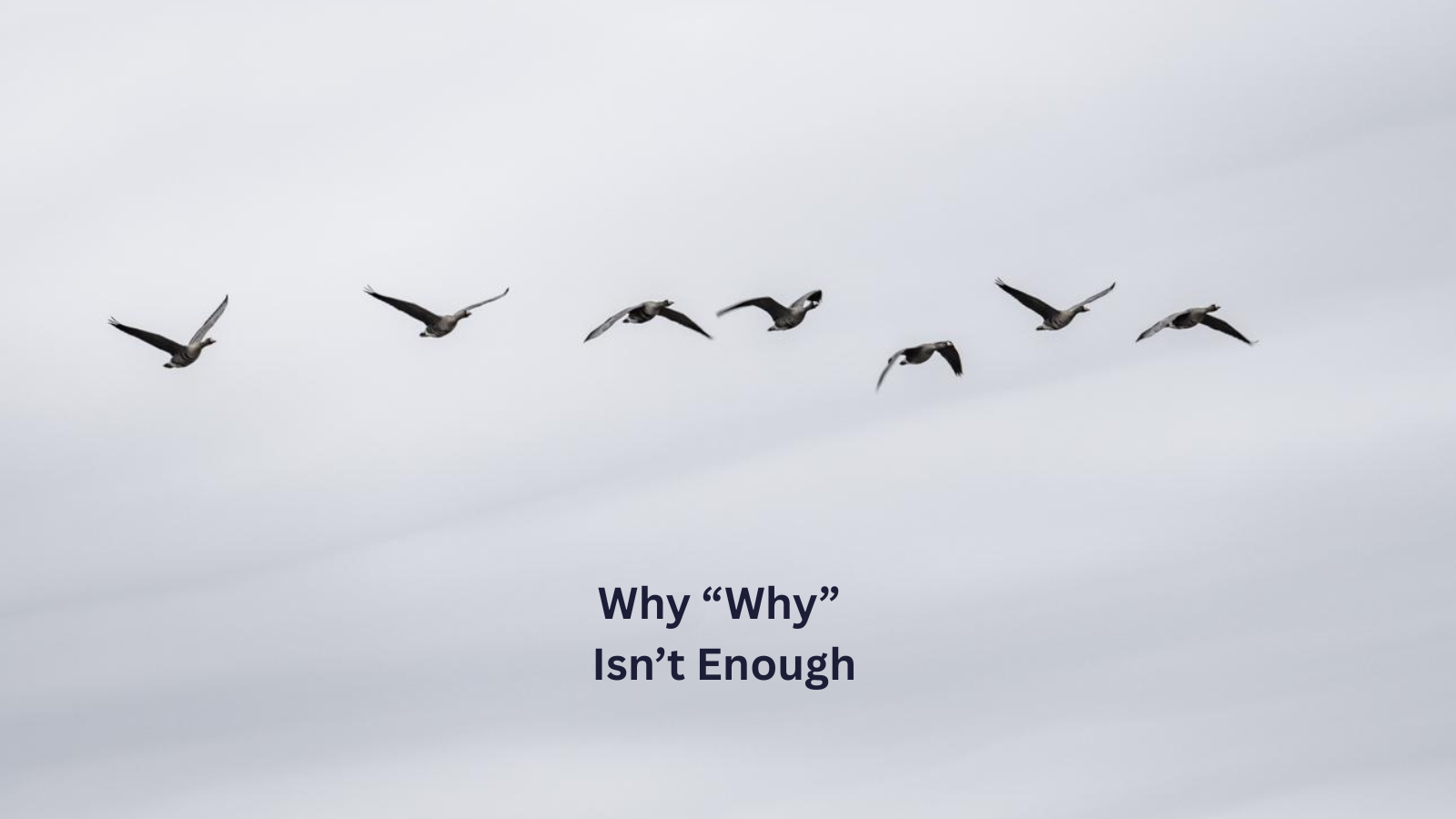
If you’ve ever watched geese flying in formation, you may have noticed that the shape is rarely perfect.
The sides shift. The lead changes. The formation adjusts depending on the wind and the distance. No single bird stays in front the entire time. The role rotates. The effort is shared.
What matters isn’t holding a fixed position. What matters is paying attention, to the conditions, to the group, to what is needed in that moment.
Our lives don’t follow a fixed formation either. We move forward, adjust, step back, move again.
What we thought would be a long-term direction sometimes becomes one stage in a much longer process.
And what once felt like the goal may turn out to be part of how we got somewhere else.
The question isn’t whether “why” matters. It does. But it’s not the only thing that guides us.
What matters just as much is how we pay attention over time to changes in ourselves, in our work, and in the world around us.
Clarity doesn’t always arrive all at once. More often, it develops gradually. In moments where something no longer fits.
In decisions that don’t feel as certain as they once did. In small shifts that we begin to notice, even if we can’t fully explain them.
We don’t move forward because we have a perfect answer. We move forward because we’re willing to adjust. To notice. To reconsider. To respond to what’s changing.
“Why” can help us begin.
But it’s attention, and the willingness to adapt, that carries us forward.