
Standing Alone
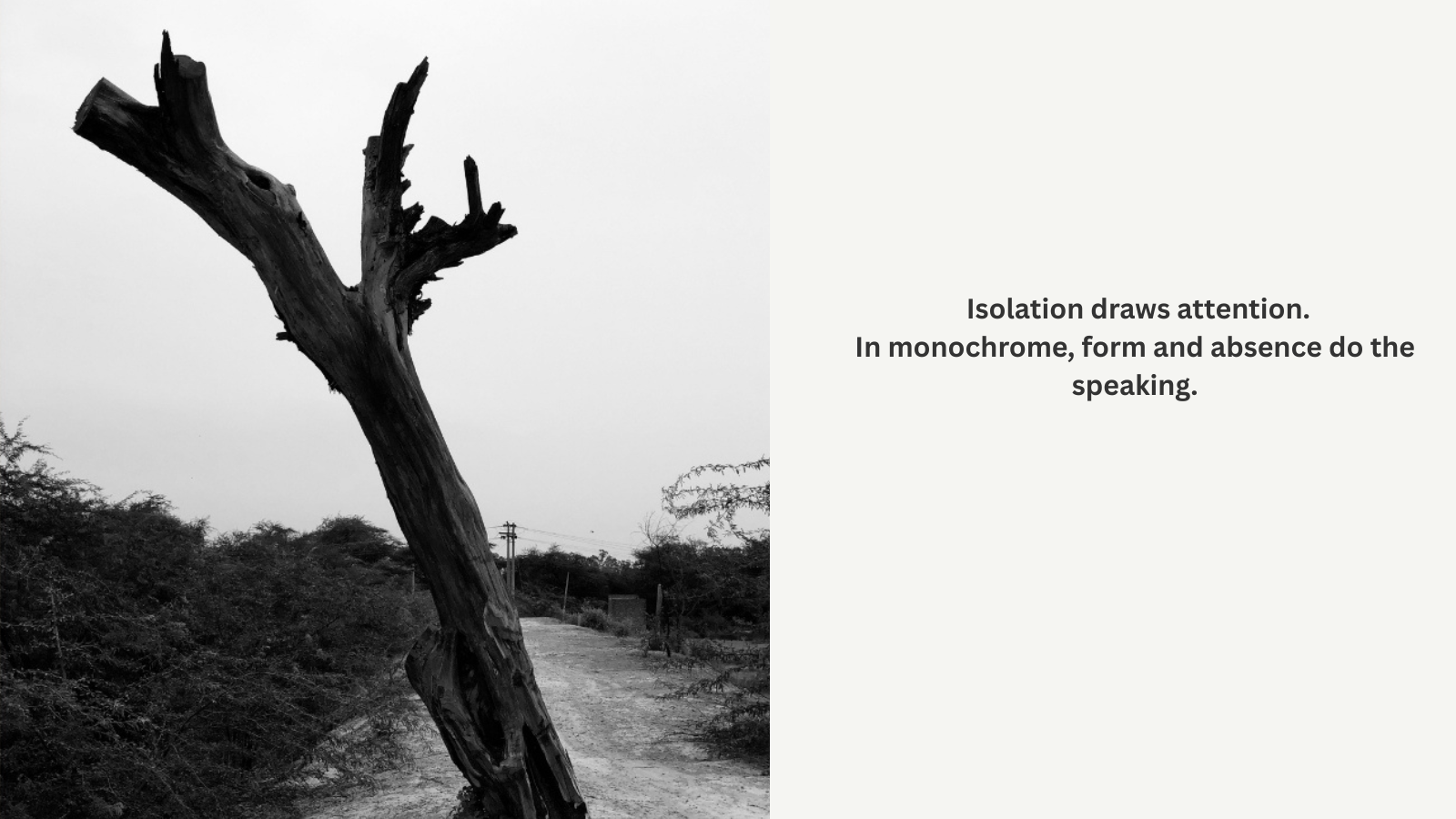
Monochrome photography relies on cohesion rather than contrast.
In this image, a lone dark tree rises from a pale road, surrounded by muted ground and distant utility poles. There is little separation between elements, only gradation, texture, and form.
The scene feels sparse, but not empty. The road continues. The poles recede. Something remains beyond the frame.
What draws attention is not color, but isolation.
Why does the tree stand alone, older than the growth around it? What happened here?
The photograph doesn’t answer these questions. It leaves them in place.
Is This a Metaphorical Kiss?
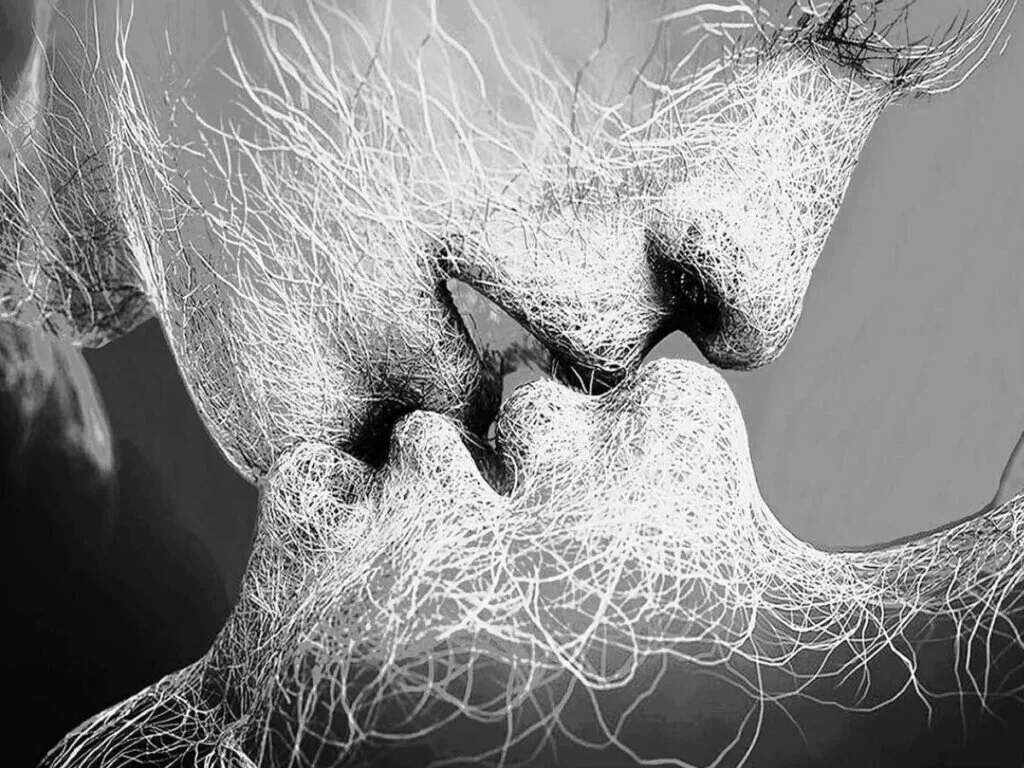
A kiss is a simple gesture. But in black and white, it becomes something else.
Less literal. More symbolic.
This image shows two faces touching, yet the details are reduced to lines and light. The familiar shape is still there, but the texture feels almost electric. As if connection has been stripped down to its raw energy.
That’s the power of black-and-white art. It removes what we expect to see and reveals what we often overlook. Form. Emotion. The quiet tension between closeness and mystery.
A kiss like this isn’t just a moment. It’s a metaphor for connection itself, fragile, intricate, and full of unseen threads that pull two people toward each other.
Even without color, the meaning holds. Maybe it even becomes clearer.
“This reminds me of how monochrome imagery changes what we notice,
explored in this reflection.”
Seeing in Black and White

When we look at something without color, we notice things we would have missed.
Lines. Shapes. Shadows. The quiet details that hold everything together.
Color adds emotion, but black and white adds clarity. It removes distraction. It shows us what stays when everything else is stripped away.
A flower in black and white is still a flower, but it becomes something else too.
More symbolic.
More internal.
Almost like a thought taking shape.
What we see becomes less about the petals and more about meaning.
Sometimes absence reveals what presence hides.
Maybe that’s why a black rose doesn’t feel like loss to me. It feels like a beginning.
A reminder that change often starts in places we don’t expect, in the shadows, in the quiet, in the parts of life we usually overlook
Why Monochrome Art Still Matters

Art has always been a part of how I understand the world. The more I write about attention, alignment, and small moments, the more I see how visual simplicity shapes the way we feel. Monochrome images—painted, photographed, or sketched—remind us that depth doesn’t require complexity. Sometimes, removing color helps us see the truth of an image more clearly.
Monochrome art uses a single color or a range of that color. With fewer distractions, the eye settles. Form, texture, and shape become the story. It doesn’t matter whether the artist uses paint, charcoal, ink, or the lens of a camera—the result is often the same: clarity.
Yves Klein showed this beautifully in the 1950s with his deep ultramarine blue series. His work proved that one color, handled with intention, can feel expansive and emotional. Black-and-white photography offers a similar effect. Without color, we are drawn to light, shadow, and stillness. Ordinary scenes gain depth. Empty spaces feel meaningful. What was simple now invites reflection.
For thousands of years, cultures have used the contrast of light and darkness as a metaphor for balance, good and bad, day and night. Monochrome images tap into that timeless instinct. They quiet the mind for a moment and let us focus on what matters inside the frame.
In a world full of noise, monochrome art gives us a quiet place to look.
If monochrome art teaches us anything, it’s that attention changes everything. When we slow down enough to look closely, small moments reveal their depth. That’s the idea behind my next piece: The Art of Paying Attention.
A Scene That Holds Its Breath
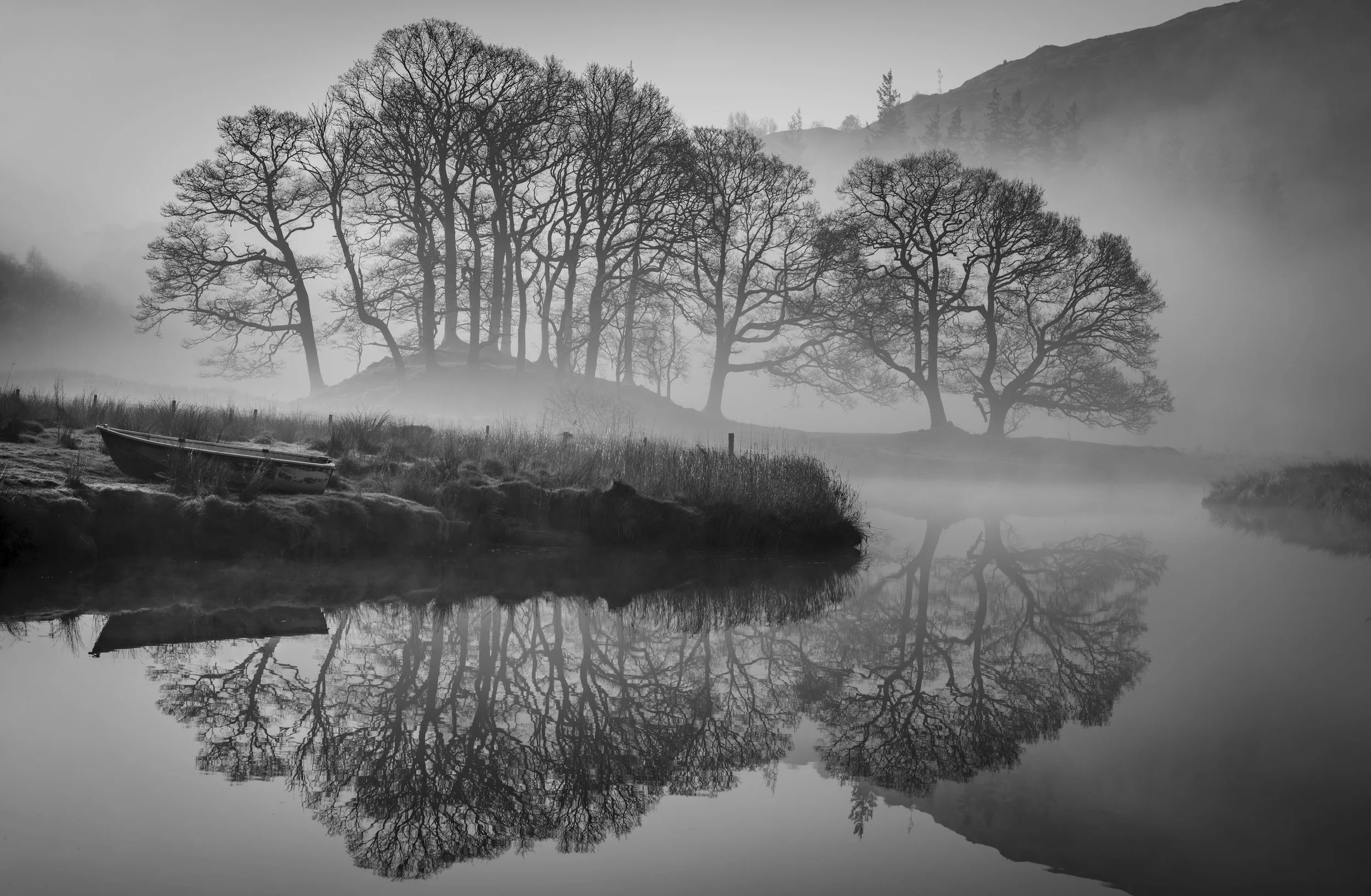
Some images feel quiet before you even understand why.
This photograph is one of them.
The composition is simple: a line of winter trees, a fog-laced hillside, a small abandoned boat resting on frozen ground. But the simplicity is deceptive. Every element is arranged with a kind of natural precision—the curvature of the branches, the soft diffusion of light, the way the fog pulls the edges inward until the scene feels almost suspended.
The absence of color works in its favor. Black and white removes distraction; what’s left is tone, contrast, and shape. But even the blacks aren’t singular. They shift gently from charcoal to smoke to silver, creating an unexpected richness in a palette we usually think of as minimal.
And then there is the reflection.
The water becomes a second canvas, carrying the image downward like an echo. The mirrored branches appear more abstract than their real counterparts, almost like ink drawings bleeding into still water. This duality gives the photograph its depth. You look once at the landscape, and then again at its quieter, dreamlike twin.
Even the abandoned boat contributes to the atmosphere. It doesn’t dominate the scene; it anchors it. A small reminder of human presence in a world that otherwise feels entirely untouched.
This is the kind of photograph that rewards stillness, both in its subject and in the viewer. It doesn’t demand interpretation. It offers space.
And sometimes, that’s enough.
Click Button Below