

If I Ran the Zoo, by Dr Seuss →

Dr. Seuss Enterprises, which preserves the author's legacy, announced this week six books – "And to Think That I Saw It on Mulberry Street," "If I Ran the Zoo," "McElligot's Pool," "On Beyond Zebra!," "Scrambled Eggs Super!," and "The Cat's Quizzer" – would no longer be printed. Mar 5, 2021
Why did this happen? The Republicans seemed convinced that the Democrats and President Biden were to blame. “Yes!” So what did the company that owns the rights to these books and Dr. Seuss’s family, who owns that company, find out about this book and decide to stop printing it? Read the review and re-read the book; maybe the answer is clear.
If Gerald McGrew ran the Zoo, he'd let all the animals go and fill it with more unusual beasts--a ten-footed lion, an Elephant-Cat, a Mulligatawny, a Tufted Mazurka, and many more.
It’s a pretty good zoo.
Said young Gerald McGrew
And the fellow that runs it
Seems proud of it too
The first documented appearance of the word nerd is as the name of a creature in Dr. Seuss's book If I Ran the Zoo (1950), in which the narrator Gerald McGrew claims that he would collectMerkleye, a Nerd, and a Seersucker too" for his imaginary zoo. The slang meaning of the term dates to 1951
If I Ran the Zoo was banned for the line "all wear their eyes at a slant,” which refers to the helpers, accompanied by an illustration of Asian stereotypes. Dr. Seuss’s books were positive and inspiring, but some earlier books had disturbing images of hurtful, racially stereotypical drawings. The good news is that we see an evolution in cartoons and books. His later works, such as The Sneetches or Horton Hears a Who!, emphasize inclusion and acceptance. Disney’s old movies and comics had racial implications, and even Mickey Mouse had some racial threads in his creation. Disney covered those events by adding disclaimers and referring to the problem as “outdated cultural depictions.”

Work Matters: Insights & Strategies for Job Seekers in a Rapidly Changing Economy →

In Work Matters, author and career development coach Brent M. Jones ( yes, I am reviewing my book here, but then it is my website, and besides that, I think it is a good book needed right now) reflects on the current environment and what the implications are for those seeking work and offers insights on how to navigate the disruption with proven, time-tested job-search strategies.
A job for most of us is more than just how we make a living. It shapes how we see ourselves, as well as how others see us. It gives our days structure, purpose, and meaning. But in a rapidly changing marketplace — reshaped in recent years by technology and automation and devastated in 2020 by a global pandemic that has left millions out of work — finding a job has become exponentially more challenging.
The book is needed right now. We still face unexpected changes in the marketplace, and this book helps focus us on what to do next.
Buy the Paperback or eBook on Amazon click here to link to the site.
Six Years, by Harlan Coben

Six years have passed since Jake Fisher watched Natalie, the love of his life, marry another man, Todd. He went to the wedding and promised never to follow her and re-enter her life. His heart was broken but he just buried himself in his career as a college professor. Natalie has been on his mind every day for six years when Jake comes across Todd's obituary and cannot keep himself away from the funeral. The widow is not Natali,e and she has been married to Todd for almost 20 years. Jack may have once promised never to follow and stay out of her life, but he no longer believes he needs to honor that promise. Jakesearchede,s but he finds he does not know the truth about Natalie’s life. Some of the people he thought were part of her life can not be located and some do not remember her JakWhenn Jakelearnsd more about Natali,e he has his own life threatened.
The plot is a masterpiece of suspense, and you will not want to put it down looking and hoping answers come.
Quote from the book
“Part of the human condition is that we all think we are uniquely complex while everyone else is somewhat simpler to read. That is not true, of course. We all have dreams; hopes, wants, lust, and heartaches. We all have our brand of crazy.”
“Hope is cruel. Hope reminds me of what it almost was. Hope makes the physical ache return.”
The Cat in the Hat by Dr. Suess →

The Cat in the Hat, by Dr. Seuss (Theodor Geisel), was first published in 1957. It is a story about a tall human-like cat who dresses in a red & white striped hat with a red bow tie.
With his companions, "Thing One & Thing Two,” they try to entertain some neighbors and wind up wrecking the house. Finally, the Cat uses a unique tool to clean everything up. He then says goodbyes and disappears just before the children's mother walks in.
The book offers lessons that need to be learned. For example, The Cat in the Hat is about stranger danger. Although it may seem fun to let a big cat into your house, maybe you should think twice before you do. That's just common sense for all ages.
This is the book that made Dr. Seuss famous. It kicked off an emphasis on beginning readers’ books. The focus on imagination for the characters and the ease of reading resulted in these books being read repeatedly. OK, the truth is they are often read every night. Many kids learned to read from them.
Characters: The Cat in the Hat,
Thing One, Thing Two, Sally, Sally's Brother, Fish & Mother
The moral of this story might be “Be careful inviting neighbors over! or Beware of who you let in the house.
#Children’s Literature
Down and Out in Paris and London by George Orwell →
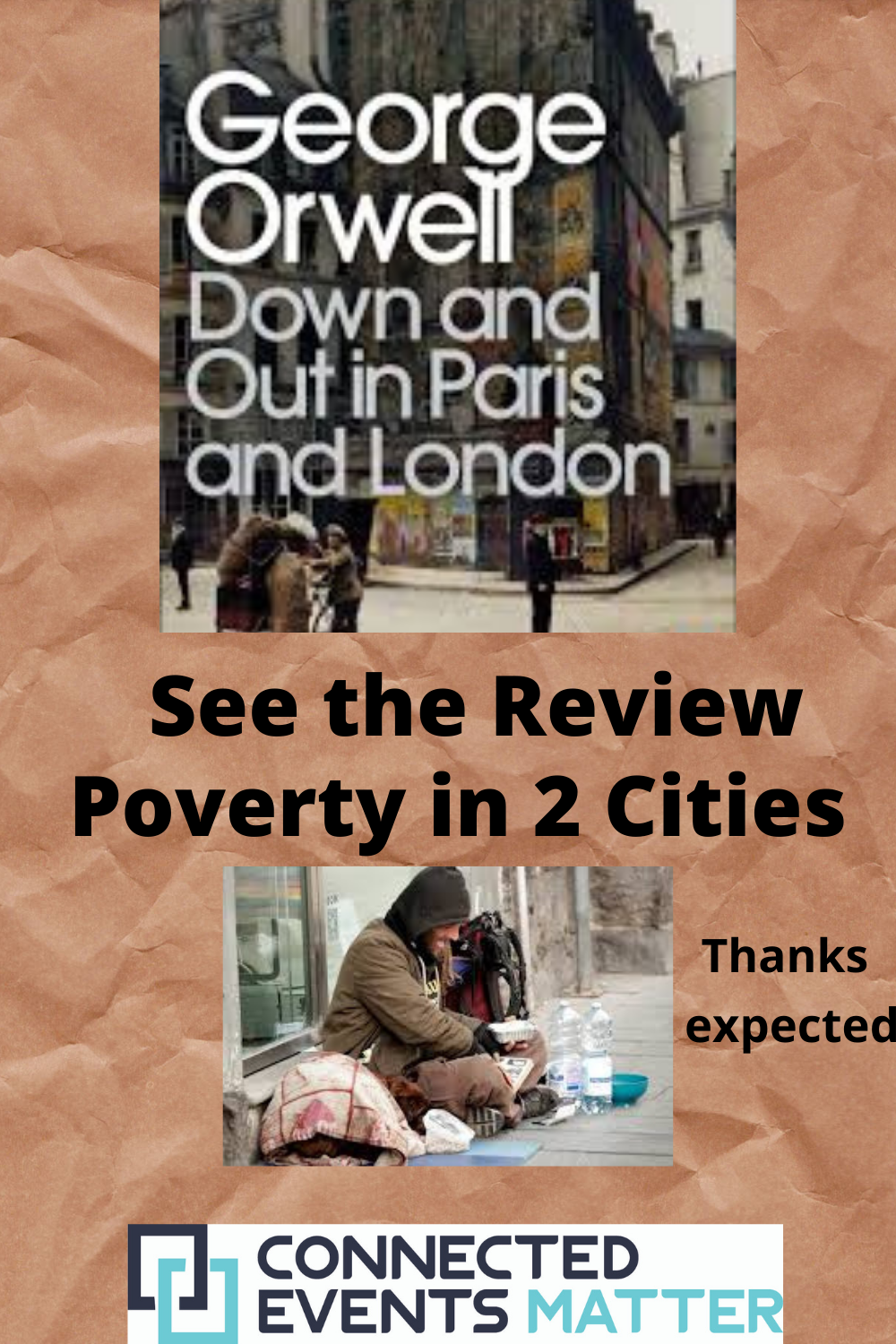
(See the “Taking others for Granted” article in the Positive Thoughts section for more on what the Meaning of this Book is?)
It is 1933, and it will be 10 + years before Orwell publishes Animal Farm and 1984, both of which will warn of the dangers of totalitarianism and promote his beliefs in a fairer society. In his book, Down and Out in London & Paris, he writes about poverty and how he survived.
Orwell was a tutor in London, but he went to Paris. He has no job when he arrives, and he cuts back on food and later pawns his good clothes to get by for a few days. He finds an old friend Boris, a fat Russian, but he is also out of work. They struggle for weeks, and eventually, the two of them finally do find work-Boris as a waiter and Orwell as a dishwasher. Find work- Boris The dishwashing job is 14 hours a day of cleaning in the sweltering heat of kitchens on the bottom floors of the hotel basements.
Orwell's Paris experience with poverty was eating at restaurants, living in rented rooms, and working in almost prison-like circumstances; no mention is made of goals or desires. He can see that there are few opportunities to rise above where one starts in life. He describes drinking on a Saturday night as the "one thing that made life worth living.” At one point, a murder happens right outside where he is sleeping, and he tells us that within three minutes, he has gone back to sleep, not wanting to waste time over it.
Boris talks Orwell into going to another hotel to work because of the promotion to maître d’ he can get. Orwell follows him, but the new kitchen, where he is still a dishwasher, is even more hot and cramped than before. He now works 18 to 20 hours a day and makes less. Finally, he is so demoralized that he returns to London, which comprises the book's second part.
Orwell describes London’s poor as mobile, unable to rent or stay in a job long, but forced to wander from shelter to shelter across London. When he arrives back in London, his plans to be a babysitter for a wealthy family fall through. He has no money and must pawn his best suit again. He finds that he must join others wandering from shelter to shelter and living off food that is barely fit for human consumption, living as a beggar and a tramp. The hunger and filth are with him constantly, and he feels the challenge of being considered disagreeable to others.
When the book ends, Orwell can get the job he had initially planned. His closing remarks are that poverty is a condition best to be avoided.
This book will add to how you see George Orwell's books Animal Farm and 1984. This autobiography precedes those books and suggests how his viewpoint on society may have evolved.
Quotes by George Orwell
“It is curious how people take it for granted that they have a right to preach at you and pray over you as soon as your income falls below a certain level.”
“The stars are a free show; it doesn't cost anything to use your eyes.”
“Within certain limits, it is true that the less money you have, the less you worry.”
“It is fatal to look hungry. It makes people want to kick you.”
“Dirt is a great respecter of persons; it lets you alone when you are well dressed, but as soon as your collar is gone, it flies towards you from all directions.”
Catcher in the Rye by JD. Salinger →

The Catcher in the Rye is a novel by J. D. Salinger initially intended for adults. Still, the book’s strong themes of alienation and its critique of the superficiality of society led to it being widely read by adolescents. The book was widely banned because of its language and focus on sex.
The book covers 16-year-old Holden’s last day at Pencey, a fashionable prep school, from which he has flunked out and been expelled, and the following two days, which he spends in hiding in New York City. Confused and disillusioned, he is obsessed with preserving his innocence: he wishes to be “the catcher in the rye” to protect the children from falling off the cliff. This wish is interpreted as a metaphor for entering adulthood which is probably suggested because, at the same time, part of him wants to connect with other people on an adult level in a sexual encounter. In contrast, part of him wants to reject the adult world as “phony” and retreat into his childhood memories.
The hero and heroine of this novel, Holden’s dead brother Allie and Jane Gallagher, never appear in it, but they are always in Holden’s consciousness, together with his sister Phoebe. Caulfield is depressed throughout the book, unable to concentrate, and lacks interest in everything. He appears to be both manic and psychotic.
Holden is crazy about Jane, always thinking of her, always wanting to call her up, but he never does. He is always about to but does not because he’s never “in the mood.”
The two days are full of events, and the literalness and innocence of Holden’s point of view in the face of the tremendously complicated and often depraved facts of life make for the humor of this novel.
Quotes from Catcher in the Rye
“What knocks me out is a book that, when you're all done reading it, you wish the author that wrote it was a terrific friend of yours, and you could call him up on the phone whenever you felt like it. That doesn't happen much, though.”
“Among other things, you'll find that you're not the first person who was ever confused, frightened, and even sickened by human behavior. You're by no means alone on that score; you’ll be excited and stimulated to know. Many, many men have been just as troubled morally and spiritually as you are right now. Happily, some of them kept records of their troubles. You'll learn from them—if you want to. Just as someday, if you have something to offer, someone will learn something from you. It's a beautiful reciprocal arrangement. And it isn't education. It's history. It's poetry.”
“I'm quite illiterate, but I read a lot. ”
The Jungle by Upton Sinclair →

Upton Sinclair presented the life of Jurgis Rudkus, a Lithuanian immigrant, in the meatpacking district of Chicago, where many other immigrants were also trying to get by. Jurgis tried to support his Ona and other relatives, but eventually, they all, including the children and his sick father, had to find work to survive, but the jobs led to real tragedies for them all. Jurgis takes a job at Brown's slaughterhouse, where he finds working-conditions harsh. The couple struggles to survive as they fall deeply into debt and become prey to con men. When they finally have some savings for a house down payment, it is a slum house, and they soon lose it and all the money they put into it and are evicted.
The central theme of The Jungle is the evil of capitalism, a system that, in Sinclair’s view, was inhuman, destructive, unjust, brutal, violent, and, as implied by the name, about human greed and the social damage it does
Every event in the book is written to portray a particular failure of capitalism, which is, in Sinclair's view, inhuman, destructive, unjust, brutal, and violent.
The meat packing industry and its harsh working conditions are perfect for Sinclair's primary purpose to advance socialism in the United States.
The book’s impact would have disappointed Sinclair because most readers were more concerned with several passages exposing health violations and unsanitary practices in the American meat packing industry during the early 20th century, which significantly contributed to a public outcry that led to reforms, including the Meat Inspection Act.
Sinclair said of the public reaction, "I aimed at the public's heart, and by accident, I hit it in the stomach.
Upton Sinclair Quotes
“It is difficult to get a man to understand something when his salary depends on his not understanding it.”
“I aimed at the public's heart, and by accident, I hit it in the stomach.”
“Fascism” is capitalism plus murder.
“All art is propaganda. It is universally and inescapably propaganda; sometimes unconsciously, but often deliberately, propaganda.”
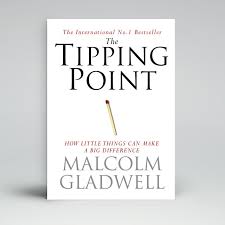
The Tipping Point: How Little Things Can Make a Big Difference by Malcolm Gladwell →

The Tipping Point: How Little Things Can Make a Big Difference, by Malcolm Gladwell: The subtitle is really what the book is about.
Most events start with little things, and then, a step at a time, a point is reached when an enormous consequence follows. All the little things over time caused the tipping end, and the change was significant and even a surprise. When the change comes, it is referred to as the moment of critical mass, the threshold, and the boiling point.
The question is how to identify when that point will be reached? Gladwell says that the three components of the Tipping Point, or three agents of change, are “The Law of the Few, The Stickiness Factor, and The Power of Context.”
"The Law of the Few" is the 80/20 principle where 20% of the people involved in a project will bring about 80% of the results. Gladwell says that the key is in understanding the skill sets of the 20% and if enough individuals with the needed skill set are working on the project.
“The Stickiness Factor” has to do with the project’s message. What is it about a message that will make it memorable? Sesame Street and Blue’s Clues use repetition in their characters, resulting in an enhancement of retention.
“The Power of Context,” Gladwell says, has to do with influences on human behavior and the changes as one moves from birth through adulthood. Age, genetics, thoughts, and feelings reveal attitudes and values.
The Tipping Point looks for those times when an idea, trend, or social behavior spreads like wildfire. It is the boiling point when ideas take off. Gladwell takes this phenomenon and shows how he thinks it changes people’s feelings about change.
Is Covid 19 and the Pandemic a Tipping Point? Time will tell, but some examples are already evident. Small businesses are predicted to see at least a 20% reduction as many go broke. In the restraint category, some have expected that 85% of the independent restaurants will go broke, and some but not all of that business may move to the chains.
In many trade categories, it seems clear that the survivors will be the financially strong businesses; some are just anticipating their competitors to fold and to be able to assume their market share. This may push prices up. Debt for all business sectors will be dramatically increased, and the previously expected expansion of automation may be severely slowed down.
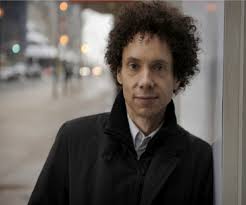
Malcolm Gladwell of COVID-19: If I had to identify the best thing that could come out of this, it would be a resurgence in the profile and importance of the public health community.*
see article*
Malcolm Gladwell: The lesson of the COVID-19 pandemic THE WORLD AFTER COVID-19 - with Malcolm Gladwell April 9, 2020. Click the link to see the original article
The Tipping Points Quotes
“There is a simple way to package information that can make it irresistible under the right circumstances. All you have to do is find it.”
“Look at the world around you. It may seem like an immovable, implacable place. It is not; it can be tipped with the slightest push — in just the right place .”
“The idea that epidemics can rise or fall in one dramatic moment — is the most important because it is the principle that… permits the greatest insight into why modern change happens the way it does.”
“When it comes to epidemics, though, this dis proportionality becomes even more extreme; a tiny percentage of people do the majority of the work.”
“To create one contagious movement, you often have to create many small movements first.”
Lord of the Flies, by William Golding →

THE REAL “LORD OF THE FLIES” IS A REFERENCE TO THE DEVIL. THE BOYS FEAR MORE AND MORE THE BEAST AS THE SYMBOL OF THE DEVIL
Lord of the Flies is a 1954 novel by William Golding. A group of British boys is stranded on an uninhabited island. Through their attempt to govern themselves, the book’s focus becomes a study of human nature and their disastrous attempt to control themselves. The boys take sides in a conflict between two competing human impulses: the instinct to live by rules and respect moral traditions and the instinct to gratify their desires. Individuality does not survive when it conflicts with the group’s collective will, mostly the resulting influence of the more dominant members, two of which are Ralph, who stands for civilization and democracy, and Jack, who signifies savagery and dictatorship.
The boy named Piggy is a central character in the story, and he represents intellect and rationality. At first, his glasses influence him since the group can only get fire by using the mirror to magnify the sun. Piggy is fat, a rule follower, and he is eventually killed. His violent death symbolizes the loss of order, innocence, and savagery that takes over the group.
The potential existence of a beast is used as the main symbol in this novel, and many boys believe the beast is the source of evil on the island. The Lord of the Flies is a reference to the devil, and as the boys fear more and more the beast, as a symbol of the devil, they become more savage and evil.
Simon is a boy who, because of his goodness, is felt to be a protection for the others from the beast, but soon after, he learns that the beast is nothing more than a paratrooper who landed in a tree and died their long before Simon himself is killed.
Eventually, a British sailor finds the boys on the island, and he is disappointed with what they have become. The boys quickly become just boys again.
Lord of the Flies Quotes
“Ralph wept for the end of innocence, the darkness of man's heart, and the fall through the air of the true, wise friend Piggy.”
“The thing is - fear can't hurt you any more than a dream.”
“We did everything adults would do.
“The greatest ideas are the simplest.”

The Picture of Dorian Gray, by Oscar Wilde →
https://www.youtube.com/watch?v=fuZ5zchKCS8 See my youtube video on this also.

Dorian Gray is a handsome, selfish young man who Basil Hallward is painting. While he sits for the painting, he is introduced and has ample time to listen to Lord Henry Wotton, who expounds his hedonist views of life, admiring Gray’s beauty.
Hallward, a very moral man, is excited to be painting the handsome young man who has become the inspiration his art needed, and the result is that his painting becomes his life’s masterpiece. Lord Henry seeks to influence young Gray and take over Hallward’s friendship.
Gray is a willing student of Lord Henry's "new" hedonism, and the result is that he begins to indulge in every pleasure and virtually every 'sin' he can conceive of.
With the finished painting at his home, Gray sees the striking beauty of the image, and as it influences him to covet it, he begins to fear that it will fade and fears and even expects that his sinful lusts will lead to the erosion of his physical beauty.
This leads Dorian to desire and express that he would sell his soul to ensure that the picture, rather than he, would age and fade as he sins. The wish is granted, and Dorian pursues a life of amoral experiences, including destroying many he meets as he satisfies his lusts.
He stays young and beautiful but his portrait ages and records every sinful act becoming more disgusting and uglier as they are committed. After years of watching the painting reflect the horror of his life’s activities, he hates it.
The painting ultimately leads to Gray’s death, but the story leads to many questions and assumptions. One more obvious question is whether it is accurate to connect being beautiful to mean that one is good and if being ugly implies that one is evil.
The book presented a view of sin’s impact very effectively, using the portrait as the symbol of degradation.
The Gunslinger, by Stephen King →

The Gunslinger is a novel by Stephen King and brings the genre of Western fiction, fantasy, science fiction, and horror together.
It is the first volume in the Dark Tower series published in 1982, connecting five short stories published between 1978 and 1981.
The plot centers on Roland Deschain, the last gunslinger, chasing his adversary, "the man in black," for many years, following Roland through a desert and beyond. He meets several people along his way, including a boy named Jake Chambers, and together they make their way out of the desert, where they see the man in black.
Roland and Jake make their way into the twisting tunnels within the mountain, traveling on an old railway handcar. They are attacked by monstrous subterranean creatures called "Slow Mutants." At the tunnel's exit, as the track on which they are traveling begins to break, Roland lets Jake fall into an abyss and continues his quest.
When he finds the man in black, he sends Roland a vision of the universe, the galaxies, and beyond, attempting to frighten him. Roland resolves to continue west and is captured and put to sleep. When he wakes up, it is ten years later, and there is a skeleton next to him.
A good book, of course, but an unusual Western
Heart of Atlantis by Stephen King →

Five stories in the Hearts in Atlantis revolve around the Vietnam War, a central theme in Stephen King’s generation.
“Low Men in Yellow Coats” is set in the summer of 1960. Bobby Garfield and his friends Sully-John and Carol, Bobby Garfield meet TedBrautigana,n who lives on the third floor of Bobby’s building. Ted hires Bobby to watch for mysterious strangers that he refers to as “low men” from another world.
One day, Bobby discovers his friend Carol has been beaten by three bullies with a baseball bat. He takes her to his apartment, where Tedmust removeeherershirttoo set her dislocated shoulder. Bobby’smothere,r Liz comes home and misunderstands the situation. She had just been raped at a real estate seminarandwass ready to think the worst.
Ted appears in some way connected to the Dark Tower and confesses to Bobby that he is being stalked by "low men" who work for The Crimson King. The Low Man captured Ted, and Bobby is given a choice to go with them to wherever they are taking Ted but decides to stay. Sometime later, Bobby receives an envelope from Ted filled with red rose petals (which surround the Dark Tower). He knows that Ted is once again free and has gotten away from the low men.
In “Hearts in Atlantis,” Pete Riley becomes involved with Carol at the University of Maine in Orono in 1966. The title not only is a metaphor for the romance but also refers to an ongoing card game that threatens to overwhelm Pete and his dormmates. Carol leaves school, joins a movement, and becomes involved with radicals and a bombing of a chemical laboratory that kills several people.
“Blind Willie,” set in 1983, Willie Shearman, who befriended Carol but held her down while she was beaten in 1960, had fought in Vietnam and remained haunted by both his actions toward Carol and what he witnessed during the war. His efforts to do penance for both involve begging as a blind Vietnam veteran in New York City, which makes him a lot of money, but he does go blind doing it.
“Why We’re in Vietnam” and “Heavenly Shades of Night Are Falling” are the last two stories.
Sullyattendsafelloww soldier's funeral and reflects on the events in Vietnam, perhaps trying to answer the question of why,y but then dies of a heart attack.
In “Heavenly Shades of Night are Falling,” Bobby returns to Harwich for Sully's funeral. He finds Carol and a baseball glove sent to him by Ted.


