

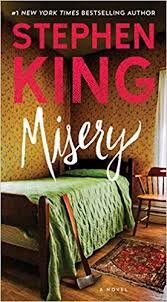
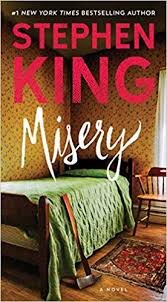
Misery a Novel, by Stephen King
Stephen King’s novel Misery tells of a famous writer, Paul Sheldon, who crashes his car in a snowstorm and gets rescued by Annie Wilkes, a lifelong nurse and number one fan of Misery Chastain, the character Paul has made into a long series of successful books.

Paul has his only copy of a new book, Fast Cars, which he hopes will replace Misery Chastain, now that he has killed her off in his last book.
Annie takes Paul back to her home and is thrilled to have her favorite author to nurse but really upset with the outcome of the Misery book. She nurses him, it seems, and pushes him to write another Misery book and bring Misery Chastain back to life somehow.
Annie forces Paul to burn his Fast Cars manuscript a he quickly learns how serious she is and that she may kill him if he doesn’t do what she asks.
This novel works on several levels with the theme of staying alive itself showing the power of writing as Paul struggles to stay alive. Annie loves Paul for his ability to tell a story and that saves his life.
The book is brilliant in its plot and the intensity of Annie.
See Favorite Author section for more about Stephen King
Quotes From the Book Misery
“Writers remember everything...especially the hurts. Strip a writer to the buff, point to the scars, and he'll tell you the story of each small one. From the big ones you get novels. A little talent is a nice thing to have if you want to be a writer, but the only real requirement is the ability to remember the story of every scar.
Art consists of the persistence of memory.
“I am your number one fan.”
“There may be fairies, there may be elves, but God helps those who help themselves.”
“dirty birdy”
“Can I? Yeah. You bet I can. There's a million things in this world can't do. Couldn't hit a curve ball, even back in high school. Can't fix a leaky faucet. Can't roller-skate or make an F-chord on the guitar that sounds like anything but shit. I have tried twice to be married and couldn't do it either time. But if you want me to take you away, to scare you or involve you or make you cry or grin, yeah. I can. I can bring it to you and keep bringing it until you holler uncle. I am able. I CAN.”
“Writers remember everything...especially the hurts. Strip a writer to the buff, point to the scars, and he'll tell you the story of each small one. From the big ones you get novels. A little talent is a nice thing to have if you want to be a writer, but the only real requirement is the ability to remember the story of every scar.
Art consists of the persistence of memory.”
“I am in trouble here. This woman is not right.”
“He lay back, put his arm over his eyes, and tried to hold onto the anger, because the anger made him feel brave. A brave man could think. A coward couldn't.”


The Dead Zone, by Stephen King →

Johnny Smith awakens from a coma caused by a car accident; he finds that almost five years have passed, and he remembers and starts to experience his psychic abilities again. The years in a coma cost him his one true love, who moved on, got married, and had a child.
Johnny’s psychic powers allow him to read minds and see a person's future with a mere touch. When he shakes the hand of a wanna-be politician, Greg Stillson, Johnny can see that if this man becomes Presiden,t the world will be in a terrible position. Eventually, he decides to kill Stillson.
Stephen King, in his memoir On Writing, King said that this book, “The Dead Zone,” that is, in part, came about when he considered the question of whether a political assassin could not only be "right” but also could become "the good guy" in a story.
The Dead Zone is a novel in which a villain is a terrible man and politician whose thirst for power knows no bounds and who will do anything to win.
See More about Stephen King in the Favorite Author Section
Quotes from Dead Zone
“We all do what we can, and it has to be good enough, and if it isn't good enough, it has to do.”
“Ninety-five percent of people who walk the earth are inert. One percent are saints, and one percent are assholes. The other three percent are people who do what they say they can do.”
“Because things like this you can only say once. And you either get it wrong or right; it’s the end either way because it's too hard to try to say again.”
“She suddenly realized she was sitting in an apartment by herself late at night, eating an apple and watching a movie on TV that she cared nothing about, and doing it all because it was easier than thinking; thinking was so boring when all you had to think about was yourself and your lost love.”
The Judge by Steve Martini →

California attorney Paul Madriani becomes the defense attorney for Judge Armando Acosta, who has been busted for soliciting an undercover vice operative found murdered and left in a dumpster.
The judge claims it is a setup linked to a grand jury he has overseen looking at a possible police cover-up of a different murder.
DA Coleman Kline fires assistant DA Lenore Goya as she starts into the case herself, and she then moves questionably to head up Acosta's defense. The DA seems obsessive in his pursuit of the judge. Lenore's fingerprint is found at the murder scene, and she's forced off the case, forcing Paul to step in.
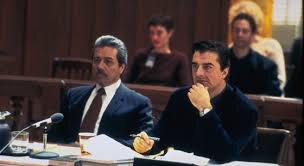

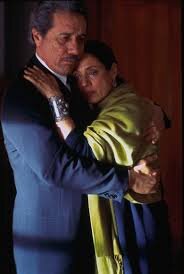
Author Steve Martini brings some insightful dialog and experience to what comes next and that takes place during the trial. Madriani’s skills in jury selection show us quickly that he is on top of his game and is experienced, polished and leads us through the story.
This was an excellent legal thriller. Well done.
The Laws of Human Nature, by Robert Greene →

Humans are social animals whose lives depend on our relationships with people. Our skills are not enough; we need to know why people do what they do.
Robert Greene’s book takes ideas from Pericles, Queen Elizabeth I, Martin Luther King Jr, and many others to teach us what he considers critical to surviving humanity. Detachment from our own emotions, self-control, and how to not conform to what everyone else wants us to be.
The theme of this book is just how irrational and unreasonable people are. It suggests that being rational is good, and the author’s stated solution is ‘I don’t need to feel this way and maybe what’s going on in the world is not what I think.’ He suggests that we meditate and remember life goes on.
Chapter one, Master Your Emotional Self, follows an introduction that tells us, “we inevitably have to deal with a variety of individuals who stir up trouble and make our life difficult.” The introduction tells us that “we inevitably have to deal with a variety of individuals, who stir up trouble, and make our lives difficult and unpleasant.”
The book is 609 pages long. It has an index and 18 chapters, but I would only give it two stars for having anything unique to offer.
The Soul Of A Butterfly, Reflections of Life's Journey, by Muhammad Ali →

Float Like a Butterfly, Sting Like a Bee. His Hands Can't Hit What His Eyes Can't See". - Muhammad Ali
Muhammad Ali, born Cassius Marcellus Clay Jr., was a former three-time World Heavyweight Boxing Champion and considered the greatest heavyweight of all time. With help from his daughter, Hana Yasmeen Ali, he wrote this book himself. It was intended to reflect on his life, but for many of us who lived through these times, it is a crucial touchstone to look back and confirm our thoughts.
Ali states in the introduction: “During my boxing career, you did not see the real Muhammad Ali. You just saw a little boxing and a little showmanship. It was after I retired from boxing that my true work began; I had more time than to develop my spiritual being the way that I once developed my muscles and agility.”
For many of us, it seems wrong to think that we didn’t see the real Ali during his boxing years. Even so, we didn’t just measure his early life and boxing history with only those fantastic bouts with Joe Frazier and George Foreman. His big decisions, made on principle, were made during that time. In his later life, when he went as a “Messenger of Peace” for the United Nations, those decisions, made on principle, gave him credibility.
His faith in God, expressed through his faith in Islam, responded to where those principles took him. Ali sees his later life’s battles with illness as his test of faith, where his real work began by using his faith in God to win the battle.
Ali said, "I would like to be remembered as a man who won the heavyweight title three times, was humorous, and treated everyone right. As a man who never looked down on those who looked up to him… who stood for his beliefs… who tried to unite humankind through faith and love. And if all that’s too much, then I’d settle for being remembered only as a great boxer who became a leader and champion of his people. And I wouldn’t mind if folks forgot how pretty I was.” - Muhammad Ali.
A journey is well worth reflecting on.

Muhammad Ali Quotes
"Service to others is the rent you pay for your room here on earth.".
"Only a man who knows what it is like to be defeated can reach down to the bottom of his soul and come up with the extra ounce of power it takes to win when the match is even."
"A man who views the world the same at 50 as he did at 20 has wasted 30 years of his life.”
"Hating people because of their color is wrong. And it doesn't matter which color does the hating. It's just plain wrong."
"It isn't the mountains ahead to climb that wear you out; it's the pebble in your shoe."
"What you're thinking is what you're becoming.”
Memory Man, by David Baldacci →

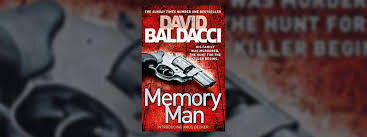
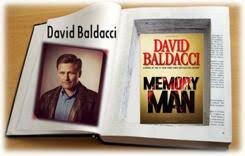
Amos Decker, the memory man, 22-year-old and NFL rookie, was struck on the field that he died twice, ending his football career. The injury-induced hypothermia and synesthesia, and he becomes a different person for the rest of his life and will forget nothing. After some help at a particular rehabilitation institute for those like him, he becomes a cop and a detective.
Years later, his wife, daughter, and brother-in-law are brutally murdered in his home. He can’t continue as a cop and becomes a private investigator. He has hit bottom, is grossly overweight, and, in his way, grief-stricken.
Sebastian Leopold walks into the police station and confesses to the killing of his family. While he is in jail, a mass shooting occurs at a local high school. Decker, I pulled back to working with his old partner and the police department to solve the killings; a surprising link that connects the school killings with those of his family opens up the plot with twists and turns to leave questions that are only answered at the very end.
A well-done story, the first in a series for the Amos Decker character.
See More about David Baldacci in the Favorite Authors Section


Innocence by Dean Koontz →

When Addison Goodheart is born the midwife takes one glance at the baby and attempts to smother him. His mother raises him in the woods and she is the only human he knows until age 8 when his mother forces him to leave and go into the woods on his own. He finds his way to a highway and hides in the back of a truck and eventually makes it to what probably is New York City. Every one he meets thinks he is hideous and they try to kill him.
He finds a man in the city who is like him, hideous, and he grows up living with this man in a secret place below the city only coming out at night. After 18 years pass the man he has lived with, and called his father, is murdered by two street people.
Addison wanders the nights for years and eventually meets 19 year old Gwyneth who seems to understand him but she has a phobia where she doesn’t want to be touched.
Gwyneth’s also lives alone in the city and is being hunted by Ryan Telford who is a sexual pervert and wants to kill her. She enlists Addison to help her.
Koontz’s allegory of good and evil suggests that evil is beyond redemption through all humankind. The conclusion is a surprise. The book was a surprise and different than what we have become accustomed to. with Dean Koontz.



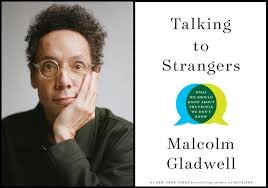
Talking to Strangers by Malcom Gladwell →
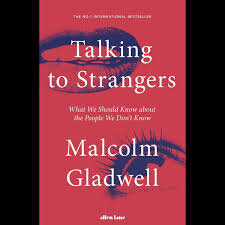
“Talking to Strangers is a classic Gladwellian intellectual adventure, a challenging and controversial excursion through history, psychology, and scandals taken straight from the news.” “Something is very wrong, Gladwell argues, with the tools and strategies we use to make sense of people we don’t know.”
He uses examples for his conclusions from the TV show Friends, the Amanda Knox and Bernie Madoff cases, to support his conclusions. He starts right out in the introduction and takes us step by step through the story of Sandra Bland, the African American woman who in July 2015 was stopped by a traffic cop in a small Texas town. She was on her way to a new job and a police car came up behind her. Doing what almost all of us would have done, she moved aside to let the car pass and that is when the trouble started. In spite of a recording that was made Gladwell’s approach “is an attempt to understand what really happened”
One puzzle looked at early in the book is: “Why can’t we tell when the stranger in front of us is lying to our face?” To understand this point he shows how Castro’s Cuba had a spy network that totally fooled US intelligence.
The final point made in the book said: “Because we do not know how to talk to strangers, what do we do when things go awry with strangers? We blame the stranger.
My own conclusion is that I didn’t think the book went very deep into it subject and it seemed like we were expected to just be glad someone asked the questions? I blame Gladwell for that by the way.

Missing You, by Harlan Coben →

The novel starts out: “Kat Donovan spun off her father’s old stool, readying to leave O’Malley’s Pub, when Stacy said, “You’re not going to like what I did.”
Kat Donovan is a cop, just like her dad was. Feeling alone she looks through a on line dating site and comes across the face of Jeff Raynes an old flame from years back. She drops him a note but he at first doesn’t seem to remember her. With a hint he comes out of his shell and warms up but then backs away saying he doesn’t want to connect again.
Before long Brandon Phelps, a college student from Connecticut, comes all the way to New York to ask for Kat’s help in finding his missing mother, Dana, but he won’t tell her why he even thinks she can help.
This all overlaps Kat’s interest in Monte Leburne who years ago was convicted of killing her dad who at the time was a NYPD detective.
These three very different stories Harlan Cobern weaves together with twists and unexpected turns into a plot that leaves you not seeing what is coming until the very end. No surprise for this author.
See more about Harlan Cobern at https://connectedeventsmatter.com/literary-favorites/2019/6/20/harlan-coben
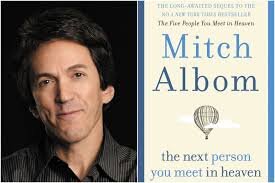
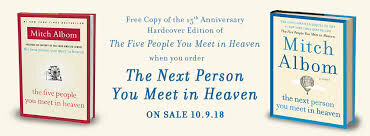
The next person you meet in heaven, by Mitch Albom

Mitch Albom’s “the next person you meet in heaven” is a sequel to his number one bestseller, “The Five People You Meet in Heaven”. In the original book he introduced Eddie, a war veteran and amusement park mechanic, who died saving the life of a young girl named Annie. Eddie went on to Heaven and met 5 people and learned that every life matters.
In this book Annie is grown up and is marrying Paulo, her childhood boyfriend. But when her wedding is over, on the following day, she and Paulo go up in a hot air balloon ride and have a terrible accident. Annie finds herself on her own heavenly journey where she meets Eddie, one of the five people she will meet. She also sees episodes from her own left that left her depressed and sad, but she was able to see the lessons she learned from them.
What is surprising about this book is that it is so much like the first book that you start out not expecting to like it. It is just a simple book and a simple story, but Mitch Albom has now sold over 36 million books and is approach works.

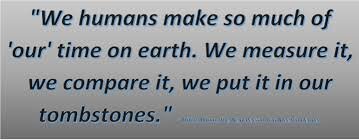
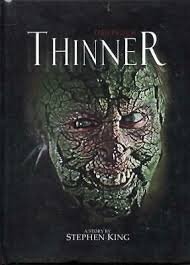
Thinner by Stephen King

“Thinner, the old Gypsy man with the rotting nose whispers to William Halleck as Haleck and his wife, Heidi, come out of the court house. Just that one word, sent on the wafting, cloying sweetness of his breath. “Thinner.” And before Halleck can jerk away, the old Gypsy reaches out and caresses his cheek with one twisted finger. His lips spread open like a wound, showing a few tombstone stumps poking out of his gums. They are black and green. His tongue squirms between them and then slides out to slick his grinning, bitter lips. Thinner.”
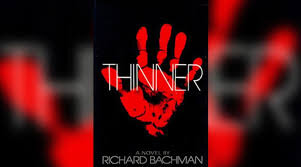
Steven King originally wrote this book under his pseudonym Richard Bachman. One of six books he wrote using that name.
Billy Halleck is a fat, obese, lawyer who has to defend himself for killing a women who jaywalked by running into her. He was driving with his wife and was distracted (go ahead, read it and find out why) and didn’t see the women in time. She was a Gypsy, daughter of Taduz Lemke, the head of the Gypsy clan in town at that time.
Billy knew the judge and he case is dismissed at a preliminary stage thanks to the judge. Taduz Lemke meets Billy on the courthouse steps and strokes Billy's cheek and whispers one word to him: "Thinner".
Billy begins to lose weight at a steadily accelerating pace, and he soon realizes that Lemke has cursed him as well as the judge who started to grow scales on his skin. Another helper in getting the case dismissed came from the police chief who soft-pedaled the charges and he was also cursed leading to a horrifying case of acne.
Just another good story that holds you interest from a master storyteller
See more about Stephen King a Literary Influence and the books that have been reviewed of his on this site. https://connectedeventsmatter.com/literary-favorites/2018/6/21/stephen-king

One Good Deed by David Baldacci

“It was a good day to be free of prison. The mechanical whoosh and greasy smell of the opening bus doors greeted Aloysius Archer, as he breathed free air for the first time in a while.” The year was 1949 and he was just released from Carderock Prison and he is on his way to Poca City on parole.
The small town is complicated and dangerous even for a man just out of prison and who served in the war. His first night in town at a local bar he is hired to collect a debt seemingly a simple job. The $5,000 debt is owed to Hank Pittleman, a man that seems to own the town. Lucas Tuttle owes the money has no intention of paying up which could be a real problem for Archer who got an advance on his fee before starting the job.
Archer explains his new job to his parole officer, Miss Crabtee, who just seems to take it in stride but also who is tough and will be watching him closely.
When a murder takes place right under Archer's nose the police, who know he is an ex-convict, suspect him and he has no choice but to track down the killer.
Baldacci is a master storyteller who weaves plots that twist and turn, and you don’t see what is coming until it happens. Another great book.
See more about David Baldacci and his other book reviews
that are on this site at:
https://connectedeventsmatter.com/literary-favorites/2019/3/29/david-baldacci
Blowout by Rachel Maddow

It is a shame that many who would benefit and see the situation the same way will likely just see the authors name and go no farther. Rachel Maddow is likely considered on the wrong side by many who are polarized with the political climate today but this book isn’t about being Republican or Democrat it is about how corrupting Big Oil has been to the world.
The Washington Post, in their praise for the book, said that her viewpoint is different only because it has real facts behind it. At least for the sake of this book wouldn’t it have been better to have left the implication of a “side to her point of view” and just said the facts are awful and we ought to be very alarmed at what big oil has done to the world.
“At its heart, this book is a tale of two countries, the United States and Russia, and how, as Maddow sees it—individually and together—they have been warped by a rapacious fossil fuel industry. . . . Fulminating comes easy to Rachel Maddow. What sets her apart from other serial fulminators is that she does it with facts—and sardonic wit.”—The Washington Post

The book is not an easy read. It is a very detailed look at her subject. If you finish it you should get a “extra credit” for what you will learn.